


Table of contents: Carburetor ↓ Cars without catalyst ↓ Multi-point injection system ↓ Central injection system ↓ Air filter ↓
Twice a year or every 10,000 km (whichever comes first).
Idle speed is adjusted at the factory and no further adjustment is required.
Only if the CO content after long-term operation no longer meets the standards, the carburetor should be adjusted.
Carburetor
Before checking and adjusting, the following parts must be in perfect condition:
1. With the power steering installed, set the front wheels to the center position. The hand brake should be applied.
- The battery must be charged.
- Engine oil and coolant levels must be at the required levels.
- All vacuum hoses must be connected.
- The air intake system must be sealed.
- The cylinders must have good compression.
- The exhaust gas recirculation system must function perfectly.
- The throttle valve should open and close well.
- Turn off all electrical consumers such as headlights, heater fan, rear window defroster, etc.
- The cooling fan should not be running.
2. Warm up the engine, i.e. the remote thermometer pointer should be in the middle position. During adjustment, the engine should maintain its operating temperature, i.e. the engine should be started during pauses to warm it up again. The engine should operate at a speed of less than 1000 rpm.
3. Connect the tachometer according to the operating instructions.
4. Start the engine and look through the carburetor inspection window to make sure the fuel level is at the center line.
5. Run the engine for two or three minutes at 2000 - 3000 rpm and then let it idle for one minute.
6. Read the idle speed value on the tachometer. The engine should run at 750±50 rpm.
7. If the idle speed is not within the required range, turn the screw until the value is within the required range. If the idle speed cannot be adjusted and all of the above systems are in good condition, the carburetor may need to be replaced.
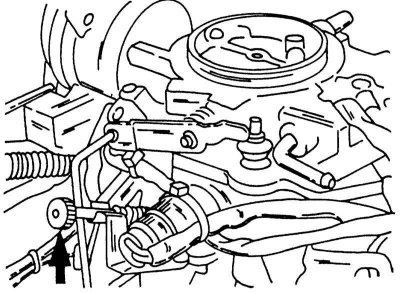
The knurled bolt is used to adjust the carburetor.
8. Turn off the engine. The tachometer remains connected.
9. In the middle of the exhaust manifold cover, disconnect the lambda probe plug. The second plug should be disconnected from the intake air control valve. It is located in the position shown in the illustration on the right side of the ignition coil in front of the suspension strut (if you stand in front of the engine compartment).
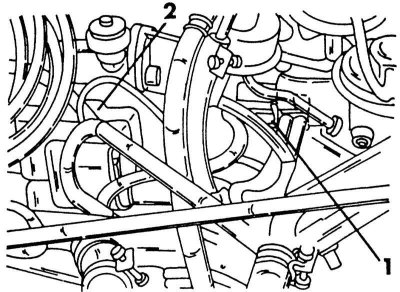
Position of the intake air control valve (1) next to the ignition coil (2).
10. On the right, next to the exhaust manifold heat shield, you can see the CO measurement tube. Remove the tube cap and connect the CO measurement device according to the instructions. The connection between the measuring device and the tube must be tight.
11. Start the engine, accelerate it to 2000 - 3000 rpm and then return to idle. Read the instrument readings. The value should be within 1.0±0.5%. If the CO content does not correspond to the required value, you should turn the adjusting screw inserted into the throttle valve block. It is sealed to prevent unauthorized rotation. Since the carburetor must be removed, among other things, in order to drill out the seal, it is recommended that this work be carried out by a specialized workshop. The illustration shows the location of the seal. If you do the work yourself, do not drill the seal too deeply. After drilling out the seal, reinstall the carburetor and turn the screw inside with a regular screwdriver until the CO value is within the required limits. After adjustment, check the idle speed again and finally insert a new seal into the hole. You do not need to remove the carburetor for this.
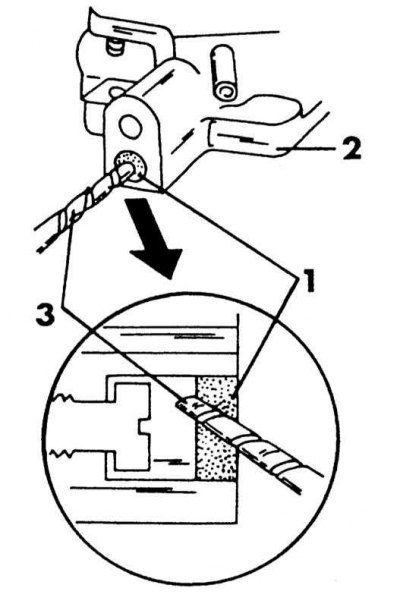
The seal (1) for the CO content adjustment screw in the throttle body (2) can be drilled out in the specified manner using a drill (3).
Cars without catalyst
Idle speed is adjusted in the same way as on models with a catalytic converter, but to adjust the mixture composition, a special screwdriver is required, which is inserted into the notches of the adjusting screw (see illustration below), a tachometer and, for best results, a CO meter. If necessary, the work can be carried out without the latter device, if the instructions are strictly followed, but environmental protection laws should be kept in mind.
1. First, adjust the idle speed.
2. Perform the preparatory operations described above and read the tachometer. If the idle speed is outside the range of 750±50 rpm, the idle speed must be adjusted. The idle speed adjusting screw looks the same as shown in illustrations. Check the CO content using a suitable device and adjust if necessary.
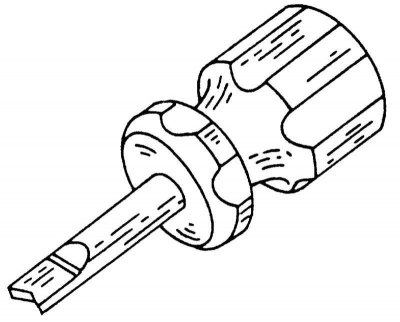
A special screwdriver for adjusting the idle mixture composition.
Without CO meter
1. Check that the engine is at its operating temperature.
2. To adjust the mixture composition, there is a screw under the idle speed adjustment screw. Screw this screw in completely with a special screwdriver (not too much) and turn it out two full turns. The idle speed should increase by 50 rpm compared to the current value.
3. Using a special screwdriver, turn the mixture adjustment screw until the engine runs at the highest possible speed. Then turn the idle adjustment screw until the engine runs at the appropriate speed Specifications number of revolutions. The CO content should more or less correspond to the required value, i.e. should lie within the range of 1.5±0.5%.
Using a CO meter
1. Adjust idle speed as described above.
2. Check that the engine is still at its operating temperature.
3. Connect the CO meter. The hose must be pushed into the exhaust pipe at least 40 cm.
4. Check through the carburetor inspection window that the fuel level is at the center line.
5. Using a special screwdriver, turn the mixture composition adjustment screw so that the device shows a value of 1.5±0.5%.
6. Repeat the described adjustments until the CO content and the number of revolutions correspond to the required values.
Multi-point injection system
Idle speed and CO content adjustment is usually maintained automatically by the control unit, but it may be necessary to adjust if the idle speed does not meet the requirements after a long period of use. It is best to contact a Nissan workshop, but if you carefully follow the following description, you can adjust the idle speed yourself.
Before checking and adjusting, the following conditions must be met, i.e. the following elements and systems must be in perfect condition.
1. Set the front wheels to the middle position, apply the handbrake.
2. The battery must be well charged.
3. The ignition system must be in good condition and work perfectly.
4. The engine oil and coolant levels must meet the required values.
5. All vacuum hoses must be connected.
6. The air intake system must be sealed.
7. The cylinder compression must correspond to the required values.
8. The throttle valve should open and close fully.
9. All fuses must be inserted.
10. Turn off all electrical consumers, i.e., for example, headlights, heater fan, rear window defroster, etc.
11. When measuring CO content, insert the measuring tube of the device into the exhaust pipe by at least 40 cm.
12. On automatic transmission, set the lever to the "N" position.
13. Turn off the air conditioner.
14. The cooling fan should not work.
15. When checking the idle speed, proceed as follows:
16. Warm up the engine, i.e. the remote thermometer pointer should be in the middle position. When adjusting, the engine should be at operating temperature, i.e. start the engine again during pauses and warm it up. The engine should operate at a speed of less than 1000 rpm.
17. Turn off the engine and connect the tachometer according to the instructions.
18. With the engine off, locate the throttle position sensor (see illustration) and disconnect the plug. Start the engine.
19. Run the engine at 2000 - 3000 rpm for 2 or 3 minutes and then let it idle for two minutes.
20. Read the tachometer. The engine should be running at 800 rpm.
21. If the idle speed value does not correspond to the required value, turn the screw (1) (see illustration below), until the idle speed reaches the required value. When turning to the left, the idle speed decreases, when turning to the right, the idle speed increases. If the idle speed value cannot be determined, and all the above systems and components are in good condition, contact a Nissan workshop.
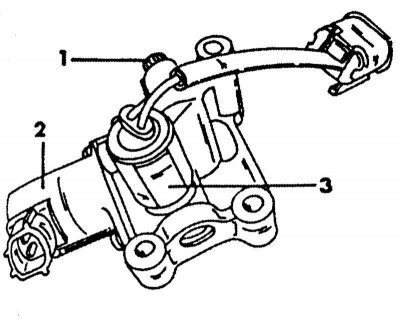
View of additional air valve and related components
1 - idle speed adjustment bolt; 2 - additional air valve; 3 - switching valve
22. Turn off the engine. The tachometer remains connected.
23. Stop the engine, connect the throttle position sensor plug and start the engine again.
24. Accelerate the engine 2-3 times to 2000 rpm and read the idle speed on the tachometer. The speed should be within 850±50 rpm. Poor idle speed may be caused by the additional air valve, its cables or the electronic control device.
25. Measure the CO content according to the instructions for the measuring device. If the value is not 0.5%, the cause must be found in the workshop. Accurate measurement and adjustment of the CO content is associated with some difficulties and is therefore not described.
Central injection system
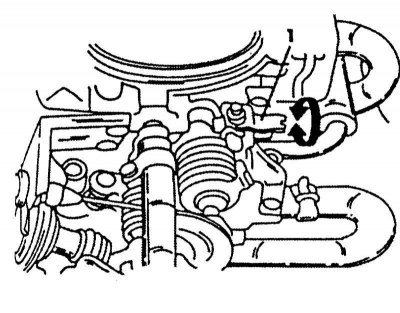
Position of the idle speed adjustment screw (1) on the SR20Di engine.
The injection system regulates idle speed automatically to a set value.
Idle speed is controlled by precisely adjusting the amount of air that bypasses the throttle valve via the additional air valve. The additional air valve is switched on and off to precisely control the amount of air. The crankshaft angle sensor monitors the exact engine speed and reports the information to the control unit. Based on this information, the control unit switches the additional air valve on or off to maintain the idle speed at a pre-programmed value. Other factors such as engine warm-up, coasting, fuel consumption and engine load (air conditioner, electrical load) are automatically assessed and compensated.
Although not normally required, idle speed can be checked and adjusted. The requirements given for the multi-point injection system must be met before checking and adjusting. Idle speed is checked in the same way as described above for the carburetor. Cars with manual and automatic transmissions have the same idle speed.
Air filter
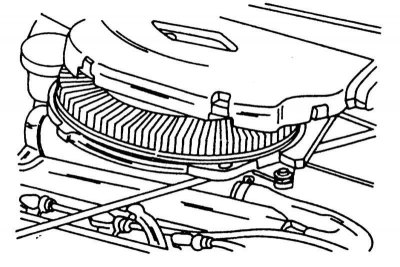
Removing and installing the air filter element. Left for the SR20DE engine, right for the SR20Di engine.
The air filter has a paper element that cannot be cleaned. The filter element should be replaced every two years or every 60,000 km. To remove the element, remove the cover and take out the old element. The figure above shows the removal of the filter element on both engines. Collected dust should be removed from the filter housing with a rag. Insert the new filter element and put the cover back in place.