


2. Relieve pressure in the fuel system.
3. Remove the coils and spark plugs from each cylinder.
4. Connect the tachometer to the engine (not necessary when using CONSULT-III).
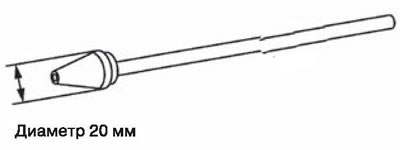
5. Install the compression gauge (B) with the adapter (A) into the spark plug hole.
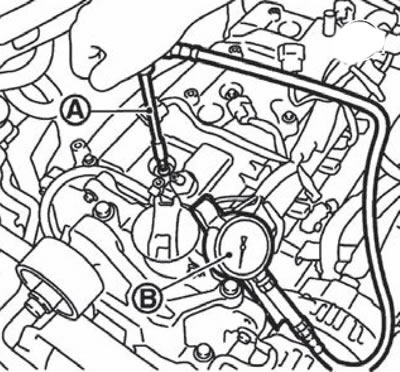
Note: Use an adapter with an insertion diameter of at least 20 mm, otherwise it may slip into the cylinder and cause engine damage.
6. With the accelerator pedal fully depressed, turn the ignition switch to the "START" position to turn the engine crankshaft with the starter. After the compression gauge needle readings stabilize, read the compression value and engine crankshaft speed. Perform the described procedure for each engine cylinder.
Note: To check the compression in the engine cylinders, it is necessary to use a fully charged battery to obtain the required crankshaft speed.
The text was borrowed from here nissanbook.ru
Note.
- If the crankshaft speed does not correspond to the required one, check the tightness
- electrolyte in the battery. Make sure that the battery is fully charged and repeat the crankshaft speed measurement.
- IF the compression values are below the maximum permissible value, check the valve clearances and the condition of the parts associated with the combustion chamber (valves, valve seats, pistons, piston rings, cylinder bore, cylinder head, cylinder head gasket). After checking, check the compression in the cylinders again.
- In a cylinder with a low compression value, it is necessary to add a small amount of oil through the hole under the spark plug and check the compression again:
- If the compression in these cylinders has increased after adding oil, then the piston rings are most likely worn out or damaged. Check the condition of the piston rings and replace them with new ones if necessary.
- If the compression remains low, the cause may be poor valve condition and/or valve seats. Check the valves and seats for damage. Replace the valve or valve seat.
- If low compression is observed in adjacent cylinders, the cause may be a defective cylinder head gasket. Replace the defective gasket with a new one.
7. After checking, install the removed parts.
8. Start the engine and make sure it runs smoothly.
9. Perform fault diagnostics. If necessary, delete stored fault codes.