


1. Remove the cylinder head cover.
2. Measure the valve clearance:
Set the piston of the first cylinder to the top dead center position of the compression stroke, for which it is necessary to turn the crankshaft pulley (1) clockwise until the TDC mark (no color) (B) is aligned with the indicator (A) on the front cover.
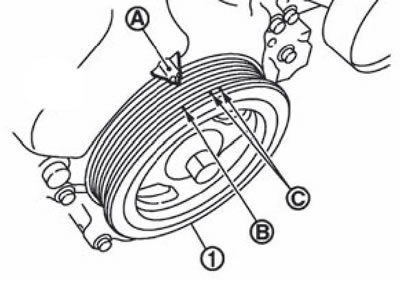
Note: The white mark (C) is not used in this procedure.
Make sure that the camshaft lobes on the intake and exhaust camshafts, which belong to the first cylinder of the engine, are pointing upward and inward (in the direction of the black arrows in the figure).
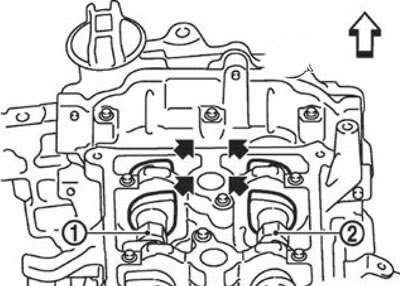
1. Intake camshaft.
2. Exhaust camshaft.
The white arrow points towards the front of the car.
If the cams are not pointing in the direction shown, rotate the crankshaft pulley one revolution (360°) and align the timing marks again in the manner described above.
Using a set of flat feeler gauges, measure the clearance between the valve lifter and the camshaft.
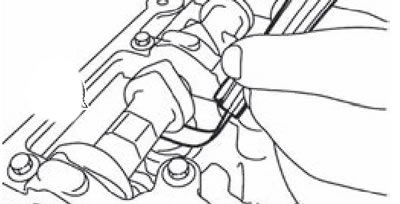
Note: Standard valve clearance:
- Inlet: 0.30 mm.
- Issue: 0.33 mm.
Check the clearances in the valves indicated in the figure below by black arrows or marked "x" in the table.
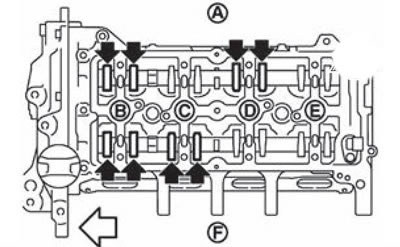
A. Release side.
B. Cylinder No.1.
S. Cylinder No.2.
D. Cylinder No.3.
E. Cylinder No.4.
F. Intake side. The white deal points towards the front of the car.

Set the piston of the fourth cylinder to the top dead center position of the compression stroke, for which turn the crankshaft pulley (1) one revolution (360°) and align the TDC mark (no color) (B) with the indicator (A) on the front cover.
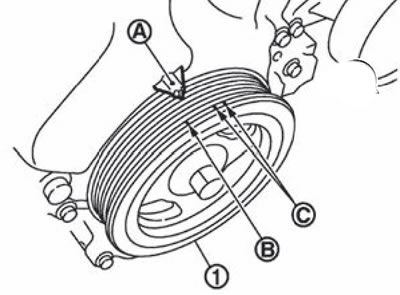
Note: The white mark (C) is not used in this procedure.
Check the clearances in the valves indicated in the figure below by black arrows or marked "x" in the table.
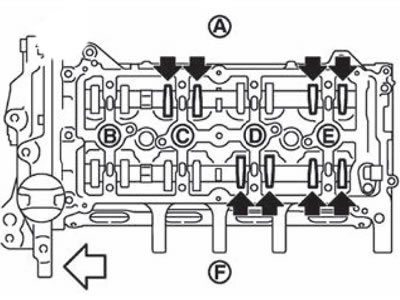
A. Release side.
B. Cylinder No.1.
S. Cylinder No.2.
D. Cylinder No.3.
E. Cylinder No.4.
F. Intake side. The white arrow points towards the front of the vehicle.

3. If the obtained values do not correspond to the norm, perform the clearance adjustment procedure.