


2. Depressurize the fuel lines.
3. Remove coils and spark plugs from each cylinder.
4. Connect the tachometer to the engine (not required when using CONSULT-III).
5. Insert compression tester (IN) with adapter (A) (special tool) into the spark plug hole.

Note. Use an adapter with a diameter of the head inserted into the spark plug hole, not more than 20 mm. Otherwise, there may be problems with removing the adapter after the measurement.
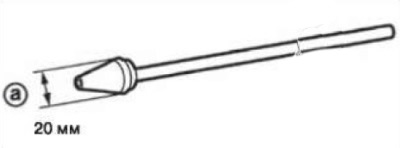
6. With the accelerator pedal fully depressed, turn the ignition switch to the «START» to rotate the crankshaft of the engine with a starter. When the pressure gauge readings stabilize, read the compression value and the engine speed. Do the same procedure on each engine cylinder.
Note. The value of the compression value is given in the section «Service data and specification» of this chapter.
Attention. Always use a fully charged battery to obtain the desired engine speed.
If the engine speed is not within the specified range, check the gravity of the battery electrolyte. Fully charge the battery and check the engine speed again.
If the compression value is below the minimum allowable value, check the valve clearances and the condition of the elements associated with the combustion chamber (valves, valve seats, pistons, piston rings, cylinder walls, cylinder head, cylinder head gasket). After checking the relevant parts, measure the compression in the cylinders again.
If one of the engine cylinders has a low compression value, pour a small amount of engine oil into the spark plug hole, then repeat the measurement.
If compression improves after adding oil, this indicates worn or damaged piston rings. Check the condition of the piston rings and replace them if necessary.
If compression is still low after adding oil, this indicates valve failure. Check valves for damage. If necessary, replace the corresponding valve or valve seat.
If two adjacent cylinders have a low compression value that does not change after adding engine oil, this indicates damage to the cylinder head gasket, it is necessary to replace it with a new one.
7. After checking, install the removed parts.
8. Start the engine and make sure it runs smoothly.
9. Perform troubleshooting. When issuing fault codes, remove them.