


Table of contents: Precautions when turning the…↓ Precautions when draining coolant…↓ Precautions when disconnecting fuel…↓ Precautions for removal and…↓ Precautions when checking, repairing…↓ Precautions for assembly and…↓ Applying a tightening force to a…↓ Precautions when working with sealant ↓
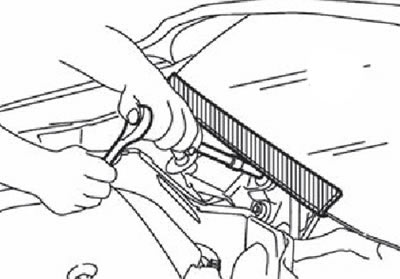
When working with the upper hood panel removed, it is necessary to cover the lower edge of the windshield with a polyurethane strip or other suitable material.
Precautions when turning the steering wheel after disconnecting the battery
Note.
- All control units can be removed and installed only after disconnecting both terminals from the battery and setting the ignition switch to the "LOCK" position.
- After completing the work, you must make sure that all control unit connectors are securely connected, and then connect the battery terminals.
- Always perform self-diagnosis using the CONSULT-III diagnostic tool. If a fault code is detected, perform diagnostics based on the self-diagnosis results.
- In vehicles with a steering wheel lock module, if the battery is disconnected or discharged, the steering wheel is locked and cannot be turned.
- If you need to turn the steering wheel after disconnecting the battery, you must perform the following procedure before starting repair work.
Procedure for carrying out work
1. Connect both terminals to the battery.
Note: If the battery is low, you will need to use extension cables to connect an additional power source.
2. Using the smart key or mechanical key, turn the ignition switch to the "ACC" position. At this point, the steering lock is unlocked.
3. Disconnect both terminals from the battery. The steering lock will remain open and the steering wheel can be turned.
4. Perform the necessary repair operations.
5. After completing the repair, return the ignition switch to the "LOCK" position before connecting the battery. (At this point the steering shaft lock is unlocked).
6. Using the CONSULT-III diagnostic device, perform self-diagnostics of all control units.
Precautions when draining coolant and engine oil
Drain the coolant and engine oil when the engine has cooled down.
Precautions when disconnecting fuel lines
Before starting work, it is necessary to ensure that there is no possibility of sparking or open flame in the work area.
Before disassembling, relieve residual fuel pressure in the system.
After disconnecting the pipes, close the holes with plugs to prevent fuel leaks.
Precautions for removal and disassembly
Where there is an indication to use a special tool, this requirement must be followed. When working, take precautions, do not apply excessive force and strictly follow the instructions.
Be careful not to damage the mating surfaces of the parts or the friction surfaces.
To ensure the correct relative position of the components being connected, dowel pins are used. When replacing or assembling components that use dowel pins, check that they are aligned correctly.
To prevent foreign objects from getting into the open holes of the engine, it is necessary to cover the holes with adhesive tape or plug the holes with rags.
Label and arrange parts in the correct order to facilitate repair and subsequent assembly.
When loosening nuts and bolts, follow the following basic rule: first loosen the element on one side, then on the diagonally opposite side, etc. Strictly follow the order of unscrewing the fasteners given in the instructions. At this stage, you can use a tool with a power drive (pneumatic impact wrench).
Precautions when checking, repairing and replacing components
Carefully inspect components before repair or replacement. Inspect new components in the same manner and replace if necessary.
Precautions for assembly and installation
Use a torque wrench to tighten bolts and nuts to specifications.
Tighten the bolts and nuts evenly, in several passes, starting from the center, then on the diagonally opposite sides, and then in the same order. Strictly follow the tightening order given in the instructions.
Seals, gaskets or sealing rings must be replaced after disassembly.
Thoroughly wash, clean and blow out each part with compressed air. Carefully check the oil and coolant supply channels for blockages.
Be careful not to damage the mating surfaces of the parts or the friction surfaces. Clean the surfaces completely from dust and rag residues. Before work, thoroughly lubricate the working surfaces with oil (sliding surfaces).
After filling the cooling system with liquid, remove air from the system (perform the pumping procedure).
After completing the repair, run the engine at high speed to check the tightness of the cooling and lubrication systems, as well as the fuel and exhaust systems.
Applying a tightening force to a specific angle
To finally tighten the threaded connections listed below, it is necessary to use a ratchet with an angled dial (corner wrench) (special tool: KV10112100 (BT8653-A)):
Bolts for fastening camshaft sprockets.
Cylinder head mounting bolts.
Main bearing cap bolts.
Connecting rod bolts.
Crankshaft pulley bolt (there is no need to use a special tool for tightening at an angle if there are special notches on the bolt).
Do not perform final tightening to the torque value. Tightening of the specified bolts to the torque value is used only at the preliminary stage.
Make sure the threaded and seating surfaces are clean and lubricated with fresh engine oil.
Precautions when working with sealant
Removal old sealant
After removing the fastening bolts, separate the mating surfaces using a special knife and remove the old sealant.
Caution: Be careful not to damage the mating surfaces.
Tap the knife to get it in between the edges, then move the knife along the joint with sideways blows as shown in the picture.
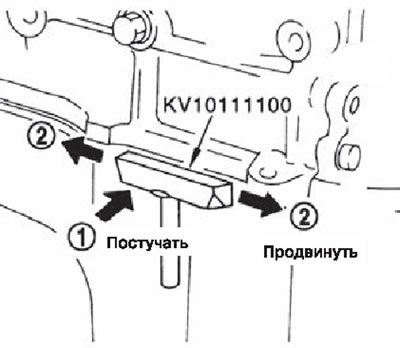
Where it is difficult to use a knife, separate the components using light blows from a plastic or rubber mallet.
Caution: If the use of a screwdriver becomes unavoidable for any reason, take care not to damage the mating surfaces.
Applying sealant
1. Use a scraper to clean the mating surfaces from old sealant. Completely clean the grooves, mounting bolts and bolt holes from sealant.
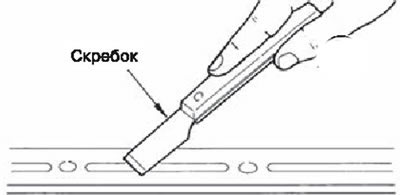
2. Wipe the mating surfaces of the parts and gaskets with gasoline (used for domestic purposes) to remove moisture, grease and foreign particles from the surface.
3. Insert the sealant can into the gun (special device).
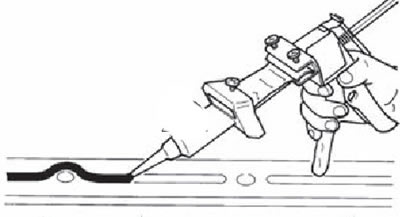
Note: Use original sealant or equivalent.
4. A bead of sealant of a certain thickness must be applied without breaks to the intended place.
If there are grooves for sealant, the sealant should be applied into the grooves.
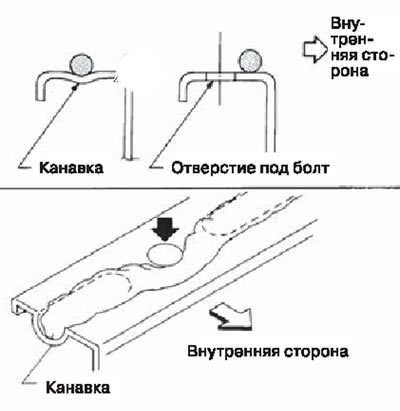
Usually, bolt holes are sealed with sealant on the inside surface. Sometimes, sealant needs to be applied around the holes. Carefully read the instructions for using the sealant.
After applying the sealant, assemble within 5 minutes.
Remove any protruding sealant immediately.
Tightening of bolts or nuts should be done only once (without additional tightening after installation).
You must wait at least 30 minutes before adding oil and coolant to the engine.
Attention: If the repair procedure description contains special requirements, they must be followed.