


Table of contents: Wheels with steel rims ↓ Wheels with alloy wheels ↓ Tire Care and Wheel Rotation ↓
Wheels with steel rims
Stamped steel wheels are subject to regular cleaning, during which all foreign objects and mud deposits must be removed from them. The adhesion of foreign objects leads to a violation of the wheel balance and can cause vibrations of the car during movement and uneven wear of the treads. Scraped paint should be restored at the earliest opportunity to prevent the development of corrosion of the wheel.
Minor rim deformations can be corrected by straightening with a hammer. The wheel must be removed from the car. In case of severe damage, the wheel must be replaced. It is good practice to periodically remove the wheels for a thorough inspection of the wheels for signs of corrosion, cracks and other damage.
Wheels with alloy wheels
Cast wheels, like steel ones, should be regularly cleaned from dirt and foreign objects that affect wheel balancing. Aluminum alloy wheels are also susceptible to corrosion, especially when in contact with salt water.
Cast wheels, being made of a softer material than stamped ones, are more easily scratched when in contact with hard objects, but scratches and scuffs do not have a significant impact on the suitability of the wheel for use. In case of severe damage, the wheel is subject to replacement. Deformed and cracked cast wheels are not subject to restoration repair.
Tire Care and Wheel Rotation
It is unacceptable to use tires with a tread depth of less than 1.5 mm. Sometimes tires are factory-equipped with wear indicators, when they come flush with the tread surface, the tire is also subject to replacement (see accompanying illustration).
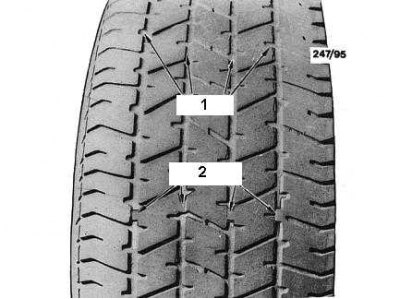
1 - tread pattern grooves (permissible depth - not less than 1.5 mm)
2 - tread wear indicators
Tires should also be changed if there are obvious defects, both internal and external. Minor punctures and leaks can be fixed at a tire shop. If you have any doubts about the condition of your car's tires, consult a tire service specialist.
The tread grooves and tire sides should be inspected regularly for foreign objects such as nails, small stones, etc. All such objects should be removed from the tread immediately after detection. In the event of a puncture, the wheel should be taken to a tire shop for repair.
Tire inflation valves must be equipped with protective caps (to avoid the development of corrosion of the nipple). In addition, they should be regularly (every time you check your tire inflation pressure) clean from dirt and dust and check for signs of air leaks.
Check your tyres regularly for signs of uneven wear and if any are found, refer to the section on tyre fault diagnosis in the Introduction to this manual to determine the cause and possible remedies. If uneven tyre wear can be identified at an early stage and the cause is corrected promptly, the life of the tyres can be extended.
To increase the service life of your tires, you should regularly balance your wheels and check the front wheel alignment (suspension geometry) at a special stand.
It is useful to periodically rotate the wheels, which also allows you to keep the tires in working condition longer, although it is not one of the procedures that must be performed to ensure traffic safety. It should also be remembered that wheels equipped with radial tires can only be rearranged from front to back during rotation without moving to the opposite side of the car (see accompanying illustration).
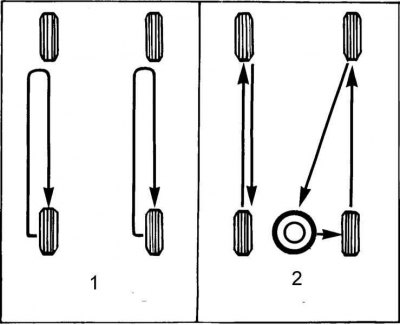
1 - rotation of wheels without turning on the spare
2 - rotation with spare wheel engaged
Maintaining the required tire pressure is perhaps the most important of the regular wheel maintenance procedures. Deviation of the inflation pressure from the norm in either direction leads to accelerated tire wear and even to their rupture during movement due to overheating. If possible, check the tire inflation pressure on cold wheels (otherwise the result will be overestimated due to thermal expansion of air).
As a rule, it is prohibited to equip a car with tires of different sizes and with different tread patterns. Ideally, all wheels, including the spare, should be equipped with tires of the same size. It is strictly prohibited to simultaneously install wheels equipped with tires with radial and conventional cords.