


Table of contents: Checking the level ↓ Pumping procedure ↓
Checking the level
- Make sure that the fluid level in the reservoir is between the "MIN" and "MAX" marks.
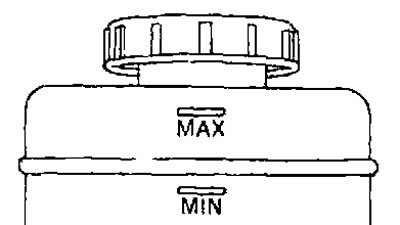
- Visually check for fluid leaks around the reservoir.
- If the fluid level is extremely low (below the "MIN" mark), check for fluid leaks from the clutch system.
Pumping procedure
Note: Do not use a vacuum or mechanical device to bleed the hydraulic system, as such devices do not completely remove air from the system.
Attention:
- Monitor the fluid level in the tank and do not allow it to empty.
- Do not spill adhesive fluid on painted surfaces. If fluid is spilled, wipe it up immediately and rinse the area with water.
- Bleed the coupling (1).
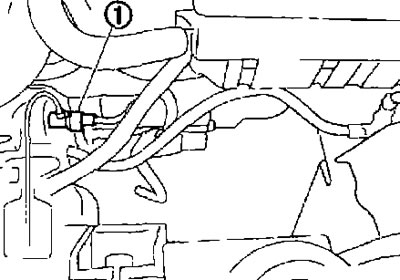
1. Fill the reservoir with fresh clutch fluid.
2. Connect the clear vinyl hose to the bleed nipple of the coupling.
3. 15 times, with an interval of 2-3 seconds, slowly press the clutch pedal all the way down and release it.
4. Press the locking pin (1) of the coupling (2) and fix it in this position.
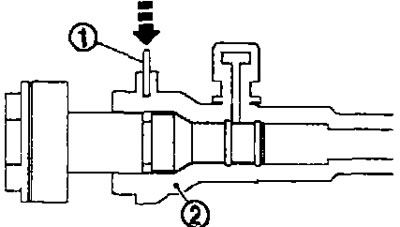
Caution: Hold the locking pin to prevent the tube from moving away from the coupling when applying pressure to the tube.
5. Move the clutch pipe (1) in the direction shown by the arrow in Fig.
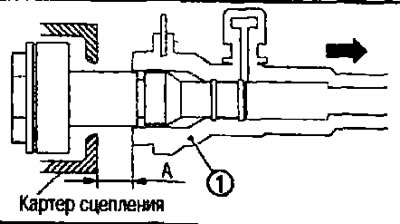
Size "A": 10 mm.
6. Quickly press the clutch pedal and hold it down, then release the air from the tube.
Caution: Hold the clutch pedal to prevent the pipe from moving away from the coupling while applying pressure to the pipe.
7. Return the clutch pipe and lock pin to their original position.
8. Release the clutch pedal and wait 5 seconds.
9. Repeat steps 3-8 until there are no air bubbles in the clutch fluid.