


CVT fluid
Checking CVT fluid
The fluid level should be checked after it has warmed up to 50-80°C. Check the fluid level as follows:
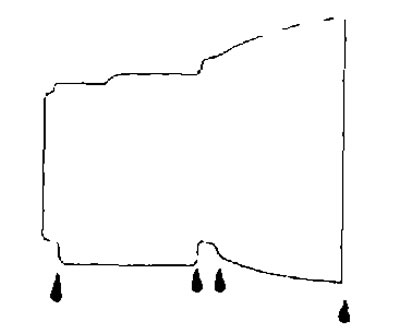
1. Check for fluid leaks.
2. After warming up the engine, drive the car in the urban cycle.
- At an ambient temperature of 20°C, it takes about 10 minutes for the CVT fluid to warm up to 50-80°C.
3. Stop the car on a level surface.
4. Apply the parking brake securely.
5. While the engine is running at idle speed, press the brake pedal and move the selector lever through all ranges.
6. Remove the dipstick from the CVT fluid filler pipe by pressing the latch on the dipstick and unlocking the dipstick.
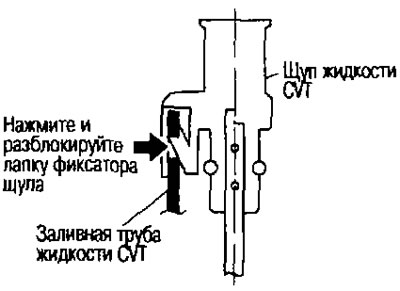
7. Wipe the fluid off the dipstick. Insert the dipstick by rotating it 180° from its original position until it touches the top end of the CVT fluid filler pipe.
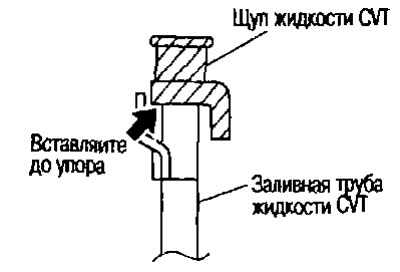
Caution: Always wipe CVT fluid off the dipstick with lint-free paper, not a rag.
8. Move the selector lever to the "P" or "N" position and make sure that the fluid level is within the normal range.
Caution: When reinserting the dipstick, insert it into the CVT fluid filler pipe and rotate it back to its original position until it is securely locked.
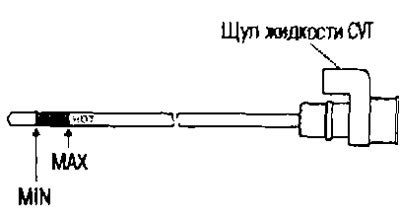
Check the condition of the CVT fluid. If the CVT fluid is very dark or smells burnt, check the operation of the CVT. After repairing the CVT, flush the cooling system.
If the CVT fluid contains friction material enzymes (couplings, band brakes, etc.) after repairing the CVT, replace the radiator and flush the radiator pipe with a cleaning solution and compressed air. See chapter "Lubrication system and engine cooling system".

| Liquid state | Probable cause | Method of elimination |
| Deposition of sticky films | CVT fluid performance deteriorated due to high temperatures | Replace the CVT fluid and check for any abnormalities in the CVT and vehicle (electrical wiring, radiator pipes, etc.) |
| Milky white or cloudy | Water got into the liquid | Replace the CVT fluid and check for areas where water may have entered |
| Lots of metal powder impurities | Increased wear of rubbing components in CVT | Replace the CVT fluid and check if the CVT is working properly |
CVT fluid replacement
1. Remove the drain plug and drain the CVT fluid from the oil pan.
2. Screw the plug into the drain hole of the oil pan.
Caution: Do not reuse the pad.
Drain plug - tightening torque. See below.
3. Fill fluids through the CVT fluid filler pipe to the required level.
4. Warm up the engine and drive the car in the urban cycle. At an ambient temperature of 20°C, it takes about 10 minutes to warm up the CVT fluid to 50-80°C.
5. Check the CVT fluid level and condition.
6. If the CVT fluid is contaminated, repeat steps 1-5.
CVT Fluid: See below. "Technical data and specifications".
Filling capacity: See below. "Technical data and specifications".
Attention:
- Use only genuine NISSAN CVT NS-2 fluid. Do not mix with other brands of fluid.
- Use of CVT fluid other than NISSAN CVT NS-2 genuine fluid may adversely affect the performance and life of the CVT and will not be covered under warranty.
- When adding CVT fluid, do not spill it on heat-generating components such as the exhaust system.
- Shake the CVT fluid container before filling
- After replacing the CVT fluid, erase the date of the previous fill using the CONSULTS-III tester.