


Table of contents: Check procedure on a stationary…↓ Evaluation of the test results on a…↓
Check procedure on a stationary vehicle
1. Check the engine oil level. Top up if necessary.
2. Drive the vehicle for about 10 minutes and warm up the CVT fluid to 50-80°C.
Check the CVT fluid level. Top up if necessary.
3. Apply the parking brake securely so that the wheels do not rotate.
4. Connect the tachometer and install it so that it is visible to the driver during testing.
The original can be read on the website: nissanbook.ru
- It is advisable to mark the specified engine speed range on the scale.
5. Start the engine, press the brake pedal and move the selector lever to position "D".
6. While keeping the brake pedal depressed, gradually press the accelerator pedal.
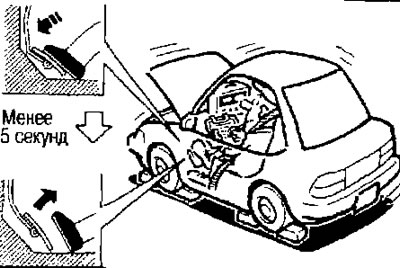
7. Quickly record the engine speed readings with the vehicle stationary and immediately remove your foot from the accelerator pedal.
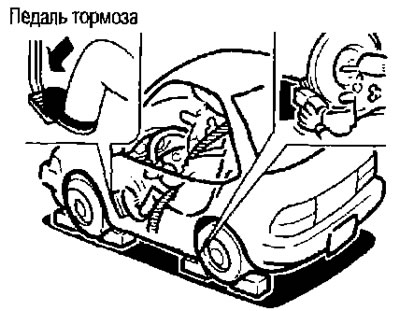
Do not hold the accelerator pedal down for more than 5 seconds while performing the check.
Engine speed with vehicle stationary: See below under "Technical data and specifications".
8. Move the selector lever to the "N" position.
9. Cool the CVT fluid.
- Let the engine run at idle speed for at least 1 minute.
10 Repeat steps 6-9, moving the selector lever to the "R" position.
Evaluation of the test results on a stationary vehicle
| Selector lever position | Probable location of the fault | ||
| "D" | "R" | ||
| Revolutions of a stationary vehicle | Higher | Norm | • Forward clutch |
| Norm | Higher | • Reverse brake | |
| Below | Below | • Overrunning clutch of the engine and torque converter | |
| Higher | Higher | • Low pressure in the main line; | |
| • Drive pulley; | |||
| • Driven pulley; | |||
| • Steel belt. | |||