


Table of contents: Main Line Pressure Check Procedure ↓ Evaluation of the results of the…↓
The location of the main line pressure test hole is shown below.
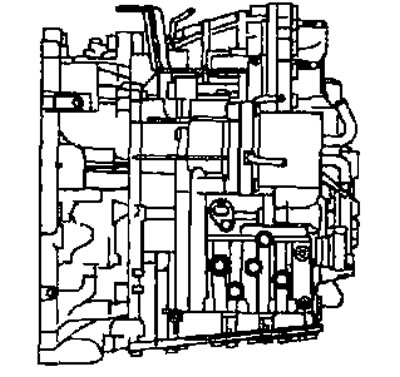
Main Line Pressure Check Procedure
1. Check the engine oil level and top up if necessary.
2. Drive the vehicle for about 10 minutes and warm up the CVT fluid to 50-80°C, then check the CVT fluid level and top up if necessary.
3. After the CVT fluid has warmed up, remove the plug from the pressure test hole and connect the hose adapter (special tool: KV31103600) (A), adapter (special tool: 25054000) (B), oil pressure gauge (suitable special tool) (WITH).
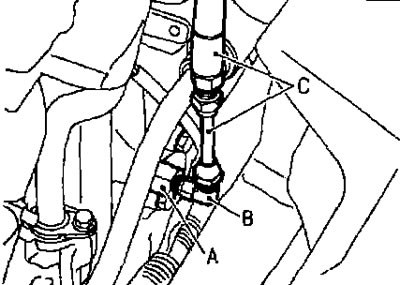
Caution: When using an oil pressure gauge, install the O-ring from the inspection hole plug.
4. Securely apply the parking brake so that the wheels do not rotate at either idle or stationary speed.
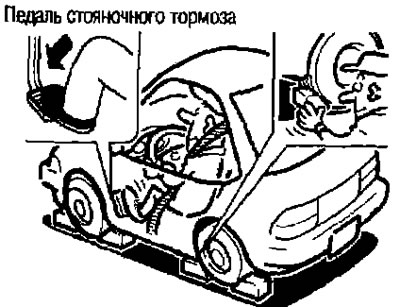
5. Start the engine and measure the pressure in the main line, both at idle speed and at stationary speed.
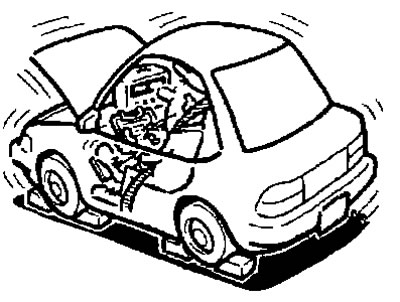
Attention:
- When taking the measurement, keep the brake pedal pressed all the way down.
- When measuring the pressure in the main line at the speed of a stationary vehicle, see the above item "Checking on a stationary vehicle".
6. After completing the measurement, replace the pressure test hole plug and tighten to the specified torque.
 : 7.5 N·m (0.77 kg·m)
Attention:
- Do not reuse the O-ring.
- Apply CVT fluid to the O-ring.
kPa (kg/cm²)
| Engine speed | Main line pressure |
| Positions "R", "D" and "L" *1 | |
| At idle speed. | 750(7,65) |
| At the speed of a stationary vehicle | 5700 (58 14)*2 |
*1: In sport mode
*2: Standard values
Evaluation of the results of the pressure test in the main line
| Result | Probable cause | |
| At idle speed. | Low pressure in all positions ("P" "R" "N" "D" "L" *) | Possible causes include a disruption in the pressure supply system and a decrease in the oil pump's performance. For example: |
| • the oil pump is worn out | ||
| • the pressure regulating valve or plug is stuck or the spring is tired | ||
| • oil leak in the chain "coarse oil filter → oil deposits → pressure regulating valve"; | ||
| • idle speed too low. | ||
| Low pressure in only one position | Possible causes include oil pressure leakage in the channel or device associated with this position after pressure is applied from the range switching valve | |
| High pressure | Possible causes include a faulty sensor or a violation of pressure regulation in the main line. For example: | |
| • Accelerator pedal position signal deviation; | ||
| • CVT fluid temperature sensor is faulty; | ||
| • the solenoid valve "A" for regulating pressure in the main line is faulty (stuck in the off position, filter clogged or line break); | ||
| • the pressure regulating valve or plug is stuck. | ||
| At the speed of a stationary vehicle | Oil pressure does not rise higher than idle speed pressure. | Possible causes include a faulty sensor or problems with pressure regulation in the main line. For example: |
| • Accelerator pedal position signal deviation; | ||
| • the TCM unit is faulty; | ||
| • the solenoid valve "A" for regulating pressure in the main line is faulty (short circuit, stuck in the on position); | ||
| • the pressure regulating valve or plug is stuck. | ||
| The pressure is rising, but not reaching the norm | Possible causes include a fault in the pressure supply system or in the pressure regulation in the main line. For example: | |
| • Accelerator pedal position signal deviation; | ||
| • the solenoid valve "A" for regulating pressure in the main line is faulty (stuck, filter clogged); | ||
| • the pressure regulating valve or plug is stuck. | ||
| Low pressure in only one position | Possible causes include an oil pressure leak in the channel or device associated with this position after pressure is applied from the range switching valve. | |
* In sport mode.