


Warning! Remember that gasoline is a highly flammable liquid! When servicing fuel system components, observe all fire safety precautions. Do not smoke, do not approach the work area with an open flame or unprotected portable equipment. Do not service the system in a room equipped with heating devices that operate on natural gas and are equipped with a pilot flame (such as water heaters and clothes dryers). Remember that gasoline is a carcinogen that can cause cancer - try to avoid fuel coming into contact with exposed areas of your body, use protective rubber gloves. In case of accidental contact, wash your hands thoroughly with warm water and soap. Collect spilled fuel immediately and do not store fuel-soaked rags near open flames. Remember that the fuel injection system is constantly under pressure. Before disconnecting the fuel lines, release any residual pressure (for more details, see Chapter Power and exhaust systems). Wear safety glasses when servicing fuel system components. Always keep a class B fire extinguisher on hand!
1. If the smell of gasoline appears in the car while driving or after a long period of parking in direct sunlight, you should immediately carry out a thorough inspection of all components of the fuel system.
2. Remove the fuel filler cap and inspect it for damage and corrosion. There should be a continuous trace of tight pressure around the entire perimeter of the sealing gasket. If any defects are found, replace the gasket.
3. Check the fuel supply and return lines for cracks, cuts and other mechanical damage. Check the tightness of the metal line fittings and fuel hose clamps.
Important! All models covered in this manual are equipped with a fuel injection system, therefore, before disconnecting fuel lines or removing any fuel system components, it is necessary to relieve residual pressure in the system (see Chapter Power and exhaust systems).
4. Since many of the components of the power supply system (such as the fuel tank and part of the fuel lines) are located under the vehicle, to check their condition, the vehicle should be lifted off the ground by hanging it on a winch, driving it onto an overpass, or installing it on supports. Make sure that the vehicle is securely fixed in the raised position.
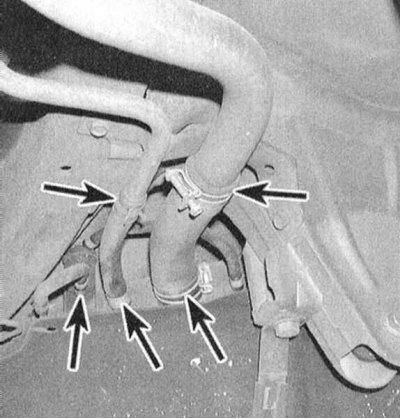
5. Check the fuel tank and its filler neck for punctures, cracks and other damage. Pay special attention to the inspection of the joint between the neck and the tank. Sometimes the rubber of the neck begins to leak fuel due to the loosening of the fastening clamps, or as a result of the aging of the material. Listed here are only those possible problems, the diagnosis and elimination of the causes of which lies within the qualifications of the average amateur mechanic.
Warning! Do not attempt to repair the fuel tank yourself under any circumstances (except for the replacement of its rubber components) - contact of residual fuel vapors contained even in a carefully ventilated tank with a gas burner torch or any other source of open flame can cause their detonation!
6. Carefully inspect all rubber hoses and metal tubes of fuel lines coming from the gas tank. Check the condition of the material of the tubes/hoses and the reliability of fastening of all nipple connections. Also check the fuel lines going to the fuel injection system. Make the necessary repairs, replace defective components (see Chapter Power and exhaust systems).