


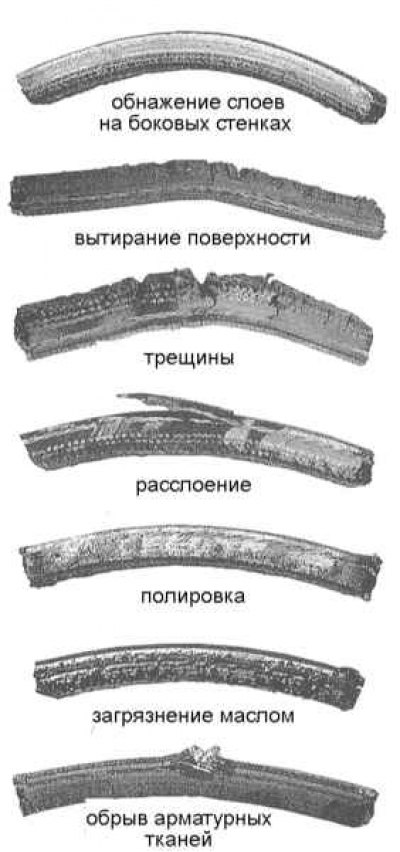
2. Turn off the engine, open the hood and find the drive belts. Using a flashlight, feel the belts along their entire length with your fingers, checking for cracks and delamination. The presence of abrasions, polished areas and other obvious defects on the belt is also unacceptable. Inspect the belts from both sides, twisting them. Defective belts must be replaced without fail.
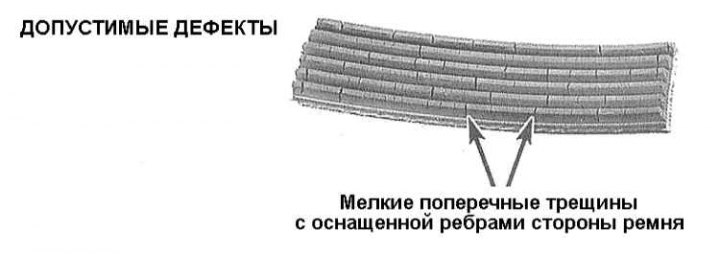
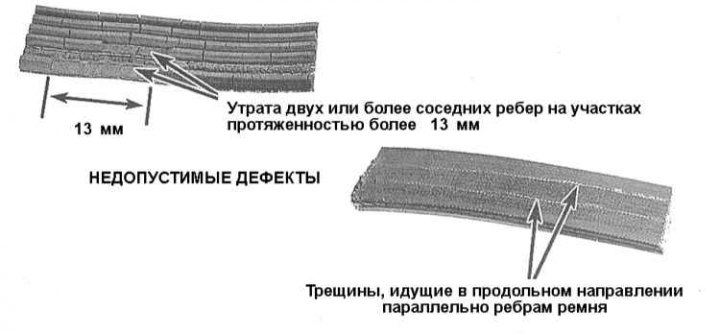
3. Check the condition of the ribs on the underside of the belts - they should be of the same depth and show no signs of deformation.
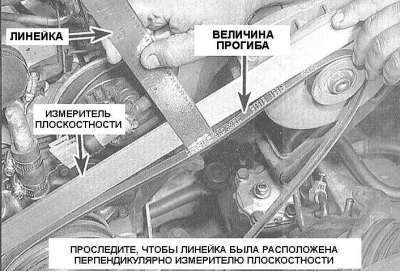
4. The belt tension force can be assessed by pressing it with your thumb on the area in the middle between two adjacent pulleys. The pressure should be firm enough. The parameter characterizing the belt tension force is the value of its deflection when pressing. As a rule, if the pulleys are located at a distance of 180 to 280 mm from each other, the deflection value should be 6.4 mm, the distance between pulleys of 305 - 405 mm corresponds to a deflection of 12.5 mm for a V-belt, and 6.4 mm for a multi-ribbed belt.
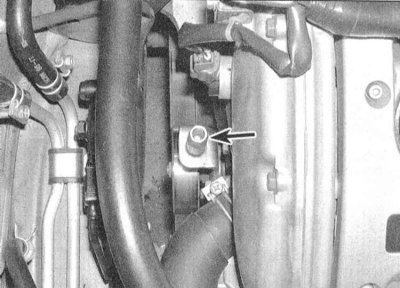
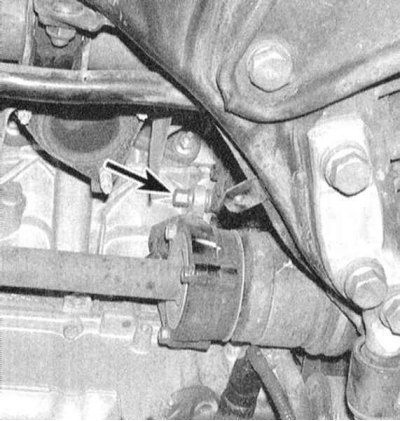
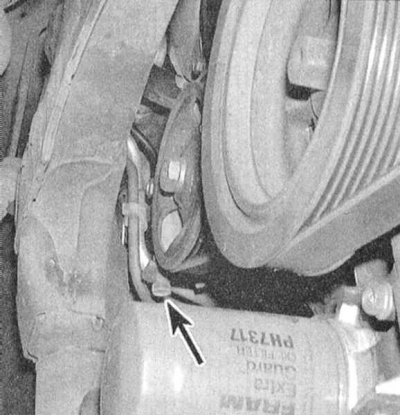
5. On early models, one belt is used to drive the water and steering pumps. The tension of this belt is controlled by a special tension roller, which is accessible only from below. The second, shorter belt drives the generator. The tension of this belt is adjusted by adjusting the position of the generator assembly. The longest belt drives the air conditioning compressor and is equipped with a tension roller installed in the upper part of the unit. On models produced since 1995, only two multi-rib drive belts are provided, the tension of one of which is adjusted by moving the steering pump assembly, while the second is equipped with an upper tension roller.
 |
 |
Replacement
1. To replace, loosen the belt tension (see above) and remove it from its pulleys. To replace the inner belt, first remove the outer one - make sure they are seated correctly in the pulley grooves.
Note: It is best to replace all drive belts at the same time.
2. When buying new belts, take the old ones with you as samples - replacement belts must strictly correspond in size to those removed from the car.
3. Once replacement is complete, adjust the tension of the new belts (see above).