


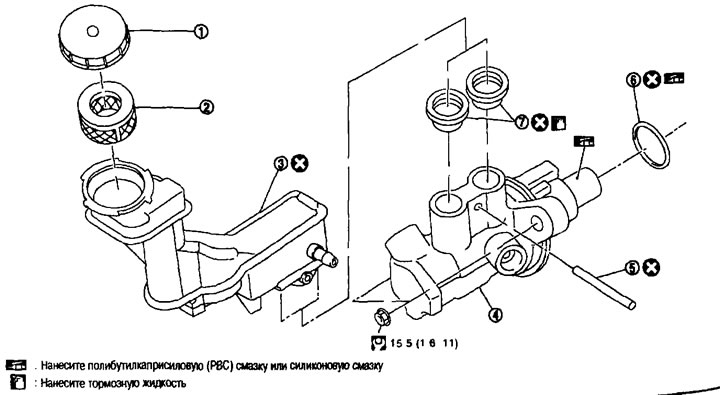
Master brake cylinder. 1. Tank lid; 2. Coarse oil filter; 3. Tank; 4. Cylinder body; 5. Pin; 6. O-ring seal; 7. Rubber bushing.
Removal and installation
Removal
Caution: Do not spill brake fluid on unpainted areas, as it may damage the paintwork. If brake fluid is spilled on painted areas, wipe it off immediately and rinse with water.
1. Remove the battery and bracket.
2. Remove the air duct and air cleaner housing. See chapter "Mechanical part of the engine".
3. Drain the brake fluid. See above.
4. Disconnect the connector from the low brake fluid level indicator switch.
5. Using a spanner, disconnect the brake pipes from the master cylinder assembly.
Caution: Do not scratch the union nuts and brake pipes.
6. Remove the master cylinder assembly.
Attention:
- Press the brake pedal several times and release the vacuum from the brake booster. Then remove the master cylinder assembly.
- Do not press the brake pedal after removing the master cylinder assembly.
- The master cylinder piston assembly has no protection. Do not damage it when removing the master cylinder.
- If you pull too hard, the piston may fall out. Do not grasp the piston. When working on the master cylinder assembly, grasp the cylinder body.
Installation
Caution: Do not spill brake fluid on painted areas; it may cause damage to the paintwork. If brake fluid spills on painted areas, wipe it off immediately and rinse with water.
Installation is carried out in the reverse order of removal, taking into account the following:
Attention:
- Do not press the brake pedal after removing the master cylinder assembly.
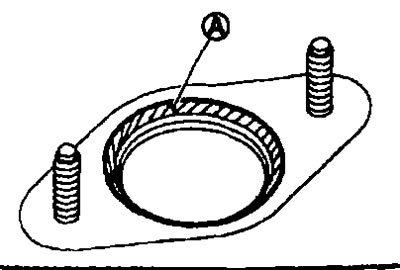
- When installing the master cylinder assembly to the brake booster, apply polybutyl caprylic (PBC) grease or silicone grease to the brake booster (See (A) in the Fig.).
- The master cylinder piston assembly is not protected. Do not damage it when working on the master cylinder or before installing the piston. Make sure that no dirt or foreign particles get on it. If necessary, clean it in fresh brake fluid.
- If you pull too hard, the piston may fall out. Do not grasp the piston. When working on the master cylinder assembly, grasp the cylinder body.
- Connect the brake pipe to the master cylinder assembly and tighten the union nut by hand. Then use a torque wrench to tighten the union nut to the specified torque. See above.
Caution: Do not scratch the union nuts and brake pipes.
After installation, bleed the brake system. See above.
Caution: Do not reuse drained brake fluid.