


Table of contents: Removal and installation ↓ Disassembly ↓ Cleaning and checking the condition ↓ Assembly ↓
Removal and installation
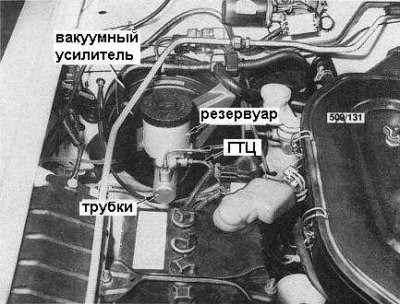
1. Cover the right front mudguard with the protective cover. The location of the brake master cylinder and related components in the engine compartment of the car is shown in the accompanying illustration.
2. Release the clamp and disconnect the electrical connector from the bottom of the brake fluid reservoir.
3. Disconnect the hydraulic pipes from the master cylinder body. Seal the ends of the pipes and the holes on the cylinder body to prevent dirt from entering the hydraulic system and to minimize fluid loss.
4. Loosen the brake master cylinder mounting nuts, move the brake booster control valve support bracket aside and remove the brake master cylinder from the vehicle.
Removal
Note: If brake fluid accidentally gets on the painted surfaces of the car body, immediately wash it off with plenty of water and allow the surface to dry naturally - do not wipe it with a rag.
Installation
Installation is carried out in reverse order.
1. Before installation, fill the brake master cylinder reservoir with clean brake fluid and pump the cylinder pistons several times so that the fluid begins to be pushed out through the holes for installing the brake pipes.
2. Tighten all fasteners to the required torque.
3. Ensure that the electrical wiring is securely attached to the bottom of the tank.
4. Finally, bleed the system.
5. Perform road tests on the vehicle. Check the proper functioning of the brakes.
Disassembly
1. After removing the brake master cylinder, drain the brake fluid from its reservoir. The components of the brake master cylinder are shown in the accompanying illustration.
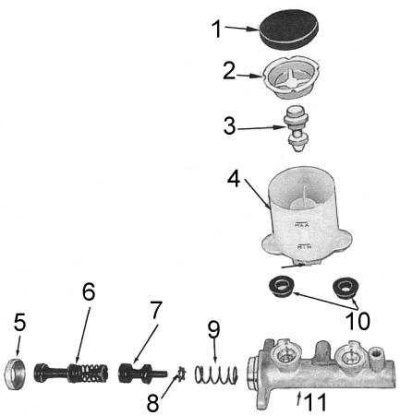
1 - lid; 2 - mesh filter; 3 - float; 4 - reservoir; 5 - limiting cover; 6 - Primary piston assembly; 7 - secondary piston; 8 - spacer washer; 9 - spring; 10 - terminals; 11 - sealing bushings; 12 - GTZ housing
2. Carefully pry the tank out of the rubber sealing bushings. Remove the tank cover and remove the mesh filter and float.
[The article was copied from here www.NissanBook.ru]
3. Remove the reservoir sealing bushings from the master cylinder body and discard them.
4. Bend the stopper cover locking tabs out of the groove at the end of the master cylinder body, remove the stopper cover from the cylinder. If the stopper tabs are damaged, replace the stopper cover.
5. Remove the primary and secondary piston assemblies with the return spring from the cylinder - remember their seating position.
Note: If necessary, tap the end of the master cylinder with a wooden block to release and then remove the pistons.
Cleaning and checking the condition
1. Wash all components of the master cylinder with methyl alcohol.
Caution: Do not use gasoline, kerosene or other cleaning solvents for this purpose.
2. Check the patency of all fluid channels.
3. Check the master cylinder mirror for signs of wear and cavities. Replace the cylinder if necessary. Do not attempt to restore the cylinder mirror by honing it.
4. Check the return springs for cracks and weakening of the force developed. Replace defective ones.
5. If the piston seals are to be replaced, remember the installation position of the old ones (on both pistons). Using a blunt instrument, remove the seals and discard them. If you are going to use a proprietary master cylinder overhaul kit, discard the old pistons as well.
Note: Where possible, be sure to use special branded repair kits that include new seals and pistons. Using such branded kits will significantly extend the service life of the unit.
Assembly
Assembly is carried out in the reverse order of disassembly.
1. Before installation, lubricate the piston seals with clean brake fluid or special grease (for rubber components). When putting on the pistons, make sure that the cuffs are oriented correctly.
2. Lubricate the master cylinder mirror with clean brake fluid and install the return spring and piston assemblies into the cylinder (in the same order).
3. Press the pistons into the cylinder, install the limiting cap and bend the locking tabs into the groove at the end of the master cylinder body.
4. Lubricate the reservoir sealing bushings with clean brake fluid or special grease (for rubber components) and place the bushings into the cylinder body.
5. Push the tank into the sealing bushings, install the float and mesh filter into the tank.
6. Install the brake master cylinder on the vehicle.