


Table of contents: 3rd charge ↓ Instructions for working with a…↓
When charging the battery, the following precautions must be observed:
- Battery cell caps (phillips-head) in modern batteries with centralized gas removal, the screws remain tightly screwed during charging.
- A frozen battery should be defrosted before charging. A charged battery freezes at -65°C, a half-charged battery freezes at -30°C, and a discharged battery freezes at -12°C. After thawing, inspect the battery for cracks in the casing and replace it if necessary.
- To charge the battery using a regular charger or a fast charger, the battery must be removed. As a last resort, you need to disconnect both wires from it.
- Using a charger with a small charging current, you can charge the battery even when it is installed. In this case, there is no need to disconnect the wires from the battery.
3rd charge
- Check the electrolyte level and add distilled water if necessary.
- Charge the battery only in a well-ventilated area or outdoors. When charging the battery without removing it from the vehicle, open the hood.
- Make sure the battery bleed hose is not damaged and the vents are not clogged.
- If the charging current of the charger can be adjusted, it should be set to approximately 10% of the battery capacity. For a 50 Ah battery, the current should be 5.0 A. In this case, the battery charging time should be approximately 10 hours.
- With the charger turned off, connect the positive cable of the charger to the positive terminal of the battery and the negative cable of the charger to the negative terminal of the battery.
- Turn on the charger.
- If the battery is charged with a constant current, it is necessary to check its temperature with your hand. The electrolyte temperature during charging should not exceed 55°C; if necessary, stop charging or reduce the charging current.
- After the battery is fully charged, turn off the charger (if possible) and unplug it.
- Disconnect the charger wires from the battery.
- Check the charged battery as described above.
Instructions for working with a battery that does not have a ventilation hole
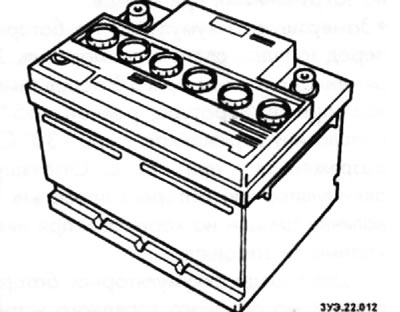
- Before charging the battery, unscrew the plugs or pry the cover with a screwdriver and place it over the holes. This will prevent electrolyte from splashing out of the battery during charging.
- Continue charging until active gas evolution begins in all cells, and when measuring the electrolyte density and voltage on the battery over the last 3 hours, these values have not increased.
- After charging, let the battery stand for 20 minutes to allow the gases to escape, and then tighten the caps.