


- A charged battery is used for testing.
- On the ammeter (with measurement ranges of 0-5 mA and 0-5 A) enable maximum range for current measurements.
- With the ignition off, disconnect the negative cable from the battery.
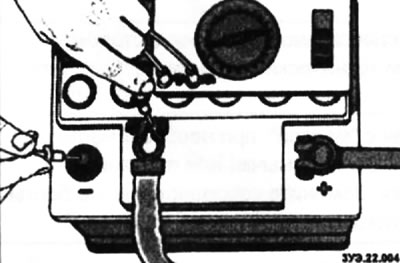
- Connect an ammeter between the negative battery terminal and the negative cable. Connect the positive wire of the ammeter to the wire, and the negative wire of the ammeter to the negative terminal of the battery.
Note: This check can also be performed using a test lamp. If the lamp connected between the wire and the negative terminal of the battery does not light, then in any case it is necessary to use an ammeter.
- Turn off all consumers, including watches and other permanently connected consumers, close the doors.
- Turn on the ammeter to different measurement ranges until a visible current value is reached (the maximum permissible leakage current value is 25 mA).
- Removal different fuses will open different electrical circuits. If, when one of the circuits is opened, the current shown by the ammeter drops to zero, then it is in this circuit that the source of the leak should be looked for. The causes of leakage may be the following: corroded and dirty contacts, frayed wire insulation, internal short circuit in the units.
- If no faults are detected in the circuits protected by fuses, then it is necessary to disconnect the units not protected by fuses, such as the generator and starter.
- If, when disconnecting one of the unprotected units, the ammeter shows zero current, then the corresponding part must be repaired or replaced. If there is a current leak in the starter or ignition system, always check the ignition switch and starter in accordance with the electrical diagram.
- Connect the negative cable to the battery.
(The material is based on data from the portal: NissanBook.ru)