


The generator is designed with parallel excitation, i.e. the excitation winding is connected in parallel to the consumers of electrical energy and is powered from the armature winding of the generator itself.
All generators are equipped with forced ventilation and driven from the engine crankshaft via a drive belt, have a fundamentally identical design and mainly differ from each other in winding data and dimensions.
The generator includes a transistor voltage regulator. It is located above the brush holder in the charging section of the generator.
The brush holder and capacitor are removed simultaneously.
The generator is installed as standard equipment. The main advantage of the generator is its ability to produce relatively high current at low speeds. In city driving conditions, the battery charges very weakly or does not charge at all. Under these conditions, even with the windshield wipers, heater, lights and radio on, the generator still recharges the battery. The generator mainly consists of a stator on which a 3-phase winding is wound, and 1 2-polar rotor with an excitation winding.
Each end of the rotor shaft runs on a ball bearing that is not lubricated.
Aluminum brackets (covers) support the bearings and are combined with lugs for mounting the generator. The back cover contains silicon diodes combined into a rectifier that converts the alternating voltage produced by the generator into direct voltage to recharge the battery and to output to the voltage regulator.
(See the source on the portal NissanBook.ru)
The rotor is driven by a belt from the engine through a pulley secured with a key on the rotor shaft.
The rectifier block made of silicon diodes is fixed inside the rear cover casing, where the brushes are also fixed, which contact the sliding rings on the rotor to supply excitation current to them.
The sliding rings are made in the form of cast drums of small diameter, connected to the rotor. The precise shape of the circumference of the sliding rings ensures minimal wear of the brushes when they come into contact with them.
Generator - Special Procedures and Precautions
When working with vehicle electrical equipment or when starting the engine from an external source, it is necessary to observe safety precautions; neglect of these precautions may result in serious damage.
- Make sure the negative battery terminal is grounded. If the contacts were accidentally reversed, or the battery was charged in the "reverse direction", the generator diodes will be damaged.
- The positive terminal of the alternator should never be grounded, but should always be connected directly to the positive terminal of the battery.
- When removing the alternator or disconnecting wires from it, always disconnect the negative battery cable first.
- The generator should never be operated without a battery connected to it.
- If the battery is to be charged from an external source, always disconnect both cables from the battery before connecting the external source.
- If you need to connect a high-power battery charger or a booster battery to jump start the engine, always double check that the negative and positive cables are properly connected to the correct battery terminals.
Generator Elements
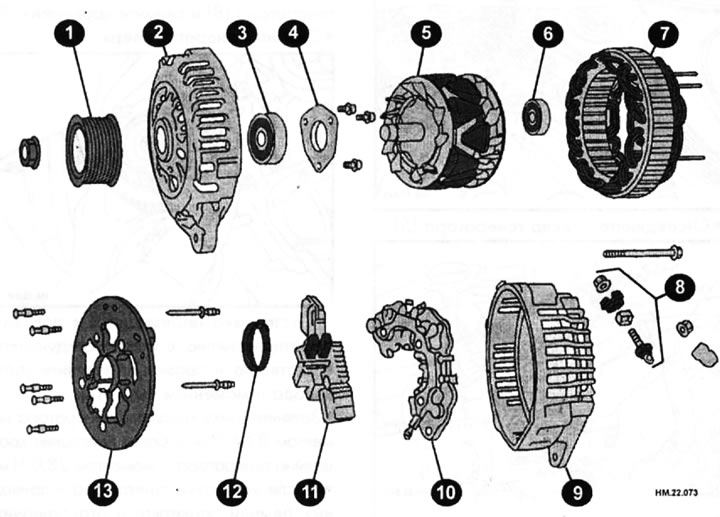
1 - pulley; 2 - front cover; 3 - bearing; 4 — bearing holder; 5 — rotor; 6 — slip ring; 7 — stator; 8 - contact; 9 — back cover; 10 — diode block; 11 - voltage regulator unit; 12 - double seal with labyrinth bushing; 13 — fan guide.