


Table of contents: A regular battery ↓ Checking the battery under load ↓ Checking the density of the…↓
A regular battery
Checking the electrolyte level
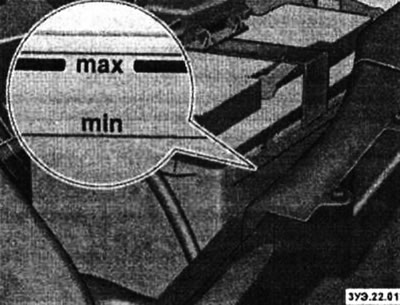
The electrolyte level in individual cans should be between the minimum and maximum level marks. If necessary, unscrew the plugs from the battery and add distilled water.
Attention: If the electrolyte level cannot be determined from the outside, then unscrew the plugs from the battery. The electrolyte level should be at the inner plastic projection. This level corresponds to the maximum level mark located on the battery case.
Checking the battery
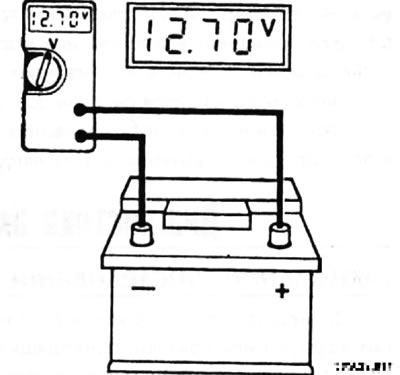
The condition of the battery can be checked by measuring the voltage between the battery terminals with a voltmeter.
- Disconnect the wires from the battery.
- Before checking, the battery must be disconnected for at least 2 hours.
- Connect a voltmeter to the battery terminals and measure the voltage.
Analysis of voltage measurement results:
12.5 V or more - battery in good condition;
12.4V or less - battery is in poor condition, charge or replace battery.
(The text was copied from the portal: NISSANBOOK)
Checking the battery under load
- Connect a voltmeter to the battery terminals.
- Start the engine and measure the battery voltage during starting.
- During engine starting, the battery voltage should not drop below 10 V (at a temperature of approximately 20°C).
- If the voltage drops sharply and the electrolyte in the battery cells has different densities, then it can be concluded that the battery is faulty.
Checking the density of the electrolyte
The results of electrolyte density measurements, together with the results of voltage measurements, make it possible to draw a conclusion about the state of charge of the battery.
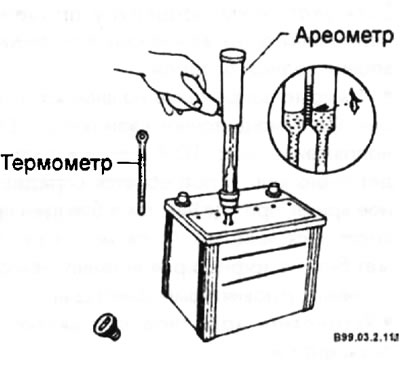
To check the density of the electrolyte, use a hydrometer, which can be purchased at spare parts stores.
The electrolyte temperature during measurements must be at least 10°C.
- Turn off the ignition.
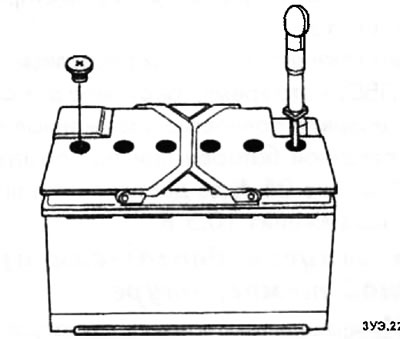
- Remove the plugs from all battery cells. If necessary, first remove the cover plate using a screwdriver.
- Insert the end of the hydrometer into one of the battery cells and fill it with enough electrolyte so that the float floats freely. The lower the specific gravity (density) of the electrolyte, the deeper the float sinks. The hydrometer scale can be used to determine the density of the electrolyte in g/ml or in degrees Baumé (+Be).
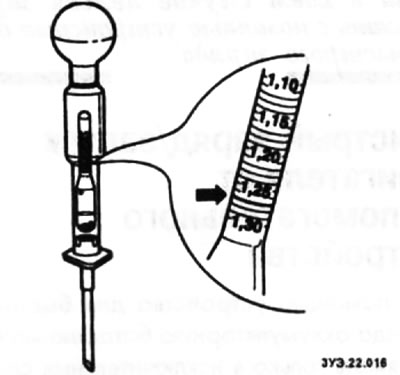
- At the same time, measure the temperature of the electrolyte. If the electrolyte level is low, tilt the battery to make it easier to measure.
- Convert the density of the electrolyte at a given temperature to the density at a standard temperature of 20°C.
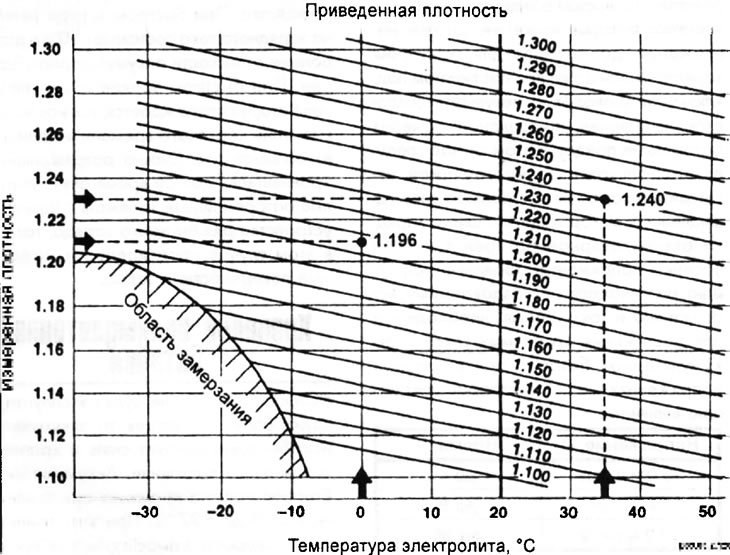
Example: electrolyte temperature is 35°C, measured density is 1.230. The reduced density will be 1.240.
- The electrolyte density must be at least 1.24 g/ml. If the density is too low, the battery should be charged.
Electrolyte density - the battery is fully charged
| Electrolyte density, g/cm³ | Temperature (°C) |
| 1,268 | 38 |
| 1,272 | 32 |
| 1,276 | 27 |
| 1,280 | 21 |
| 1,284 | 16 |
| 1,288 | 10 |
| 1,292 | 4 |
| 1,296 | -1,5 |
Electrolyte density - the battery is completely discharged
| Electrolyte density, g/cm³ | Temperature (°C) |
| 1,098 | 38 |
| 1,102 | 32 |
| 1,106 | 27 |
| 1,110 | 21 |
| 1,114 | 16 |
| 1,118 | 10 |
| 1,122 | 4 |
| 1,126 | -1,5 |
- Check all battery banks in turn. The density should be the same in all jars (a deviation of no more than 0.03 g/ml is allowed).
- There should be very little difference between different jars, and if the difference exceeds 0.03 g/cm³, the reasons for this may be the following:
♦ loss of electrolyte from a battery caused by splashing or leakage, which can lead to a decrease in the specific gravity of the electrolyte when the lack of electrolyte is compensated for by adding distilled water instead of fresh electrolyte;
♦ An internal short circuit caused by bending of the plates or something similar leads to a malfunction of the entire battery and its inevitable rapid failure and breakdown.
If the battery is sealed and does not have a built-in hydrometer to assess the state of charge, then you can measure the voltage on the battery with an accurate voltmeter.
A fully charged battery should have a voltage of at least 12.6 V when the engine is not running. If the voltage is less than 12.6 V, fully charge the battery and repeat the test.