


Table of contents: Reserve capacity ↓ Engine cranking current at low…↓
The battery has two characteristics:
1. Reserve capacity at 27°C, defined as the time during which a fully charged battery can supply a current of 25 A at a voltage of 10.5 V or higher.
2. Low temperature current, measured in tests at -18°C, as a characteristic of the power used to crank the crankshaft.
Reserve capacity
Reserve capacity is the maximum length of time that a vehicle can be driven at night with minimal electrical load and without recharging by the generator.
Expressed in minutes, the reserve capacity (RC) is the time required to completely discharge a fully charged battery at 27°C and 25 A to a final voltage of 10.5 V.
Engine cranking current at low temperature
The material is based on data from the portal NISSANBOOK.ru
Cold cranking current measurements are performed at a battery temperature of -18°C. The minimum current that the battery must maintain for 30 seconds at a given temperature and a voltage of at least 7.2 V is measured. This value characterizes the battery's ability to start an engine in cold conditions. The battery is not designed for indefinite use. However, with proper care it will work for many years. If the battery pack performs well during testing, but has poor performance characteristics for no apparent reason, the factors listed below may cause failures.
- The car's electrical appliances were left on overnight.
- Low average riding speeds for short periods of time.
- The electrical load in the vehicle exceeds the generator's capacity, especially if additional equipment is installed after purchasing the vehicle.
- Defects in the charging system such as short circuits, alternator belt slippage, faulty alternator or voltage regulator.
- Improper use of the battery, including poor cleaning of the terminals and insufficiently tight tightening, and poor battery fastening.
- Mechanical damage to the electrical system, such as short circuits or broken wires.
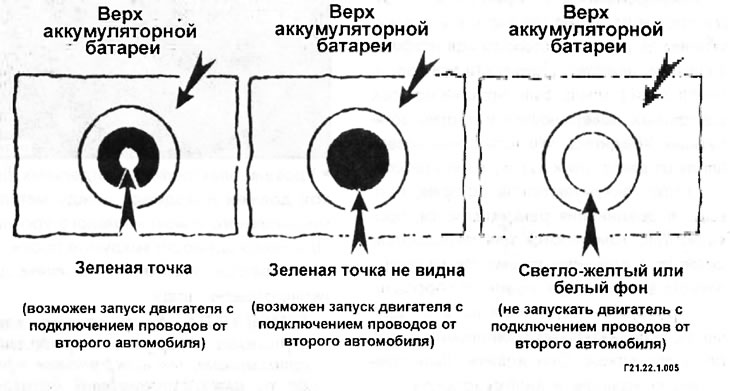
The indicator color is green: the battery is charged normally. The electrolyte level is ok.
Indicator color is black: The battery is not charged or is very weakly charged, so the battery should be tested according to the procedure described in section "Diagnostics". The charging system and electrical equipment must be checked at the same time. Sometimes a third signal may be visible.
The indicator color is yellow or colorless: the electrolyte level has reached a critical level. Add distilled water. This condition may be caused by overcharging, prolonged charging, damage to the battery case, excessive tilting, or normal battery aging. The appearance of such a signal may mean that charging is being carried out at too high a voltage as a result of a failure of the charging system. Therefore, it may be necessary to check the charging system and electrical equipment. If you have difficulty starting the engine and the difficulty is caused by the battery, the battery should be replaced.