


Note: Of the rear suspension cross rods, only the adjustable ones can be removed without preparatory work. To remove the front rods, it is necessary to remove the fuel tank (see Section 3) or rear suspension crossmember assembly (see Chapter 19 of this Section).
1. With the car on its wheels on level ground, apply the handbrake and select first or reverse (manual transmission) or position 'P' (automatic transmission). Block the front wheels, loosen the rear wheel nuts, then jack up the rear of the car and support it on axle stands. Remove the wheel.
2. Unscrew both lock nuts of the tie rod pivot bolts (photo).
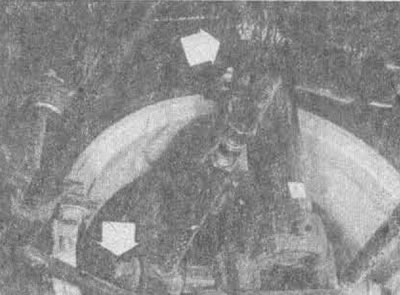
18.2. Unscrew both nuts of the hinge bolts (marked with arrows), to release the rear (adjustable) transverse thrust
3. Remove the back (adjustable) traction.
4. Loosen the outer tie rod pivot bolt.
5. If the rear suspension crossmember needs to be removed or lowered, note that it may be easier to remove the rear section of the exhaust system first (see section 3) and rear anti-roll bar (see Chapter 17 of this Section).
6. Once you have a clear work area, remove the inner tie rod pivot bolt and front tie rod.
7. Check the condition of the rods and bushings, replace them if necessary. The bushings are not available separately, so if one of the bushings is worn, the entire rod assembly must be replaced.
8. Do not disturb the rear installation unnecessarily (adjustable) rods. If a new rod is installed, check that it is the specified installation length. (Chapter 36 of this Section).
9. When installing, thoroughly clean all components and areas around the mounting points. Installation is carried out in the reverse order of removal, noting the following points. Tighten the crossmember mounting nuts to the specified tightening torque Specification. The cross-rod pivot bolts are installed from the front to the rear side, the nuts must be tightened to the specified tightening force Specification only when the vehicle is lowered to the ground so that all the weight is on the wheels. Before tightening the mounts, rock the vehicle to settle the suspension components.
10. Finally, it will be necessary to check the wheel alignment and steering angles (see Chapter 36 of this Section).