


Table of contents: Checking wheel bearing play ↓ Checking the shock absorber…↓ Checking ball joints ↓
The main signs of a faulty front suspension are accelerated and one-sided wear of the front tires and increased gaps in the mating parts. These external manifestations of malfunctions appear as a result of a violation of wheel alignment and a significant change in their installation angles. It is recommended to first check the tilt of the shock absorber strut, then the wheel alignment.
Changes in wheel camber and shock absorber strut angles occur as a result of bending of the front axle elements, wear of rubber-metal bushings, ball joints, weakening (sagging) of the springs or their breakage. Therefore, before determining the installation angles, check the condition of the front suspension elements, their deflection, fastening and play, as well as the adjustment of the wheel bearings.
Checking the play in the connections is determined after preliminary adjustment of the wheel hub bearings.
Checking wheel bearing play
During vehicle operation, it is necessary to check and carry out maintenance operations on the wheel hub bearings in a timely manner. Otherwise, you will face major problems associated with replacing not only the bearings, but also the hubs themselves.
If there is insufficient lubrication in the hub bearing assembly or if the bearing play is not adjusted correctly, the hub heats up to a temperature exceeding the operating temperature, causing the lubricant to leak out, the bearings to deteriorate, and the hub to fail.
The wheels move on double-row ball bearings. With the lubricant in place, they can last for over 1,000,000 km. However, noise can become a problem much earlier. If the noise gets louder, for example, when turning right, the defective bearing is in the left one.
- Raise the front or rear of the vehicle, depending on the wheel being checked.
- Grasp the wheel firmly at the top and bottom and try to move it in a perpendicular direction.
- If the bearings are in good condition, there should be virtually no play. (Maximum allowable clearance is -0.05 mm).
Typical bearing inspection
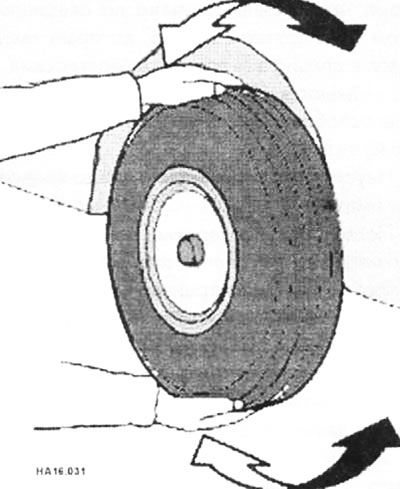
- If the play is noticeable, ask an assistant to press the brakes hard and pump the wheel again. If the play is no longer felt, this means that the play is only in the wheel bearing. If there is play on the braked wheel, check the front suspension components of the vehicle.
- Check for noise from wheel bearings. Spin the wheel with your hand and let it spin freely. Listen to the bearing noise. If the bearing is noisy, it needs to be replaced.
Caution: An incorrectly adjusted wheel bearing may cause noise.
Checking the shock absorber installed on the vehicle
The purpose of the shock absorber is to smooth out the harsh movement of the spring and prevent the occurrence of wheel vibration so that the impacts felt by the wheels are not completely transmitted to the body and, consequently, to the driver and passengers. As the wheels move up and down, the shock absorber shortens or lengthens, thus limiting excess movement due to its hydraulic operating principle.
Typically, a shock absorber does not fail suddenly; its effect weakens gradually, which may not be immediately noticeable. There is a hard and fast rule: after two tire changes, due to wear, the shock absorbers retain only 50% of their effectiveness and are ripe for replacement or repair.
It is impossible to make an accurate diagnosis using the well-known "swinging" method (when a car is rocked by the wing and then suddenly released), because the spring's movement may already be damped. This method is only applicable to identifying a completely failed shock absorber.
An accurate picture of the shock absorber's condition can be obtained on a special test bench, which is available in specialized workshops.
There are some clear symptoms of weakening shock absorber effectiveness:
- Unstable handling when the wheels do not have constant contact with the road.
- After driving over uneven surfaces, the body sways, the car "swerves" on turns, and the inner wheel is not pressed hard enough against the road, while the outer wheel is not unloaded enough.
- Intermittent braking distance under full braking.
- Uneven and increased tire wear.
- Traces of oil are visible on the outside of the shock absorber under the spring plate of the shock absorber strut.
Please note: Small traces of oil are considered normal.
Checking ball joints
Check the ball joints for grease leaks. If the ball joint boot is cracked or otherwise damaged, replace the ball joint assembly.
Check the free play of the ball joint pin as follows.
- Raise the front or rear of the vehicle, depending on the joint being tested.
- Attach a dial indicator to the wheel guard and rest the indicator leg against the head of the lower control arm.
- When checking the front suspension components, make sure the front wheels are in a straight-ahead position and the brake pedal is released.
- Insert a tire lever between the control arm head and the steering knuckle (next to the indicator leg).
- While moving the blade, observe the indicator readings. The maximum movement should be 0.5 mm. Otherwise, replace the ball joint.
- Move the indicator and check the axial movement of the control arm. The displacement should be practically zero.
Caution: Be careful not to damage the ball joint boot.