


Table of contents: Checking tire pressure ↓ Checking the valve of a tubeless tire ↓ Checking the tire tread depth ↓
- Regularly inspecting your tires will help prevent possible damage and wear. During the inspection, you can obtain information about possible faults in the steering and suspension, which will help you avoid serious problems with them.
- Watch for any signs of abnormal tire wear. They may indicate a violation of wheel balance or alignment angles. These faults should be corrected in a workshop.
- Carefully inspect for cuts, punctures and foreign inclusions. Sometimes a tire holds pressure for a short time or slowly loses pressure after a puncture. If there is a drop in pressure, check whether the nipple is tight and tighten it, if necessary, with a special wrench. Check for pressure leaks by applying soapy water to suspect areas. If there is a leak, bubbles will appear there.
- Carefully check the inside of each tire for brake fluid leaks. If any are found, have your brakes checked immediately.
- Check your tire pressure regularly. It cannot be accurately determined visually, especially in the case of radial tires, so a pressure gauge with precise graduations is required.
- Remember to maintain the correct pressure in the spare tire.
Checking tire pressure
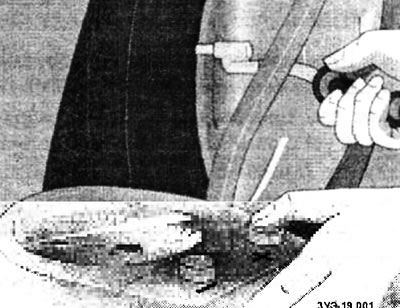
- Tire pressure should only be checked when the tires are cold, i.e. at least 3 hours after driving.
- Unscrew the protective cap.
- Connect the pressure gauge and measure the pressure. Compare this value with the recommended pressure on the certification plate on the door pillar. An increase in pressure of 0.3-0.5 Bar (atm) is a common occurrence for warm tires.
- Screw the nipple valve cap back into place to prevent dirt and water from entering the valve. Check all four tires and, if necessary, inflate them to the correct pressure.
- You should check the tire pressure at least once a month on all wheels, including the spare.
- Please note that the recommended pressure for temporary spare tires is higher than for the tires installed on the vehicle.
- In addition, it is necessary to check the tire pressure before a long trip on a high-speed road, since when driving at high speed, the temperature load on the tires will be the greatest.
[The text is published on the website: NISSANBOOK.ru]
Checking the valve of a tubeless tire
- Unscrew the protective cap from the tire valve.
- Apply a little soapy lather or saliva to the valve. If a bubble appears, it is necessary to tighten the valve nipple (3) using the unscrewed cap (2). (1 - rubber protective cap 4 - valve)
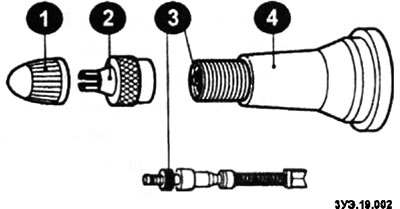
Caution: Only the metal cap (2) can be used to tighten the nipple. These caps are available in many locations.
- Check the valve again. If bubbles appear again and the valve cannot be tightened any further, the valve must be replaced in a workshop.
- Be sure to put the rubber protective cap on the valve.
Checking the tire tread depth
Tires on balanced wheels, when the required pressure is maintained in them, with correctly adjusted wheel alignment angles and with normal operation of the shock absorbers, should wear approximately equally over their entire surface. Generally speaking, it is impossible to even roughly estimate the service life of tires from a particular manufacturer, since service life depends on various factors.
- nature of the road surface;
- tire pressure;
- weather conditions.
Rapid wear of tires is primarily caused by a "sporty" driving style and abrupt braking.
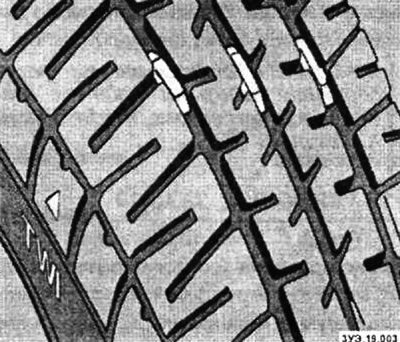
If the tire depth approaches the minimum acceptable value, which can sometimes be determined by the wear indicator appearing around the entire circumference of the tire, which is 1.6 mm high, then the tire must be replaced. For safety reasons, it is recommended to replace tires when the tread depth reaches 2 mm.
Please note: Tyres marked M+S provide adequate traction on snow or mud only when the tread depth is at least 4 mm.
Note: You can check your tires for cuts and determine the depth of the cut using a screwdriver. If the cut reaches the tire carcass, the steel breaker will corrode due to the moisture that has entered. Because of this, the tire may become separated from the carcass and soon fail. For this reason, if the cut reaches the frame, then such a tire must be replaced.