


Table of contents: Functions performed by the working…↓ Properties that a CVT fluid should…↓
There are two types of CVT fluid testing: level testing and color testing.
Functions performed by the working fluid
- Transfer of traction force as a working fluid of the torque converter.
- Lubrication of gears and bearing areas.
- Serves as a lubricant and working oil for clutches and brakes.
- Absorbs shock when shifting gears.
- Working oil for valve body.
Properties that a CVT fluid should have
- It must have such an optimal coefficient of friction that the impact when the clutch engages is not strong and the clutch does not slip.
- Should not foam easily.
- At low temperatures it should have good mobility.
- The change in viscosity should be minor.
- It must be heat-resistant, not oxidize and not form sediment.
- Should not damage seals.
Checking the fluid level
Since CVT fluid expands when heated, the fluid level should only be checked when the CVT is warm (at normal operating temperature). If the car has traveled more than 30 km, the variator can be considered warm.
If the vehicle has been moving, allow the CVT to cool for about 30 minutes. The fluid level can also be checked when the CVT is cold. If no more than five hours have passed since the car stopped and the fluid temperature is almost room temperature (22-35°C), the variator is considered cold. However, to obtain accurate results, the fluid level is usually measured on a warm variator.
Caution: If the vehicle has been driven at high speed or in urban traffic for a long time, in hot weather, or if it has been towing a trailer, an accurate fluid level reading may not be obtained.
- Check for fluid leaks.
- Once the engine is warm, take it for a short drive. If, for example, the ambient temperature is 20°C, it takes about 10 minutes to warm up the CVT working fluid to 50-80°C.
- Stop the car on a level surface.
- Apply the parking brake firmly.
- With the engine idling and the brake pedal depressed, move the CVT selector lever through all ranges.
- To release the dipstick (1), which is used to determine the fluid level in the CVT, press the tab (2) on the dipstick. Pull the dipstick out of the guide tube (3). The CVT is filled with working fluid through the same tube.
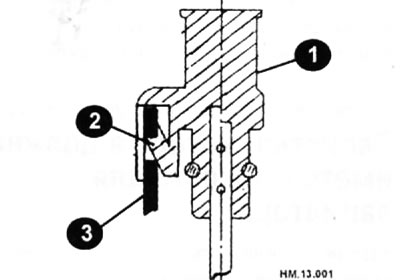
- Wipe the dipstick clean, rotate it 180° and insert it until it reaches the end of the guide tube.
Caution: Use paper towels to wipe the dipstick.
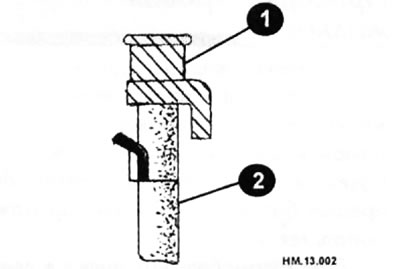
When inserting the dipstick (1) into the guide tube (2) after determining the fluid level, press it down until it snaps into place securely.
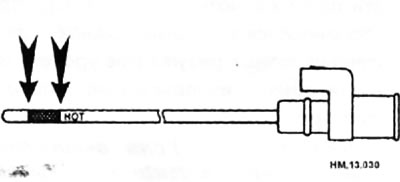
- Move the CVT selector lever to range P or N, remove the dipstick and make sure the fluid level is correct. It should be between the MIN and MAX marks on the dipstick (arrows).
Data posted on the website (NISSANBOOK.ru)
Caution: Low fluid levels can cause slippage and loss of control, while overfilling can cause foaming and fluid loss.
If the fluid level is unusually low, add fluid until the level is up to the level indicated on the dipstick, and then check for signs of fluid leaks.
If the fluid level is unusually high, drain the excess and then check the drained fluid for coolant. The presence of coolant in the CVT fluid indicates damage to the walls of the cooling system radiator, which separates the coolant from the fluid in the CVT.
Caution: If the working fluid foams, drain it and fill it with new one, and then check the drained fluid for the presence of coolant in it.
Checking the condition of the working fluid
A change in the color of the working fluid can indicate fluid burning, wear or destruction of brake discs and clutches, destruction of brass bushings, etc.
Normal color
Normal fluid is red in color and should be clear. This color is a criterion for verification and should be kept in mind.
Brown tint
This indicates harsh operating conditions. Due to the fact that the liquid has been exposed to high temperatures for a long time and has burned, not only the color changes, but a burning smell appears, the viscosity decreases, and the liquid becomes rough to the touch. All this can be easily determined. One could express the sensation of color more precisely and say that a reddish tint remains. The same color appears when the liquid is used for a long time without replacement, and in this case it needs to be replaced immediately.
The transparency disappears and the liquid turns black
In this case, it can be assumed that the liquid is contaminated with dust from clutch discs, bushings, and gears.
The fluid especially darkens when dust from worn aluminum bushings gets into it. If you operate the car in this condition for a long time, slippage will occur or extraneous noises will appear. To avoid major losses, it is necessary to immediately carry out repairs with overhaul. But even if there are no particular problems during operation, but you suspect that there is wear inside, then the first thing you need to do is remove the oil pan, clean it from metal dust or from disc wear products, clean the oil intake screen and replace the fluid. If in this condition you feel clutch slippage or extraneous noises, you must immediately carry out a major overhaul of the variator.
The emergence of "varnishing"
If the fluid has been exposed to high temperatures for a long time, a "varnishing" phenomenon occurs. In this case, the couplings or bands are already worn out, and replacing the fluid will not help. Since slippage produces a characteristic odor, it is easy to recognize. If you continue to operate the vehicle in this condition, the control valves may easily jam, which will affect the operation of the torque converter.
The appearance of a matte color
Just like with motor oil, it can be said that a large amount of moisture has entered the oil. Since in this case it is possible for coolant to enter the CVT working fluid due to damage to the cooling system, it is necessary to repair the radiator and oil cooler and replace the fluid.
Replacing the working fluid in the variator
The fluid is usually replaced every 60 thousand km.
Caution: If the vehicle has been moving, allow the transmission fluid to cool slightly before draining, as it may be too hot. If the car has not been in motion, warm up the fluid in the variator by driving the car for 10 minutes.
- Raise and securely support the vehicle.
- Place a suitable container under the variator to collect the fluid.
- Unscrew the drain plug and drain the liquid.
- Replace the drain plug. Lower the car.
- Fill with fluid until it starts to come out of the radiator fluid hose (from the return side). This procedure will require approximately 30 to 50% additional fluid. The volume of the working fluid is approximately 10.2 l.
Caution: Use only NISSAN NS-2 CVT fluid.
- The liquid is poured through a clean funnel with a fine mesh.
- Apply the parking brake and block the drive wheels. Start the engine and warm it up to operating temperature. Check for leaks.
- With the vehicle stationary, move the CVT selector through all positions.
- Check the fluid level and condition.