


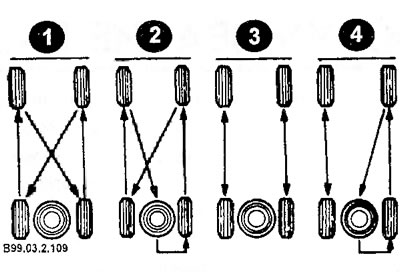
Tire rotation patterns 1 - diagonal carcass tires (4-wheel permutation scheme); 2 ~ diagonal ply tires (5-wheel rotation scheme); 3 - tires with radial carcass (4-wheel permutation scheme); 4 - tires with radial carcass (5-wheel rotation scheme).
The tires are selected to provide the best performance under normal conditions.
Wheels should be rotated at regular intervals or whenever uneven tire wear is detected.
Uniform wear of tires is ensured by rotating them after every 9,000 km. By including a regular spare tire in your tire rotation routine, you can increase tire life by 20% or more.
However, it should be noted that studded tires cannot be rotated, and radial tires should only be rotated on the same side where they were installed.
Since you will be raising your vehicle when checking the condition of your tire treads, you should also check the condition of your brakes.
(Read more on the website: nissanbook.ru)
Caution: Even if you don't swap wheels, at least check that the lug nuts are tight.
- To properly lift the vehicle when changing tires, refer to the information on lifting and towing the vehicle, but do not apply the parking brake when checking the brakes.
- To raise all four wheels off the ground, the car must be lifted or secured on stands. Support the car securely!
- After completing the wheel swap procedure, check the tire pressure and, if necessary, inflate them and check the tightness of the tire nuts.