


1. Park your car away from the highway on a level, horizontal area, preferably with a hard surface.
2. Turn on the hazard warning lights.
3. Firmly apply the parking brake. Move the manual transmission to reverse, the automatic transmission to the "P" position.
4. Make sure that all passengers have left the vehicle and use wedges to support the wheel located diagonally relative to the one to be removed.
5. Remove the jack and tools.
6. Remove the spare wheel from the bracket or hanger.
7. Place the wheel wrench on the wheel nut so that its handle is horizontal and points to the left relative to the wheel disk. Press the end of the handle and loosen the nut 1/2÷1 turn counterclockwise. Loosen the remaining wheel nuts in the same manner.
8. Position the jack under the appropriate jacking point under the front or rear axle (see accompanying illustrations) and slightly raise the car.
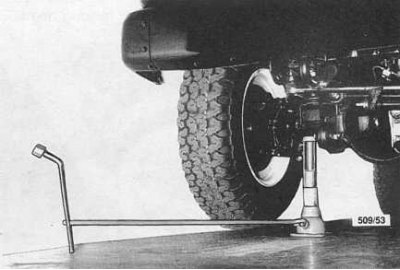
The point of inserting the jack under the front axle of the car
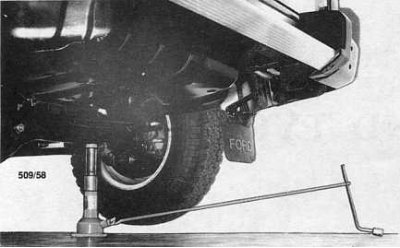
The point of inserting the jack under the rear axle of the car
9. Make sure the jack is correctly positioned and stable.
10. Raise the vehicle enough to lift the wheel to be changed off the ground. The amount of lift should provide sufficient working space for installation.
Attention! Never perform any work under a vehicle secured in a raised position only by means of a jack! Do not move the jack beyond the area marked with paint for its installation.
1. Loosen the mounting nuts and remove the wheel from the vehicle.
2. To facilitate installation, align the holes in the disc with the hub studs before putting the wheel on. If necessary, use the wheel wrench handle as a lever to temporarily hold the wheel in the raised position.
3. Holding the wheel on the hub, loosely tighten the nuts that secure it, pressing their seating cone to the edges of the hole in the disk.
4. Using a lug wrench, tighten the nuts in a diagonal pattern.
5. Lower the vehicle to the ground and remove the jack.
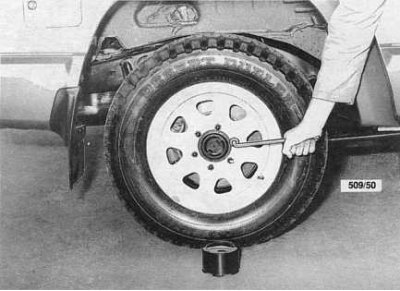
6. Using a lug wrench, tighten the wheel nuts diagonally in several stages (see accompanying illustration).
7. Remove the wedges from under the diagonally positioned wheel and put the removed wheel, jack and tool back in their proper places.
8. At the earliest opportunity, have the removed wheel repaired at a tire shop and check the tightening force of the wheel nuts with a torque wrench.
Note: If the vehicle is equipped with alloy wheels, re-tighten the wheel nuts after 1,000 km.