


Table of contents: Jacking up ↓ Towing ↓
Jacking up
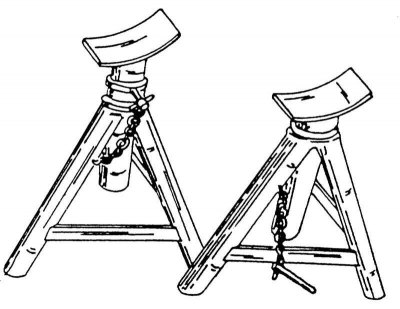
Three-legged supports are essential for working under a vehicle.
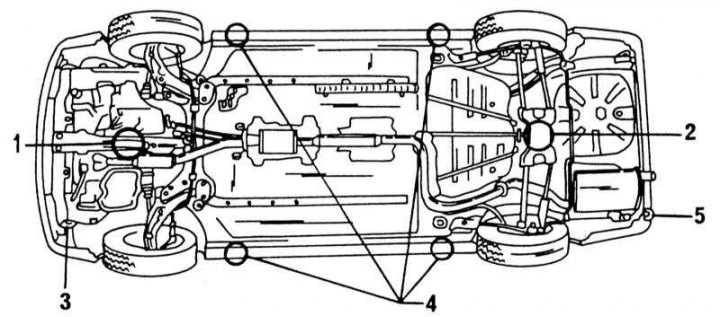
Locations for installing the lift and supports. Towing eyes are also indicated
1 - installation location, front; 2 - installation location, rear; 3 - Front towing eye; 4 - install supports here; 5 - rear towing eye
1. To jack up the front of the vehicle, apply the parking brake and, for safety, place chocks under the rear wheels.
2. When jacking up the rear of the vehicle, engage gear and place chocks under the front wheels.
3. Place reliable supports under the sides of the body. If one side rises first and then the other, you must make sure that the supports are reliable.
4. To avoid damage to the underside of the vehicle, the lift and supports must only be installed in designated locations.
5. On the front side, the lift may only be installed under the side member (1) in the place indicated in the illustration. In doing so, care must be taken not to damage any part of the front frame.
6. To raise the rear part, install the lift under the middle of the lower cross beam, i.e. under the place (2) in the illustration.
7. Always make sure that the surface on which the vehicle is to be lifted is not so soft that the lift or supports cannot sink into it. If you place a wide board under the wheels of the mobile lift, this danger will be reduced. Sometimes the surface looks solid, but the wheels of the mobile lift sink slowly.
8. Supports can be installed under the car only from the side. In the illustration these places are marked "4". Make sure that the varnish is not damaged. The varnish can be protected by placing rubber pads underneath.
9. Overpasses are the best way to lift a car, as there is no need for a lift. When entering, make sure that the overpass is located exactly in front of the wheels to maintain the correct direction. For additional safety, the overpass should have flanges for the wheels.
Towing
Towing a vehicle on all four wheels can be done at a speed not exceeding 50 km/h.
When towing a vehicle equipped with an automatic transmission for a distance exceeding 40 km, its front wheels must be off the ground. In this case, a special towing device must be used to grab the vehicle, which is attached not to the bumper, but to the main frame beam.
When towing, the parking brake must be fully released and the transmission must be in neutral.
The steering shaft must be unlocked (key in the "OFF" position). Remember that when the engine is off, the power steering system and the brake booster do not function.
Avoid towing another vehicle that is caught in the front towing eyes and never use it to secure the tow rope or fix the vehicle to the deck of a ferry or railway platform.
Traffic safety is one of the main requirements when towing a car, so strictly observe the traffic rules during towing. When towing any car in many countries, the use of a safety chain is a mandatory requirement.