


Table of contents: Precautions when towing a vehicle ↓ Nissan Towing Recommendations ↓ Freeing a Stuck Car ↓
When towing a disabled vehicle, you must comply with all applicable local rules and laws. Using improper towing equipment may cause damage to your vehicle. In order to properly tow your vehicle and avoid accidental damage to your vehicle, it is recommended that you contact a professional towing service. Before towing your vehicle, it is advisable to familiarize the towing vehicle driver with the warnings listed below.
Precautions when towing a vehicle
- When towing a vehicle, be sure to use safety chains.
- Before towing your vehicle, make sure the transmission, steering and suspension are in good condition.
If any components are damaged, the vehicle must be towed using a support trolley or by fully loading it onto a tow truck platform (cars with single axle drive).
- Nissan recommends towing your vehicle using a method that prevents the drive (front) wheels from spinning (cars with single axle drive).
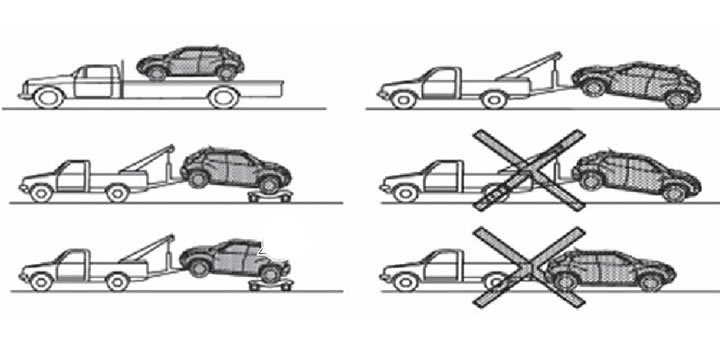
Single axle drive models
- It is forbidden to tow four-wheel drive vehicles (4WD) with any wheels resting on the road, as this can lead to serious damage to the transmission and the need for expensive repairs, which are not covered by the manufacturer's warranty obligations.
Nissan Towing Recommendations
Towing a single-axle vehicle (2WD)
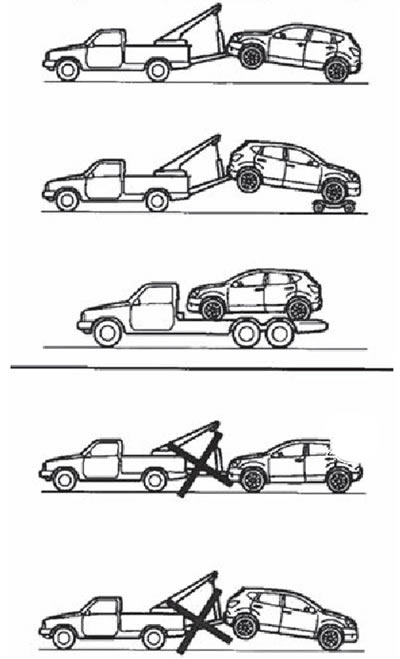
Nissan recommends towing your vehicle using dollies under the front wheels or by loading it completely onto a flatbed tow truck as shown in the illustration.
Attention.
- It is prohibited to tow vehicles equipped with a continuously variable (CVT) transmission with support on the leading (front) or all wheels, as this can lead to serious damage to the transmission and costly repairs. If it is necessary to tow a vehicle with the rear wheels raised, the front wheels must be supported on a special trolley.
- Towing the vehicle with the front wheels supported on a dolly: Set the ignition switch to the "ACC" or "ON" position (cars with Intelligent Key system) or to the "OFF" position (cars without Intelligent Key system) and secure the steering wheel (using a belt, rope, etc.) in the straight-ahead position. Move the selector lever or gearshift lever to the "N" (Neutral) position.
- When towing a vehicle with the rear wheels supported on the road without using a support dolly, be sure to release the parking brake.
Towing with rear wheels supported on the road
1. Set the ignition switch to the "ACC" or "ON" position (for vehicles equipped with the Intelligent Key system) or to the "OFF" position (for cars without Intelligent Key system).
2. Move the gear shift lever to the "N" (Neutral) position.
3. Release the parking brake.
4. Secure the safety chains before towing.
Towing all-wheel drive vehicles (4WD)
Nissan recommends that you place dollies under the front and rear wheels of your vehicle or tow your vehicle by loading it completely onto a flatbed tow truck as shown in the illustration.
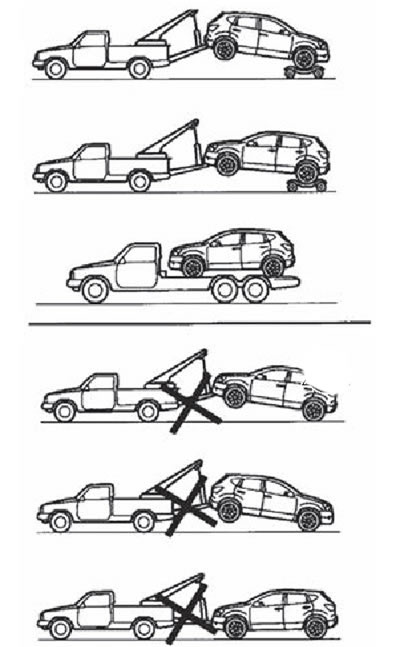
All-wheel drive models
Towing eyes
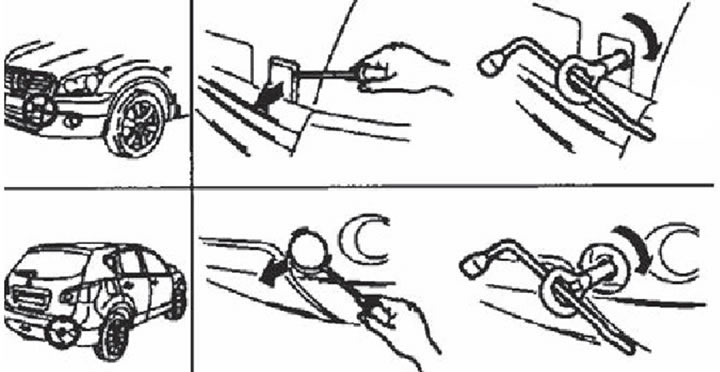
The towing eye is stored in the side storage compartment of the luggage compartment.
1. Remove the cover in the bumper using a suitable tool.
2. Screw the eyelet securely into the socket (see picture).
After using the towing eye, put it back in place.
Warning: Do not tow a four-wheel drive vehicle with any wheels on the road. This will cause serious damage to the gearbox, which will require expensive repairs. The manufacturer's warranty does not cover such cases.
Freeing a Stuck Car
Attention.
- It is prohibited to be near the towing rope when pulling out a stuck vehicle.
- Avoid high-speed wheel spin, as this can cause tire blowouts and serious personal injury. Transmission components can overheat and be damaged.
Towing eyes are used to extract a vehicle that is stuck in sand, snow or mud and cannot be moved under its own power.
- Use only the towing eye or hook, do not attach the cable to other parts of the car. Otherwise, damage to the car body may occur.
- The towing eye or towing hook is intended only for pulling out a vehicle stuck in sand, snow, mud, etc. During the pulling out of a stuck vehicle, the towing hook and eye are subjected to significant loads.
- Therefore, make sure that the towing rope does not deviate from the longitudinal axis of the vehicle.
- Do not apply lateral forces to the towing hook or eye that occur when the cable is deflected to the side.