


Table of contents: Using a temporary tire repair kit ↓ Before using the temporary tire…↓ Tire repair ↓ After tire repair ↓
Instead of a spare tire, your vehicle may be equipped with a temporary tire repair kit. This kit is intended to temporarily repair minor tire damage only. After using the tire repair kit, have your Nissan dealer inspect and repair the damaged tire.
Attention.
- Nissan recommends using only the genuine Nissan tire repair sealant that is equipped on your vehicle. Using other sealants may damage the tire's air valve seal, causing the tire to leak air.
- Do not use the temporary tire repair kit that comes with your vehicle to repair tires on other vehicles.
- Do not use the temporary tire repair kit for purposes other than repairing, inflating, and checking tire pressure.
- Connect the tire inflator to a 12V DC power source only.
- Keep water and dust away from the temporary tire repair kit.
- Do not disassemble or modify the temporary tire repair kit.
- Do not apply galvanic coating to a temporary repair kit for a damaged wheel.
- Do not use the tire repair kit in the following cases. Contact an authorized Nissan dealer for any necessary repairs.
- If the sealant has expired (indicated on the label of the sealant can).
- If the damage size exceeds 6 mm.
- If the sidewall of the tire is damaged.
- If you continue driving after a tire has been damaged, resulting in a significant loss of air pressure in the tire.
- If the tire has completely come off the wheel rim, either inward or outward.
- If the wheel rim is damaged.
- If two or more wheels are damaged.
Using a temporary tire repair kit
Remove the temporary tire repair kit from the trunk.
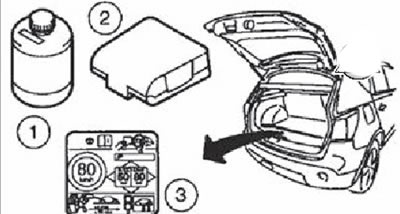
1. Container with sealant. 2. Air compressor. 3. Sticker with warning about speed limit.
Note: If your vehicle is equipped with a temporary tire repair kit, it does not come with a spare tire, jack, or tool kit. These tools are available separately from your authorized dealer. To purchase this equipment, contact your authorized Nissan dealer.
Before using the temporary tire repair kit
- If a foreign object is stuck in the tire (for example, a nail or a screw), don't take it out.
- Check the expiration date of the sealant indicated on the label of the sealant container. Do not use the sealant if the expiration date has expired.
Tire repair
1. Shake the container with sealant thoroughly.
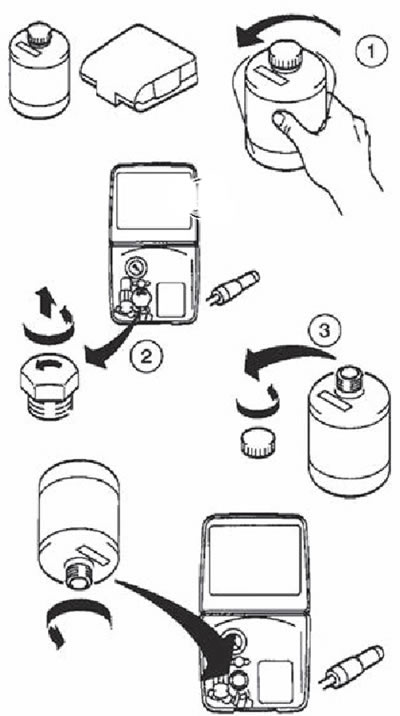
2. Remove the sealant container cap and the orange cap from the air compressor.
3. Screw the container with sealant into the compressor hole (which was covered with an orange lid).
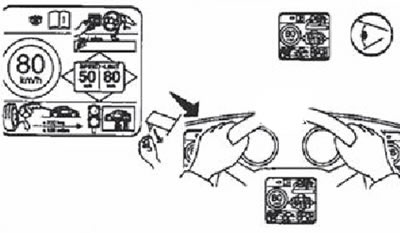
4. Place a speed limit warning sticker in a location visible to the driver.
5. Securely connect the compressor hose to the tire air valve (A).
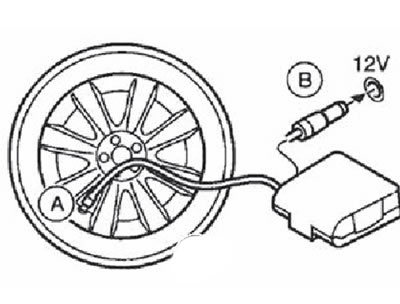
6. Insert the compressor plug into the vehicle's electrical outlet (B).
7. Turn the ignition switch to the "ACC" position.
8. Turn on the compressor and inflate the tire to the pressure indicated on the plate located on the B-pillar on the driver's side.
Caution: Do not allow the compressor to operate for more than 10 minutes.
If you cannot bring the tire pressure up to the specified level within 10 minutes, the tire is too damaged to be repaired with the temporary tire repair kit. Contact your authorized Nissan dealer.
9. Disconnect the compressor hose from the tire valve. Immediately start driving the car at a speed of no more than 80 km/h.
10. After 10 minutes or 5 km, stop and check the air pressure in the tire. If the air pressure in the tire does not decrease, the repair was done well.
If the pressure is lower than the pressure indicated on the plate, repeat the procedure from step 5.
If the air pressure in the tire drops below 130 kPa again, this means that the damage cannot be repaired with a temporary tire repair kit. Contact the service station of an authorized Nissan dealer.
Attention.
- Reuse of the sealant container and compressor hose is not permitted.
- To purchase a new sealant bottle and compressor hose, contact your authorized Nissan dealer.
After tire repair
Contact your authorized Nissan dealer or a qualified tire repair shop as soon as possible to have the damaged wheel professionally repaired or replaced.