


Attention.
- Incorrect jump starting of the engine with an additional battery may cause the battery to explode. A battery explosion can cause serious injury or even death. It may also cause damage to the vehicle. Be sure to follow all instructions below.
- Accumulator batteries emit explosive hydrogen. Therefore, it is prohibited to approach the accumulator battery with an open flame source or sparking objects.
- Always wear protective glasses when working with batteries. Remove rings, bracelets and other metal jewelry.
- Do not lean over the battery when starting the engine with a booster battery.
- Avoid contact of electrolyte with eyes, exposed skin, clothing or vehicle paintwork. Electrolyte is a solution of sulfuric acid, which is highly corrosive and can cause severe burns. If electrolyte comes into contact with skin or vehicle surfaces, immediately rinse these areas with plenty of water.
- Keep batteries out of the reach of children.
- Only batteries with a nominal voltage of 12 V are allowed to be used to start your car's engine. Using a battery with a different voltage will damage the electrical and electronic systems of your car.
- Never attempt to jump start your vehicle with a booster battery if the electrolyte in your vehicle's battery is frozen. This could cause the battery to explode and cause serious injury.
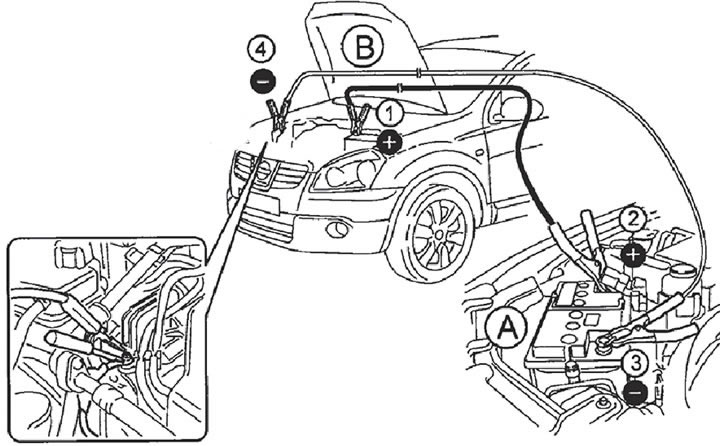
1. Prepare a vehicle with a working battery (A) to start your vehicle's engine (B).
Caution: Avoid direct contact between the bodies of two vehicles.
(The source is published on the portal nissanbook.ru)
If the battery of a vehicle (B) equipped with the Intelligent Key system runs out of power, you will not be able to switch the ignition from the "LOCK" position, and if the steering wheel lock is activated, you will not be able to turn the steering wheel. Connect the cables to another vehicle's battery (A) before turning on the ignition and unlocking the steering wheel.
2. Apply the parking brake.
3. On a vehicle with a manual transmission, engage neutral gear. If the vehicle is equipped with an automatic transmission and a manual transmission, move the selector to position "P" (Park).
4. Turn off all electrical consumers that are not needed at the moment (headlights, hazard warning lights, etc.).
5. Check that the ignition switch on a vehicle with a dead battery is in the "LOCK" position.
6. Open the hood.
7. Remove the ventilation caps from the battery (if available) and cover the battery with a cloth.
8. Connect the extension cable clamps in the sequence 1-2-3-4 (see picture).
Attention.
- Always connect the positive terminal to the positive terminal and the negative terminal to a body ground, such as the lifting eye on the engine, but not directly to the battery.
- Incorrect connection of extension cables may damage the battery charging system.
- Make sure that the connecting cables do not touch any moving parts in the engine compartment.
- When connecting and disconnecting extension leads, be careful not to let the positive lead terminals touch the vehicle body or the negative lead terminals.
9. Start the donor car engine and let it idle for a few minutes. Maintain the engine speed at approximately 2000 rpm.
10. Start your vehicle's engine (B) in the normal manner.
Caution: Do not allow the starter to operate continuously for more than 10 seconds. If the engine does not start immediately, turn off the ignition, wait about 10 seconds and try again.
11. After starting the engine on your car, carefully disconnect the negative cable first, then the positive cable, in the sequence 4-3-2-1 (see picture).
12. Remove and discard the cloth that covered the battery, as the cloth may be contaminated with sulfuric acid.
13. Reinstall the battery vent plugs (if they are provided).
14. Close the hood.