


- Making repeated unsuccessful attempts to start the engine, or leaving the lights on for a long time with the engine not running;
- Malfunction of the charging system (the alternator drive belt is loose or broken, the electrical wiring is damaged, or the alternator itself is faulty);
- Malfunction of the battery itself (the electrolyte level has dropped or the battery's service life has expired).
When performing engine starting from an external power source, attention should be paid to observing some special precautions:
- Do not attempt to start the engine from a frozen battery - warm it up first;
- Starting the engine from an auxiliary power source should only be done when the power unit and catalytic converter are cold;
- Do not use a battery booster charger to jump start the vehicle;
- Before connecting the auxiliary battery, make sure the ignition is off;
- Use only cables with sufficient cross-section and insulated terminals;
- Make sure that all electricity consumers (lighting and heating devices, windshield wipers, etc.) were also turned off;
- Wear protective gloves and glasses;
- Make sure that the auxiliary battery output voltage matches the installed voltage;
- If a battery installed in another vehicle is used as an auxiliary power source, ensure that the vehicles do not touch each other;
- The donor car's engine must be running at idle speed;
- Make sure the transmission is in neutral (manual transmission) or in position "P" (automatic transmission);
- Remove the ventilation caps from the discharged battery and cover the holes with a rag.
Connect the end of one wire (usually red in color) to the positive terminal of the dead battery. Connect the other end of this wire to the positive terminal of the auxiliary battery.
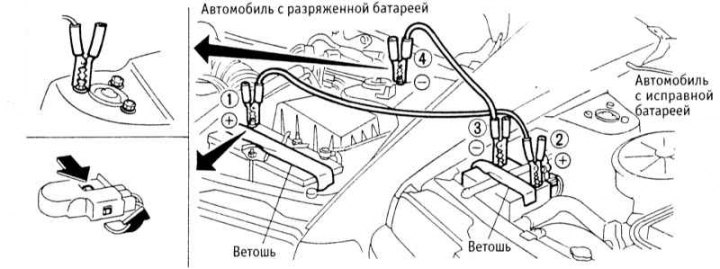
Sequence of connecting wires for starting the engine from an auxiliary power source
One end of the second wire (usually black in color) connect to the negative terminal of the booster battery. Connect the other end of the black wire to a reliable ground point on the block of the engine being started (bolt or bracket), as far away from the battery as possible.
Make sure that the connecting wires do not come into contact with moving components in the engine compartments of both vehicles (fan impeller, drive belts, etc.).
While maintaining the speed of the donor car's crankshaft at 2000 rpm, follow the standard procedure for starting the engine of a car with a low battery, and then allow it to run for a few minutes at increased speeds.
To prevent voltage surges when disconnecting the wiring, turn on the rear window defroster and heater fan, then disconnect the wires in the reverse order of their connection. Do not forget to install the removed vent caps on the battery.