


Table of contents: Passenger cabin ↓ Engine bay ↓
Passenger cabin
Warning. Do not use fuses with a nominal current value that is higher or lower than that indicated on the blown fuse. This may result in failure of the electrical system or a fire. If any component of the electrical equipment fails, check the integrity of the fuses.
The fuse box is located at the bottom, on the left side of the control panel.
The circuits to be protected (2) are shown on the rear side of the fuse box cover (1).
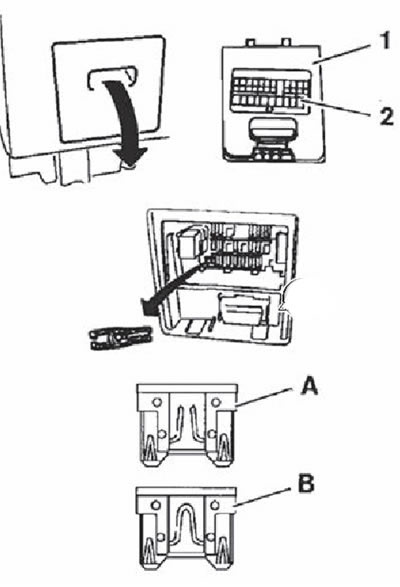
1. Make sure the ignition switch is in the "OFF" position.
[Data posted on the website: Nissanbook.ru]
2. Remove the cover (1) of the fuse box.
3. Find the blown fuse and remove it with special tweezers (if available).
Note: The tweezers are stored in the fuse box.
4. The burnt-out insert (A) should be replaced with a new one (B).
5. Replace the fuse box cover.
Note: If the new fuse also burns out, take your vehicle to an authorized Nissan dealer for inspection and repair of the vehicle's electrical system.
Engine bay
Attention.
- Do not use fuses with a nominal current value that is higher or lower than that indicated on the blown fuse. This may result in failure of the electrical system or a fire.
- If any electrical component fails, check the integrity of the fuses.
1. Make sure that the ignition switch is in the "OFF" position.
2. Open the hood.
3. Unfasten the latches (1) (for some vehicle versions) and remove the air duct (2) (for some vehicle versions).
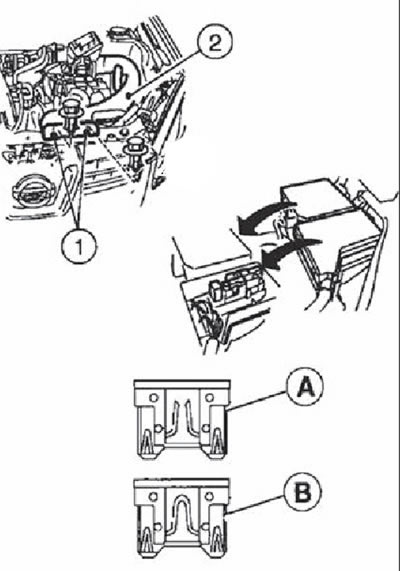
4. Remove the fuse box cover.
5. Locate the blown fuse.
6. Remove the blown fuse using special tweezers (if available).
Note: The tweezers are stored in the passenger compartment fuse box.
7. The blown fuse (A) should be replaced with a new one (B).
8. Replace the fuse box cover.
9. Install the air duct and latches (where are there) in reverse order.
10. Close the hood.
Note: If the new fuse also blows, contact an authorized Nissan dealer to have the vehicle's electrical system checked and repaired.