


Table of contents: Spare wheel ↓ Replacing a damaged wheel ↓
Spare wheel
Small spare tire (for some vehicle versions)

Marking of a small spare tire intended for temporary use only
The compact spare tire is equipped with a tire that is smaller than the normal full-size tires. It is intended for emergency use only. The compact spare tire may only be used for a short period of time. Its use for long-distance travel is prohibited. If you need to install a compact spare tire on your vehicle, follow the instructions and restrictions below. Failure to follow these instructions may result in an accident or damage to your vehicle.
Warning: Driving your vehicle for long periods with a small spare tire installed may cause it to break, which may result in loss of control over the vehicle and serious traffic accidents with injury or death.
Attention.
- Small spare tires should only be used when absolutely necessary. Replace the small spare tire with a regular tire as soon as possible.
- Drive carefully and do not exceed 80 km/h.
- Avoid driving a small wheel over uneven road surfaces. Also, do not use an automatic car wash.
- Avoid sharp turns and emergency braking.
- Do not overload the vehicle beyond the maximum permissible weight. Observe the load-bearing limitation of the small spare tire. The permissible load on the small spare tire is molded on its sidewall.
- It is prohibited to install anti-skid chains on the small spare tire. Failure to do so may result in damage to the vehicle and loss of the chain.
- It is prohibited to install a small-sized wheel on cars of other models, since it is designed specifically for your car.
- It is prohibited to install more than one small-sized wheel on a vehicle at the same time.
- Towing a trailer is prohibited.
- Like any other spare tire, the small tire should be checked regularly to ensure that the tire pressure is maintained at the recommended level of 3.0 kg/cm² (300 kPa).
Full size spare tire (for some vehicle versions)
The vehicle can use a standard spare tire (the same size as the other wheels).
Replacing a damaged wheel
When replacing a damaged wheel, follow the instructions below.
Stopping a car
Attention.
- Apply the parking brake fully.
- Make sure the gear shift lever is in neutral (vehicles with manual transmission - MT).
- Make sure that the automatic transmission (AT) or continuously variable transmission (CVT) selector lever is in the "P" (Park) position.
- Changing a wheel on a slope, on a snowy or slippery surface is not permitted: it is dangerous.
- Do not change a tire in a situation where there is an oncoming traffic lane in the immediate vicinity. Call a technical assistance vehicle.
1. Taking safety precautions, pull off the road onto the side of the road.
2. Turn on the hazard warning lights.
3. Stop the car on a level horizontal surface.
4. Apply the parking brake.
5. Move the gearshift lever to the "R" ("Reverse") position on vehicles with a manual transmission. On vehicles with an automatic (AT) or continuously variable (CVT) transmission, move the selector lever to the "P" ("Park") position.
6. Stop the engine.
7. Open the hood and install the warning triangle (if available):
- to warn other road users of danger;
- to make your vehicle more visible to roadside assistance crews.
8. For safety reasons, all passengers must exit the vehicle and remain in a safe place at a sufficient distance from the roadway and the vehicle.
Replacing a damaged wheel (for vehicles equipped with a spare wheel)
Attention. To avoid the car moving away spontaneously and possible injury to people, check the reliability of the car wheel chocks.
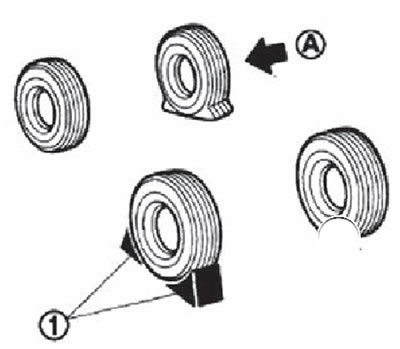
Place wheel chocks (1) at the front and rear under the wheel that is diagonally opposite the damaged wheel (A) to prevent the vehicle from moving while it is being jacked up.
Preparing the spare tire and tools
The spare wheel, jack and necessary tools are located in the luggage compartment.
1. Open the trunk door.
2. Remove both side and middle floor panels (1).
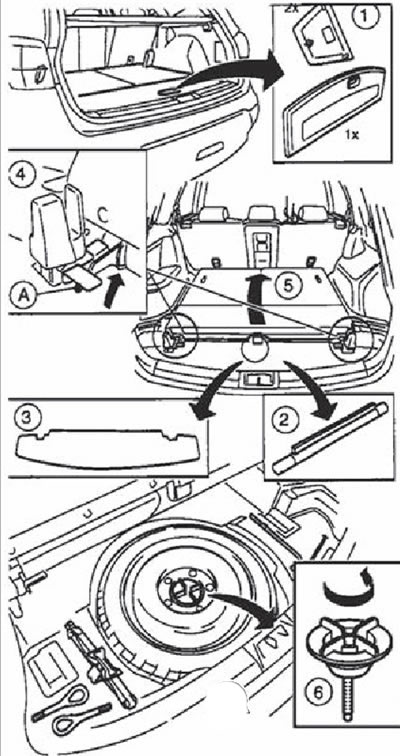
3. Remove the luggage compartment screen (2) (for some vehicle versions) and flooring (3).
4. Lower the head restraints and fold the third row seats.
5. Release the seat from the locks (A) by simultaneously pulling up the levers on both sides (4).
6. Raise the seat (5) and release the levers.
7. Take out the supplied tool kit, jack and spare tire.
Removal the decorative cap (for some vehicle versions)
Attention.
- Never remove decorative caps with your hands, as this may cause serious injury.
- Be careful when removing the decorative cap. The cap may suddenly detach from the wheel and cause injury.
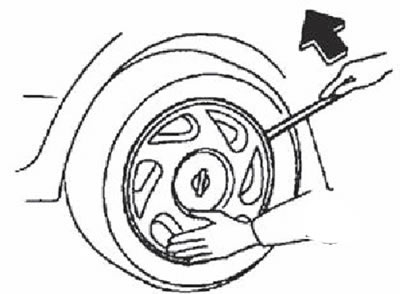
Using a suitable tool, remove the decorative cap as shown in the figure.
Removal a damaged wheel
Attention.
- Before using the jack, read the warning label on the jack body.
- It is prohibited to be under the vehicle if it is supported only by the domsrat. Use additional support stands.
- Do not use jacks intended for other vehicles.
- Use only the jack that came with your vehicle. The jack is designed to lift only your vehicle when changing a damaged tire.
- Do not use your jack to lift other vehicles.
- Install the jack only in the places specially designated for this purpose on the vehicle body. It is prohibited to install the jack in other points of the body or suspension.
- Do not raise the vehicle higher than necessary to change the tire.
- It is prohibited to place wooden blocks, stones, etc. under the jack or its support head.
- Do not start or leave the engine running if the vehicle is raised on a jack: the vehicle may move unexpectedly.
- Do not allow passengers to remain in a vehicle that is raised with a jack.
- Completely clear the vehicle of any luggage or cargo being transported.
- Place wheel chocks under the wheel that is located diagonally relative to the wheel being removed.
Caution: The jack must rest on a flat, hard surface.
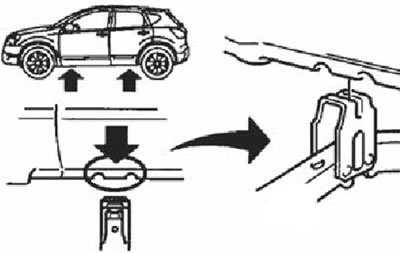
Jack support locations
1. Place the jack under the special support in the body sill, as shown in the figure. The upper head of the jack should be located exactly under the specified support.
2. Align the middle part of the jack head with the protrusion on the support point of the body, as shown in the figure.
3. The edge of the threshold must enter the groove of the jack head, as shown in the figure.
4. Loosen all wheel nuts by turning them counterclockwise one or two turns with a wheel wrench.
Caution: Do not completely loosen the wheel nuts while the wheel is on the road.
Note.
- Wheels equipped with "secret" wheel nuts (for some vehicle versions):
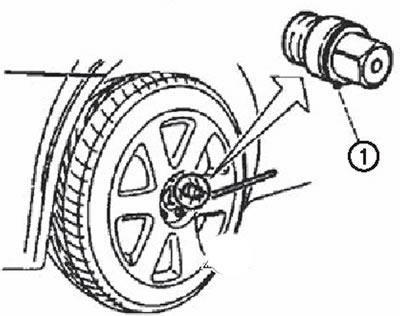
- If the wheel is equipped with "secret" nuts, install a special attachment (1) on the nut and loosen it as described above.
- "Secret" nuts can be unscrewed only with a special head. If you want to order a duplicate of the special head, you will need to tell the dealer its number.
- Write down the code number of the special socket and keep it in a safe place, but not in the car. If you lose the special socket for the "secret" nuts, contact an authorized Nissan dealer, who will make sockets according to its code number.
- Keep a special lug nut socket in your car. Otherwise, it will be impossible to remove the wheels when needed.
(The material is taken from a web resource: Nissanbook.ru)
5. To raise the vehicle, rotate the jack handle clockwise as shown in the figure.
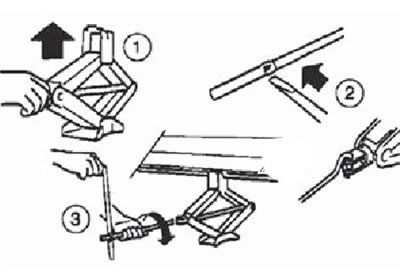
6. Carefully lift the vehicle until the wheels are completely off the road surface.
7. Loosen the wheel nuts and remove the wheel with the damaged tire.
Caution. The wheel is heavy. Be careful not to drop the wheel on your feet, use work gloves to avoid injury to your hands.
Wheel installation
Attention.
- The small wheel is intended only for temporary use when replacing a damaged wheel.
- Do not use wheel nuts that are not designed for your vehicle. Using the wrong wheel nuts or loosely tightened nuts may cause the lug nuts to come loose and the wheel to come off while driving. This may cause an accident.
- Do not lubricate the threads of wheel nuts or studs as this may cause the wheel nuts to become loose.
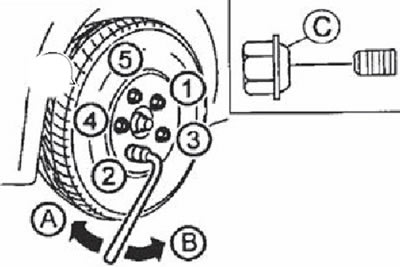
A. Tightening. B. Unthreading. C. Conical surface.
1. Clean the mating surfaces of the wheel and hub from dirt.
2. Carefully install the wheel and tighten the wheel nuts by hand. Make sure that the wheel nuts are not tilted.
Note: Wheels equipped with "secret" wheel nuts (for some vehicle versions): Place the special attachment on the nuts one by one and tighten the wheel nuts by hand.
3. Using a wheel wrench, tighten the wheel nuts evenly and alternately in the order shown in the figure (1-5).
4. Slowly lower the vehicle until the wheel touches the road surface.
5. Then use the wheel wrench to finally tighten the wheel nuts in the sequence shown in the figure.
6. Lower the vehicle completely.
7. Install the decorative cap in place (for some vehicle versions). To install the decorative cap correctly, first align the "Nissan" logo (on the central cover) with holes for nuts, that is, perpendicular to the hole for the nipple.
Note.
- At the earliest opportunity, tighten the wheel nuts to the required torque using a torque wrench.
- The tightening torque of wheel nuts is 113 Nm (12 kgf·m).
Attention. Tightening of wheel nuts should be carried out after the vehicle has run 1(00) km (as well as after replacing a faulty wheel and in other similar cases).
Wheel nuts should always be tightened to the specified torque. It is recommended to check the tightening torque and tighten the wheel nuts if necessary at each oil change. Inflate the spare tire to the recommended cold tire pressure. Tires are considered cold when the vehicle has been stationary for at least three hours or has been driven no more than 1.6 km after a long period of parking. The recommended cold tire pressure is given on a plate attached to the B-pillar in the driver's door opening.
Storing the removed wheel and tool
Caution: Make sure that after changing a wheel, the removed wheel, jack and tools are properly stored and securely fastened. In the event of a traffic accident or sudden braking of the vehicle, the items may pose a danger to people inside the vehicle if they are not properly fastened.
1. Place the tools in their designated places.
2. Replace the third row seats until the seat latches are securely locked on both sides.
3. Set the third row seat backrest to the upright position (1).
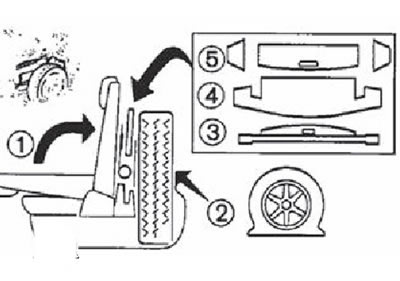
4. Place the wheel with the damaged tire in the trunk (2).
5. Place the remaining items in the order shown: luggage compartment screen (3) - floor mat (4) - middle and side floor panels (5).
"Secret" wheel nuts (for some vehicle versions)
Unscrewing "secret" wheel nuts
1. Insert the special key head (1) into the "secret" nut.
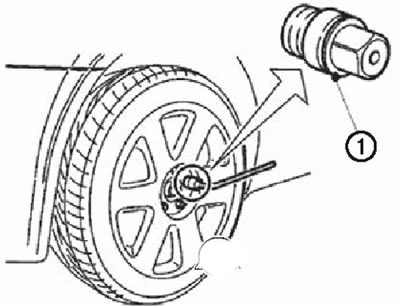
2. To loosen the "secret" nut, turn the wheel wrench counterclockwise.
Attention.
- Do not use mechanically powered impact wrenches to loosen or tighten "secret" wheel nuts.
- When installing the wheel, tighten the "secret" wheel nut to the same torque as the regular wheel nuts.
Note.
- Each special lug nut head has an individual code. The "secret" wheel nuts of your car cannot be unscrewed using a head with a different code. If you lose a special lug nut head, contact an authorized Nissan dealer who will make duplicates/from the head using its code number.
- Write down the code number of the special head.
- When you visit an authorized Nissan dealer for maintenance, make sure that the special head for the "secret" wheel nuts is in the car. Otherwise, it will be impossible to remove the wheels and it will be impossible to service the car.