


Table of contents: Distributor maintenance ↓ Removal and installation the…↓ Ignition distributor repair ↓ Gap adjustment ↓ Checking vacuum and centrifugal…↓ Distributor repair ↓
Distributor maintenance
The distributor cap should be cleaned inside and out at regular intervals to remove any carbon deposits, dust or moisture. Also clean the distributor rotor. Use a rag soaked in gasoline to clean; at the same time, check the cover for cracks. Replace the distributor rotor if the contacts are badly worn.
Brass contacts must never be ground or filed. Keep the outer surfaces of high-tension cables clean and dry to ensure proper current flow in the ignition system. Remove all wires from the distributor, clean and inspect the contacts. Wires must not be shortened to correct bad contact ends. Always replace wires.
Removal and installation the ignition distributor
If the distributor is removed from the engine, it must be installed in its original position to maintain ignition timing. For this reason, mark all components and, without turning the engine shafts, insert the distributor so that the catch is installed in its original position.
1. Disconnect the ignition cables from the distributor cap or remove the cap from the distributor by pressing the spring latches.
2. Disconnect the cable from the side of the distributor and disconnect the line from the vacuum device if connected.
3. Turn the crankshaft so that the piston of the 1st cylinder is in the TDC position of the compression stroke (see illustration for injection engine or illustration for carburetor) and mark the position of the distributor runner nose relative to the outer edge of the distributor body as shown in illustrations.
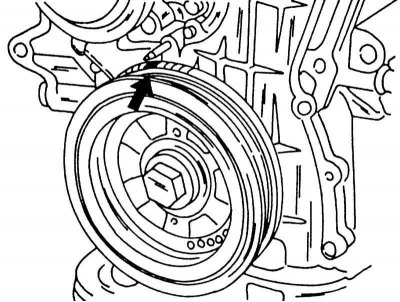
The piston of the 1st cylinder is in the TDC position if the "0" mark coincides with the pointer tip.
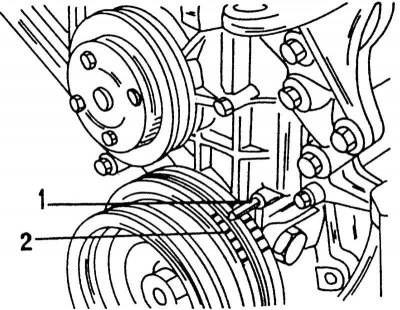
When the piston of the 1st cylinder is in the TDC position, the pointer (1) and the "0" mark on the belt pulley (2) must coincide.
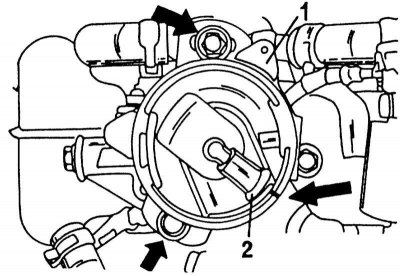
Before removing the distributor (2), draw a line on the housing (arrow) opposite the runner (2).
4. Loosen the distributor bolts and remove the distributor from the engine.
5. If the crankshaft has not been turned or the distributor has not been repaired, install the distributor in its previous position. If the distributor has been disassembled or installed after the engine has been overhauled, the following must be done:
6. Set the piston of the 1st cylinder to the TDC position of the compression stroke, i.e. all valves should be closed (to do this, remove the cylinder head cover).
(Data taken from this portal Nissanbook.ru)
7. Turn the distributor runner so that it is opposite the mark on the edge of the housing, as shown in illustrations.
8. Insert the distributor in this position and screw it in. Connect all the cables and put the vacuum hose on the distributor.
9. Finally, check the ignition timing (Section Adjusting the ignition timing).
Ignition distributor repair
Nowadays, ignition distributor repairs are hardly carried out, so we will not describe the work on injection and carburetor engines with a catalytic converter, where the distributor is part of the electronic system that cannot be interfered with. Only the distributor of an engine without a catalytic converter can be repaired if there are spare parts in the retail network. The distributor has a conventional design.
If the distributor is seriously damaged, it must be replaced.
Gap adjustment
This work is only required on a distributor for an engine without a catalytic converter. For perfect spark generation at a given moment, there must be a gap of 0.3 to 0.5 mm between the four apexes of the distributor ignition sensor rotor and the stationary stator. To measure, remove the distributor cap and rotate the crankshaft until one apex of the rotor is opposite the stator, as shown in the illustration below. Insert a feeler gauge into the existing gap, as shown in the illustration. If necessary, loosen both bolts (arrows) and move the stator outward until the gap corresponds to the required value. Then tighten the bolts again and measure the gap again.
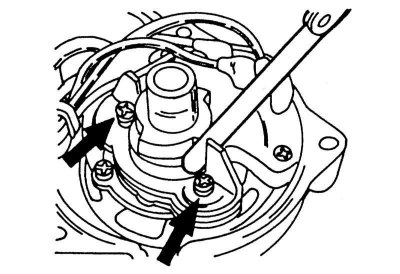
Measuring the gap between the rotor and stator of the ignition sensor.
Checking vacuum and centrifugal adjustments
These works are also required only on cars without a catalytic converter. Vacuum adjustment can only be accurately measured using electronic devices. However, the functionality of the vacuum device can be checked as follows if a stroboscope is available:
1. Find the notch in the crankshaft pulley and mark it with paint. To do this, unscrew the screwed plates to get to the belt pulley.
2. Connect the stroboscope according to its instructions and start the engine. Leave the engine idling.
3. Increase the engine speed by directing the strobe light beam at the crankshaft pulley. The notch will begin to shift, which is initially caused by the centrifugal governor mechanism.
4. Have an assistant disconnect the hose from the distributor while watching the mark on the belt pulley. If the hose is disconnected and reconnected, the mark on the belt pulley should move back and forth in the strobe beam.
5. If this is the case and the movement occurs without jerks, it can be assumed that the vacuum adjustment is working properly.
6. Otherwise, the vacuum device may be damaged. Also, the vacuum hose may have leaks. To check the centrifugal mechanism, first remove the distributor cap and grasp the runner as shown in the illustration below. Turn the runner to the left and release it again. The runner should immediately return to its original position.
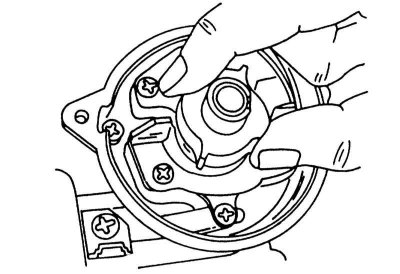
Checking the distributor centrifugal weights.
7. Start the engine and point the strobe light at the pulley again. At different RPMs, the mark should move in the strobe light beam, which indicates that the adjustment mechanism is working, but this test does not show whether the adjustment is correct at different RPMs. This can only be accurately measured with a special device.
Distributor repair
Repair of the ignition distributor of a transistor or electronic ignition system is not currently carried out, therefore descriptions of these works are not provided. In case of serious damage, the distributor must be replaced.