


Table of contents: Disassembly ↓ Checking the brushes and brush holder ↓ Checking the anchor ↓ Stator check ↓ Checking diodes ↓ Assembly ↓
The alternator and the regulator connected to it should not be adjusted or repaired unless you have the necessary experience. An alternator that does not charge the battery can be exchanged for a new one, while handing in the old one. Minor repairs, such as replacing brushes, can be done in a workshop. The alternator bearings have long-term lubrication and do not require maintenance. Keep the alternator surface clean and do not allow water or other solvents to come into contact with it. The alternator brushes slide on smooth slip rings and therefore have a very long service life. To check the brushes, you must remove the alternator. If you understand alternators, disassembly is described below.
Disassembly
Perform the following work, using the illustration below as a guide. The illustration shows a Bosch generator, which is installed on cars with a 2.0 liter engine. A Magnetti-Marelli generator is installed on a carburetor engine. The main difference is the absence of a mounting plate, since the bearing is pressed directly into the bearing shield. This should be taken into account in the following description.
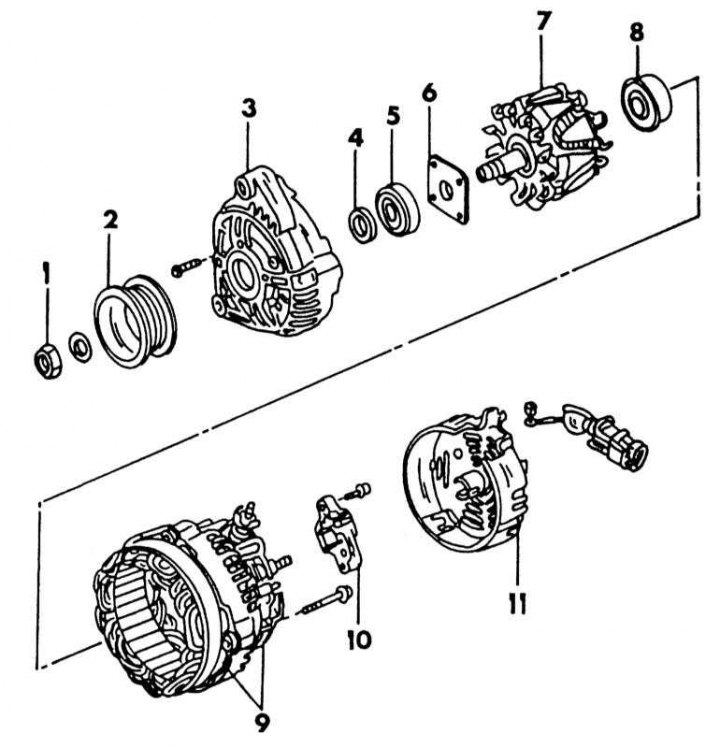
Bosch Generator Wiring Diagram
1 - nut, 45-55 Nm; 2 - belt pulley; 3 - drive bearing shield; 4 - spacer washer; 5 - ball bearing; 6 - mounting plate; 7 - anchor; 8 - contact ring bearing; 9 - stator, regulator and diodes; 10 - brush holder; 11 - back cover
1. Unscrew the nut from the armature shaft and remove the belt pulley from the shaft, as well as the fan and spacer washer (if any). When loosening the shaft, you can hold it with an old V-belt placed on the belt pulley and clamped in a vice. To remove the belt pulley, you can use a two- or three-jaw puller. It should be remembered that the belt pulley is determined for this engine.
2. Remove the woodruff key from the shaft.
3. Unscrew and remove the regulator together with the brush holder.
4. Mark the drive bearing shield and housing in opposite places and unscrew both clamping bolts from the housing. Separate the rear bearing cover from the front. To do this, you can lightly tap the front cover with a polymer hammer.
5. Place the bearing shield and anchor under a press and remove the anchor with a three-jaw puller. When pressing out, the mounting plate bolts may break off. Therefore, be sure to place the three jaws of the puller under the mounting support plate, and not just under the bearing shield. If you need to remove the bearing from the shield, loosen the bolts on the inside and press out the bearing.
6. Press the bearing away from the end of the armature slip rings. If using a puller, it should be positioned under the inner race of the bearing.
7. Unsolder the diode board from the stator. To do this, take the wires in the soldering places between the stator and the soldering iron with pliers, which will serve to remove heat. The diodes should not overheat.
8. Rectifier diodes should be removed if appropriate tools and experience are available.
9. If you have experience, check the parts as follows.
Checking the brushes and brush holder
1. Check the reliability of the contact of the brushes with the slip rings.
2. Check the mobility of the brushes in the brush holders; if necessary, clean the brush holders with Tri.
3. If the protruding part of the brush is worn down to the boundary line, new brushes must be soldered in. On a Bosch generator, the protruding length should be 10 mm; on the Magnetti-Marelli generator 5 mm. Use a ruler to measure.
Checking the anchor
If the contact rings are dirty or greasy, they should be wiped with a cloth soaked in Tri. Any grooves that may be present can be polished with very fine sandpaper.
1. To check the insulation, apply the ohmmeter probes to the armature core and slip rings. If the reading is not infinity, the armature must be replaced. Apply the probes to the armature as shown in the illustration below.
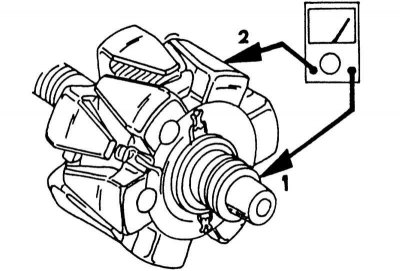
Connection method when checking the armature winding for short circuit to ground. Apply one ohmmeter probe (1) to the contact ring, the other probe (2) to the iron core. Check the other contact ring in the same way.
2. To check the armature winding for current flow, apply both probes to the contact rings. The device should show some resistance. If the ohmmeter shows infinity, then there is a break, if the opposite, then there is a short circuit. The ohmmeter is connected as shown in the illustration below. In case of both faults, the armature should be replaced, but it is better to install a new generator, since the repair will ultimately cost more.
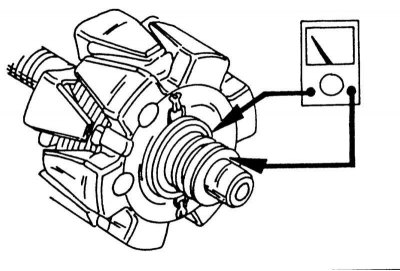
Checking the anchor for current flow. Connect both ohmmeter probes to both contact rings.
Stator check
In case of a short circuit, the cause can be detected by the strong heating of the damaged area. Otherwise, one probe of the ohmmeter should be connected to the stator core, and the other probe to the three stator wires in turn, as shown in the illustration below.
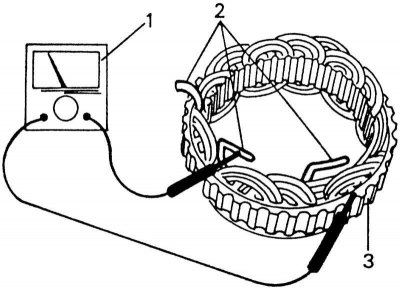
Checking the stator for a short to ground. Apply the ohmmeter (1) in order between the three wires (2) and the stator core (3).
The device should show infinity. To check the stator for current flow, connect the three stator cables to each other in pairs in order. If the device shows nothing, there is no current flow. In this case, apply the probes as shown in the illustration below.
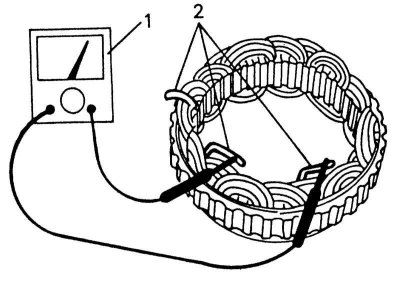
Checking the stator for current flow. Connect the ohmmeter (1) in order to the three cables (2). In this case, each two cables are checked together.
Checking diodes
An accurate check of the diodes for the voltage of transmission and determination of the blocking current is possible only with a special device, and this check should be performed in a workshop. A quick check can be done by connecting an ohmmeter equipped with a current source between each diode and the diode board in order. Watch the readings. They should be either small or large. Change the polarity of the ohmmeter. The formerly small resistances should become large, the high resistances should become small.
Assembly
On illustrations the generator assembly diagram is shown, which should be followed during assembly.
1. Assemble the drive bearing shield. To do this, press the bearing with the micro-notch side towards the rotor. On the Bosch generator, a washer should be installed under it. Apply the mounting plate and secure with bolts (only Bosch).
2. Install the anchor into the bearing shield. Position the shield well and press the anchor in.
3. If you had to unsolder the wires, they should be soldered back in place. Use tweezers to remove heat so that the diodes do not overheat.
4. Check the inside of the stator and move aside any poorly routed wires so that they do not touch the armature.
5. Insert a small wire through the hole in the brush bearing cover to lift the brushes off the rings when the cover is installed. Slide the slip ring bearing shield onto the stator and drive bearing shield, making sure that the brushes are lifted off the rings by the inserted wire (see illustration below). Since the position of the brushes is not clearly visible, you need to be patient for this job. When the slip ring bearing shield is seated, remove the wire. Screw the slip ring bearing shield on.
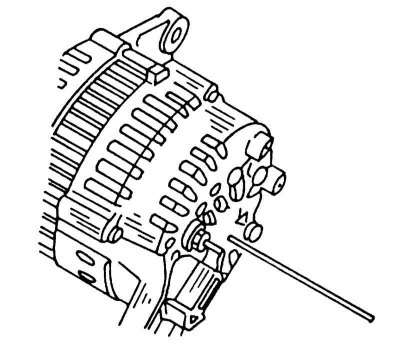
Insert a piece of wire into the generator to lift the brushes before installing the cover.
6. Put on the spacer ring and fan (Magnetti-Marelli) onto the armature shaft and fit the belt pulley. Tighten the nut to 45 - 55 Nm on a Bosch generator or 70 - 90 Nm on a Magnetti-Marelli. To do this, the belt pulley can be clamped in a vice with soft metal jaws.