


Table of contents: Lifting a car with a jack ↓ Installing the vehicle on supports…↓ Towing ↓ Removal a stuck car ↓ Towing a trailer ↓
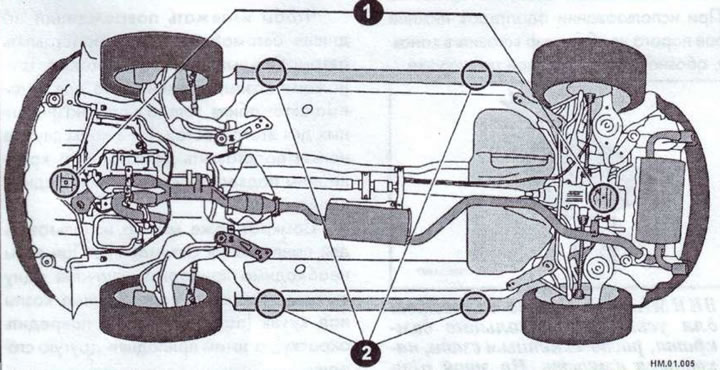
Places for installing the jack and stands: 1 - places for installing a floor jack; 2 - places for installing stands.
Lifting a car with a jack
- It should be taken into account that the jack carried in the car is intended only for lifting the car when changing a wheel. In cases where it is necessary to lift a vehicle to perform work, special stands are installed underneath it to prevent it from falling or slipping.
- To prevent the vehicle from moving on its own when it is being lifted, either with a floor jack or the jack supplied with the vehicle, block the wheel located diagonally from the wheel being lifted.
Caution: If the spare tire is mounted under the vehicle chassis, to avoid unexpected and sudden release of the load on the chassis, remove the spare tire or its carrier from the frame before raising the vehicle.
- When using a car jack, we recommend placing it under the axle, shock absorber, or lifting bracket as close as possible to the wheel being removed.
Caution: When raising the rear axle, do not place the jack under the differential, this may cause the rear cover to leak. Place the jack strictly in the recommended location.
- When raising a vehicle for servicing, always place jack stands underneath it. Never work under a vehicle when it is supported only by a jack!
- To securely fix the vehicle on the stands, it is necessary to use adapters (1), which are installed on the stands (2).
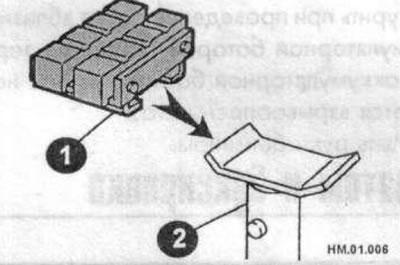
- When using adapters, the lower edge of the threshold must be inserted into the groove indicated by the arrow in the figure.
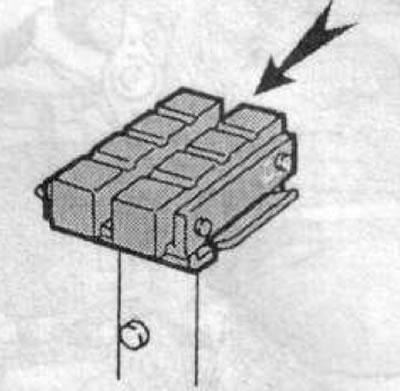
Note: There is a container located directly behind the rear floor jack mounting location. For this reason, lift the vehicle carefully.
- A two-lever lift can be used to lift the vehicle. When lifting the vehicle, extend the lift arms as wide as possible and ensure that the front and rear of the vehicle are well balanced.
- When installing the lift arms, do not allow them to come into contact with brake lines, cables, fuel lines or sill spoilers.
- The lift levers are installed in the same places as the rack jack.
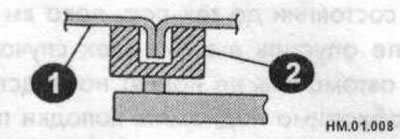
- To prevent deformation of the thresholds, insert the edge of the threshold (1) into the groove on the gasket (2) of the lift arm.
All of the above precautions when working with a car jack can be summarized into certain safety rules that must be followed when lifting a car with a jack. They are like this:
- Always raise the vehicle on a level surface.
- Apply the parking brake and block the rear wheels. This will prevent the car from rolling backwards off the jack. If the rear wheels lift, block the front wheels to keep the vehicle from rolling forward.
- Block the wheel diagonally opposite the one that will be lifted.
- If the vehicle is raised for work underneath, support it on stands. Do not place stands under the metal panels (sheets) on the bottom of the car, so that they (the panels) do not get damaged (sold out).
Caution: Do not work under a vehicle that is supported only by a tire jack.
Installing the vehicle on supports (trestles)
To avoid damage to the underside of the vehicle, place the car jack and tripod stands used to lift the vehicle only in designated areas. Under no circumstances should a jack be placed under the front or rear wheel suspension brackets.
A jack can also be used to lift a car. In this case, it is necessary to first lift one side and place support sawhorses under the body (try not to damage the paintwork), and then lift the other side.
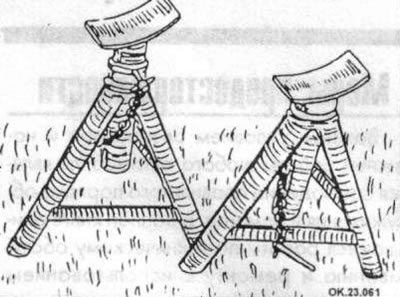
Before raising the rear of the vehicle, engage reverse or first gear. While raising the front of the vehicle, tighten the parking brake lever. For safety, support the rear wheels with wedges or place blocks (bricks) on both sides.
Be sure to ensure that the surface on which the car is placed on the jack stands is not soft, so that the jack or jack stands do not get stuck in the ground. If you place a wide board under the jack (garage jack), this danger will be significantly reduced. The same applies to a car jack. Sometimes the soil appears solid until it becomes apparent that the base of the jack is slowly sinking into the soil.
The jack stands may only be installed under the body in the designated areas, but they must be properly covered to prevent damage to the body. A piece of an old car tire works great for this if you place it between the trestles and the body.
Towing
- Use equipment specifically designed for towing. It must be attached to the vehicle frame members, not to the bumpers or brackets. Safety is the main condition when towing. A safe coupling system must be used at all times.
- Remember that when the engine is off, the power steering and brake systems do not work.
- It is recommended that front wheel drive (2WD) vehicles be towed front-first, with the front wheels off the ground. If it is necessary to tow such vehicles without lifting the front wheels, the towing speed should not exceed 60 km/h and the distance should not exceed 80 km; exceeding these limits may damage the gearbox. The front wheels must be on the towing dolly.
- Always connect safety chains before towing. When towing, make sure the transmission (CVT), steering and drivetrain are in good condition. If any of the listed components are faulty, it is necessary to use a special towing platform.
- Never tow a vehicle with a continuously variable transmission (CVT) from the rear with all four wheels on the ground, as this can cause serious damage to the transmission.
- When towing models with a continuously variable transmission (CVT) with the front wheels on the towing platform, do the following:
♦ Turn the ignition key to the OFF position and secure the steering wheel in the straight-ahead position using a rope or similar object. Never lock the steering wheel by turning the ignition key to the LOCK position, as this may damage the steering column lock mechanism.
♦ Move the CVT selector to position N (neutral gear).
- When towing models with a continuously variable transmission (CVT) and the rear wheels on the ground (if you don't use a tow platform), always release the parking brake.
- The wheels of all-wheel drive vehicles should not touch the road surface at all when being towed. They need to be towed with the front wheels raised and the rear wheels placed on a dolly, or completely loaded onto a platform.
Caution: Never tow 4WD models with a continuously variable transmission (CVT) with any wheel on the ground, as this can cause serious damage to the transmission components
The text was borrowed from here: NissanBook
Removal a stuck car
- Towing chains or cables must only be connected to the main structural elements of the vehicle.
- Towing chains or cables must be routed so that they do not come into contact with suspension, steering, brake or cooling system components.
- The tow rope must be positioned at a right angle to the front or rear of the stuck vehicle. Do not attempt to pull the vehicle out at an angle.
- When pulling out a stuck vehicle, it is not recommended to use ropes or canvas slings.
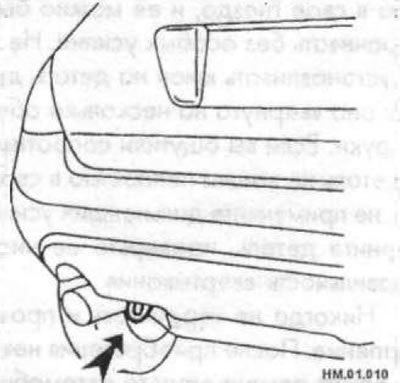
- The towing rope must only be connected to the towing eyes, otherwise damage to the body parts may occur. The location of the rear towing eye is shown in the figure by an arrow.
- The front towing eye is located in the tool kit in the trunk. To tow, you must tighten the towing eye securely yourself. The socket and cover for the towing eye is located on the right side of the front bumper.
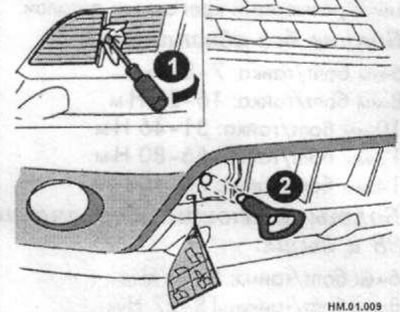
- Open the protective cover from below using a screwdriver (1). Turn the screwdriver counterclockwise as shown in the figure (arrow).
- Securely tighten the towing eye (2). Use a wheel lug wrench.
- After use, unscrew the towing eye and replace the cover.
- The towing eye is only used to pull out a vehicle stuck in sand, snow, mud, etc. Never tow a vehicle long distances using only the towing eye.
- When pulling out a stuck vehicle, the towing eye is subjected to very strong loads.
- When pulling out a stuck vehicle, do not stand next to it.
Towing a trailer
General recommendations
The weight of the trailer is the main parameter to consider when determining whether a vehicle is capable of towing it. It is necessary to calculate the power to weight ratio. To do this, you need to multiply the standard value of 30 kg/hp by the engine horsepower and subtract from it the total weight of the car with passengers and luggage. The result will be the ideal trailer weight that the vehicle can tow.
The general rule for calculating the towing load is that it should not exceed 10% of the total trailer weight.
When towing a trailer, remember that the engine and transmission are under increased load and make sure they do not overheat.
Necessary equipment
When installing a trailer towing device (towbar), remember that the load on the towing device should not exceed 10% of the maximum weight of the trailer. When installing the device, it is necessary to strictly follow the manufacturer's instructions, in particular regarding tightening torques for threaded connections and the use of reinforced bolts and nuts.
Wiring
All trailers must be equipped with brake lights, turn signals, side marker lights, turn signal repeaters, and sometimes reversing lights. For this purpose, there are wiring kits available for sale. Depending on the trailer's interior equipment and the electrical consumers inside it, a wiring kit is selected containing the necessary wires and a socket through which the trailer is connected to the vehicle's on-board network. When installing wiring, you must strictly follow the manufacturer's instructions.