Table of contents: Attention ↓ Installation of the coupling device ↓
Your vehicle is designed to transport primarily people and luggage.
It should be remembered that towing a trailer places additional load on the engine, power transmission, steering mechanism, brakes and other devices. During movement, towing a trailer aggravates the effect of such unfavorable factors as swaying by a crosswind, uneven roads and passing oncoming trucks. In this case, it is necessary to change the driving style and speed accordingly.
It is necessary to select suitable towing devices for the vehicle and trailer (clutch, spare chain, roof rack, etc.). For questions about trailer towing equipment availability and more information about trailer towing, please contact your Nissan dealer.
Please contact your Nissan dealer for a special set of tools for towing devices. If you need to tow the trailer on steep slopes and over long distances, we recommend that you consult your Nissan dealer.
Attention
- When towing a trailer, to avoid engine overheating, it is necessary to monitor the coolant temperature readings.
- The maximum permissible load must not be exceeded (trailer weight plus cargo weight), installed for the towing hitch.
- For more information, contact your Nissan dealer.
- Before starting to move, make sure that the trailer lights are in good working order.
- Observe the speed limits for driving with a trailer.
- Avoid sudden jerks, acceleration and braking.
- Avoid sharp turns and lane departures.
- Maintain a moderate speed.
- When parking, be sure to block the wheels of both the car and the scope.
- . Engage the trailer parking brake, if equipped.
- Parking on steep slopes is not recommended.
- Follow the trailer manufacturer's instructions.
- Make sure the tire pressure is correct for the maximum load indicated on the tire label.
- When loading a trailer, the heaviest objects should be placed above the drive axle.
The maximum permissible vertical load on the drawbar coupling must not be exceeded.
When towing a trailer, observe speed limits: no more than 80 km/h.
Installation of the coupling device
Nissan recommends installing a towbar under the following conditions:
- a) Maximum permissible vertical load on the drawbar: 736 N (75 kg).
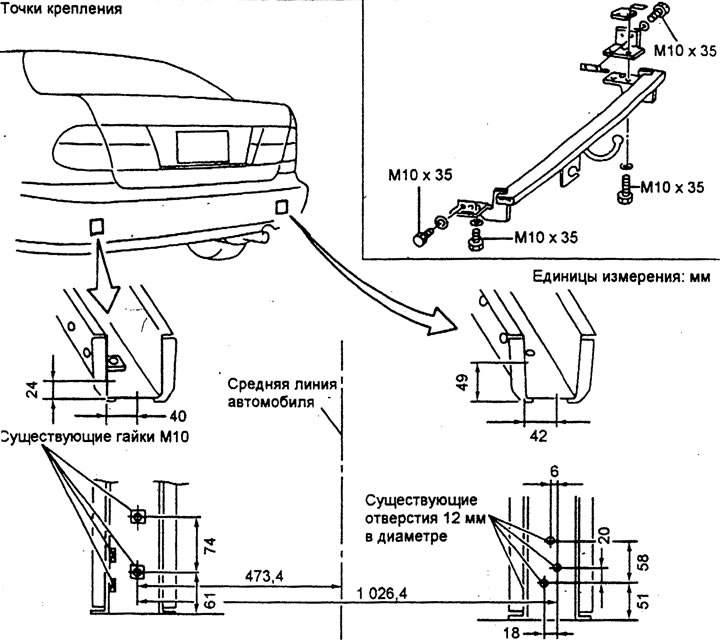
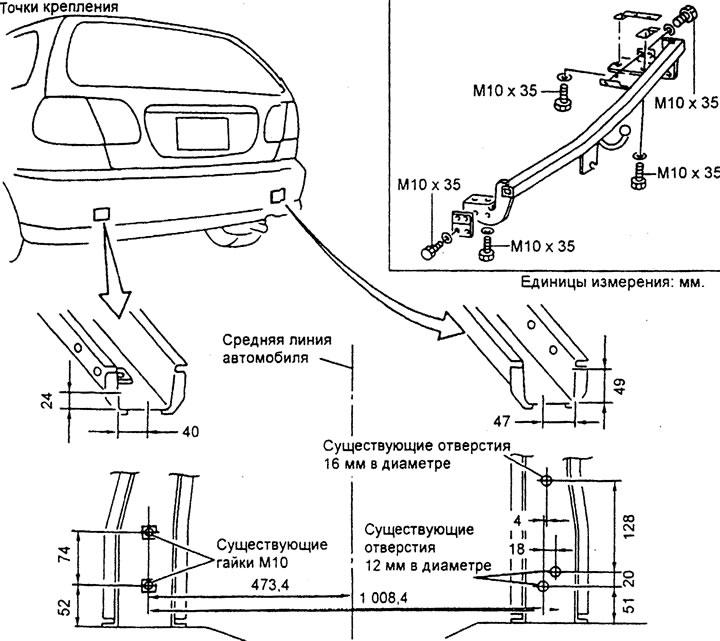
- b) The attachment points of the towing hitch must be in the places indicated in the figure.
The following figures show examples of fastening the towing hitch and the parts required for this (bolts, nuts, washers, etc.).
It is necessary to follow all the instructions of the towing hitch manufacturer regarding its installation and operation.
Installation example:
- Remove the rear bumper.
- Remove the rear left tow hook.
- Remove the muffler support (for hatchback models).
- Install the towing hitch.
- Hang the muffler on the support (for hatchback models).
- Position the rear bumper so that it covers the hitch mountings.
For more information, see the website: NISSANBOOK.RU
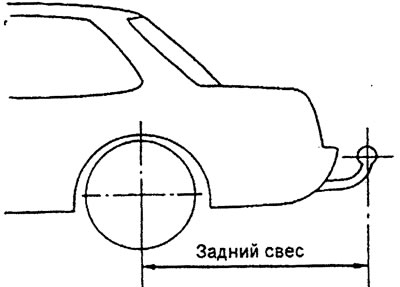
The rear overhang of the coupling device must be:
- no more than 1020 mm for sedan type models
- no more than 855 mm for hatchback models