


Table of contents: Tire pressure ↓ Types of tires ↓ Anti-skid chains ↓ Wheel rotation ↓ Tire wear and damage ↓ Tire aging ↓ Replacement of tires and wheels ↓ Wheel balancing ↓ Spare tire ↓
In case of a flat tire, please refer to the article "Flat tire".
Tire pressure
Check your tire pressure periodically (including spare tire). Incorrect pressure reduces the life of the tire and impairs vehicle control. Pressure should be checked when the tires are COLD. Tires are considered COLD after three hours of parking or when the vehicle has been driven no more than 1.6 km. The normal cold tire pressure is indicated on the tire reminder attached to the center console on the driver's side.
Insufficient pressure leads to overheating of the tires and, as a result, damage to the inner surface. At high speeds, this can cause the tread to peel off and even a tire rupture.
Types of tires
CAUTION! When replacing or rotating tires, be sure to ensure that all four tires installed on the vehicle are identical in type and design (summer, all-season or winter). Information on tire types, sizes, maximum speed ratings and availability is available from your Nissan dealer. Please note that new tires may have a lower speed rating than the original factory tires and may not match the vehicle's maximum operating speed. Do not exceed the maximum speed rating specified for the tires.
All-season tires
On some models of cars, Nissan installs all-season tires suitable for all seasonal conditions, including snow and ice. All-season tires have markings on the sidewall "ALL SEASON" and/or "M&S". In areas with long-term snow cover, it is recommended to install winter tires, which have greater grip on snow,
Summer tires
On some models of cars, Nissan installs summer tires, which are most suitable for driving on dry roads. On snowy and icy roads, the performance of summer tires is significantly reduced. On summer tires, the grip rating is marked "M&S" is missing.
When driving on snowy or icy roads, Nissan recommends using winter or all-season tires on all four wheels.
Winter tires
When replacing tires with winter ones, it is necessary to ensure that they are equivalent in size and load rating to the tires originally installed. Otherwise, the vehicle's handling and traffic safety may deteriorate.
Winter tires typically have a lower maximum speed rating than the original factory tires and therefore do not match the vehicle's maximum operating speed. The maximum speed rating specified for the tire should not be exceeded.
To improve traction on icy roads, you can use studded tires. It is important to know that in some areas and countries, the use of studded tires is prohibited. Studded winter tires generally have worse traction on wet or dry surfaces than regular winter tires.
Anti-skid chains
Please note that in some areas the use of anti-skid chains is prohibited. Chains must be sized to match the tires and installed according to the chain manufacturer's instructions. Always use chain tensioners if recommended by the manufacturer. To avoid damage to the fenders or chassis, securely fasten the ends of the chains.
In addition, you should drive at reduced speed, since at high speed the controllability and dynamic characteristics of the car with chains are significantly worse, and the risk of damaging the car increases.
Anti-skid chains must be installed on the front wheels. Chains must not be installed on the rear wheels.
Do not drive with chains installed on your wheels on asphalt roads that are not covered with snow. Otherwise, the resulting mechanical stress may cause damage to various vehicle devices.
Wheel rotation
Nissan recommends rotating your tires every 10,000 km.
The procedure for rotating wheels is described in the section "Flat tire".
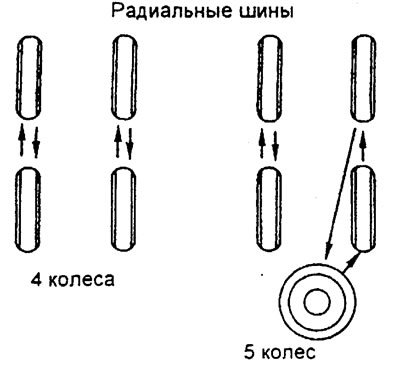
ATTENTION!
- After rotating the wheels, it is necessary to adjust the air pressure in the tires.
- For aluminum wheels, after the first 1000 km of operation, the wheel nuts should be tightened (this procedure is described in the section "Flat tire").
- Incorrect selection and installation of tires and inadequate care and maintenance may affect driving safety and increase the risk of an accident. For any questions, please contact your Nissan dealer or a tire specialist.
Tire wear and damage
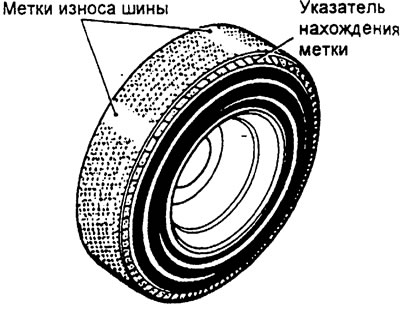
Tires should be inspected periodically for wear, cracks, bulges, and objects lodged in the tread. If excessive wear, cracks, bulges, or deep cuts are detected, the tire should be replaced immediately.
Originally installed tires have a wear indicator. When the tread wears down to the indicator strip, replace the tire.
Tire aging
It is important to remember the aging process of tires. You should not use tires that are more than six years old, regardless of whether they have been used or not.
Tires age with both time and use. Therefore, it is necessary to have them inspected and balanced regularly by a tire specialist. It is recommended to record in the operating log all incidents in which the tires were subjected to impact, even minor ones.
Replacement of tires and wheels
When replacing a tire with a new one, you should use a tire of the same size, speed index and load capacity as the one originally installed. Recommended types and sizes are listed in the section "Wheels and tires". Using tires other than those recommended, or using a mixed set of tires of different brands, designs (radial or diagonal) or tread patterns will adversely affect the vehicle's dynamic performance, braking distance, vehicle handling, ground clearance, fender-tire clearance, chain tire clearance, speedometer calibration, headlight direction, and bumper lift. Any of these factors increases the risk of a traffic accident.
Replacement of factory wheels is allowed only with wheels having the same offset. Using wheels with different offset will lead to accelerated wear of tires and will negatively affect the controllability of the car and the operation of brake discs and drums. Abnormal operation of discs and drums leads to an increase in the braking distance and accelerated wear of brake pads.
CAUTION! Do not install deformed wheels and tires, even after they have been repaired. Such wheels and tires may have internal material damage and may fail at any time.
When installing winter tires, make sure that they are the same size, brand, design and tread pattern on all four wheels.
Wheel balancing
Unbalanced wheels impair vehicle control and reduce the service life of tires. Wheels experience imbalance even during normal vehicle operation. Therefore, they should be balanced as needed.
Wheel balancing should be done with the wheels removed. Balancing the front wheels while they are rotating directly on the car can damage the transmission.
Spare tire
The spare wheel and tire that come with your vehicle may be either standard, similar to the ones already installed, or temporary. If the spare tire and tire of the temporary type are included, use them as described below. The temporary spare wheel can be distinguished from the standard one by the color of the rim. If you have any doubts about this, please contact your Nrssan dealer.