


Table of contents: General instructions ↓ Vacuum hoses ↓ Fuel hoses ↓ Metal tubes ↓ Nylon fuel lines ↓ Power steering hoses ↓ PCV system hose (forced crankcase…↓
Caution: Replacement of air conditioner hoses should be entrusted to specialized service centers that have the equipment to safely depressurize the system. Never remove any hoses or parts from the air conditioning system while it is under pressure.
General instructions
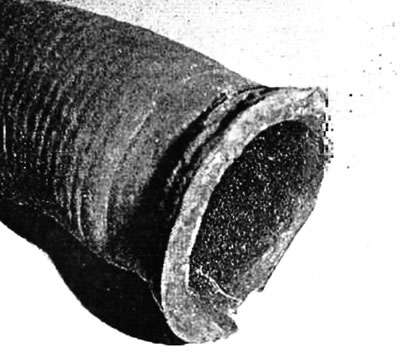
- High temperatures in the engine compartment can cause damage to rubber or plastic hoses in the engine, accessories and exhaust system. Periodic inspection of hoses includes checking for cracks, loose clamps, hardened metal, and leaks.
- Many, but not all, hoses are secured with clamps and collars. Where they are present, it is necessary to check the tightness of their tightening. Where there are none, check to see if the hose has become loose or, conversely, hardened at the attachment point.
Vacuum hoses
- Different systems require hoses with different wall thicknesses, compression resistance and temperature resistance. When replacing, make sure that the hose being replaced is identical.
- It is quite common practice to code vacuum hoses either by color or by having colored stripes welded onto them.
- Often an effective way to check the hoses is to remove them from the vehicle. If you are removing more than one hose, mark the relative positions of the hoses and their mounting locations to avoid mistakes during installation.
- A small piece of vacuum tubing with an internal diameter of 6 mm can be used as a stethoscope to detect vacuum leaks. Apply one end of the hose to your ear and the other to the hose being tested. Be careful not to come into contact with moving engine parts.
- When inspecting vacuum hoses, be sure to include all plastic tee fittings. Check the fittings for cracks, and the hose ends that attach to them for any deformation that could cause leaks.
Fuel hoses
Caution: Take precautions when working with the fuel system - work in a well-ventilated area, do not smoke, do not use open flames, etc. Immediately wipe up any accidentally spilled fuel and do not store fuel-soaked rags where they can catch fire.
- Typically the vehicle's power supply system (fuel pipes) is under pressure, so when disconnecting any fuel line, be prepared to collect any spilled fuel.
Caution: Before servicing the fuel lines, the fuel system pressure must be relieved.
- Relieve fuel system pressure. How to do this is described in the corresponding section of the chapter "Fuel system".
- Check all rubber fuel hoses for damage or abrasions. Check for cracks where the hoses bend and where they connect to the fuel filter.
- When replacing fuel lines, you must use high quality lines.
- Never use unreinforced fuel, vacuum, pure plastic or coolant hoses as fuel lines.
- It is recommended to use screw-type clamps on fuel hoses rather than spring-type clamps, which can weaken over time and come off.
Metal tubes
- Metal tubes are often used in the fuel system. Check carefully that the tubes are not pinched, broken or cracked.
- If you are replacing a section of metal tubing, use seamless steel tubing rather than metal or copper tubing, as they cannot withstand vibration.
- Check the metal brake lines for cracks or loose connections. Any signs of brake fluid leakage indicate the need to check the brake system.
Nylon fuel lines
Nylon fuel lines are used in some areas of the fuel injection system. These tubes require special materials and repair methods.
Power steering hoses
Check the power steering hoses for leaks, loose connections and worn clamps. Tighten loose connections. Worn clamps or leaking hoses need to be replaced.
PCV system hose (forced crankcase ventilation)
On most models, to reduce hydrocarbon (HC) emissions, a portion of the gas entering the engine crankcase is directed through the PCV valve to the intake manifold via a rubber hose. Before entering the combustion chambers, this gas is mixed with the incoming air in the intake manifold.
Check the PCV hose (forced crankcase ventilation) for cracks, leaks and other damage. Disconnect it from the valve cover and from the intake manifold and check the inside of the hose for any obstructions to the gas flow. If the hose is clogged, flush it with solvent.