


Table of contents: Examination ↓ Typical belt faults ↓ Checking the alternator drive belt…↓ Adjustment ↓
Belt tension should be checked every 10,000-12,000 km. Loose belts can cause poor engine cooling and reduced alternator or power steering pump output. An overtightened belt places excessive load on the alternator and power steering pump bearings. Over time and with wear, the belt weakens and begins to slip on the pulleys, creating a whistling noise. The noise is usually heard when accelerating or making sharp turns.
Examination
Inspect all drive belts for cracks, frayed areas, and loose threads.
A shiny belt will slip, while a good belt will have a faint factory texture. Cracks usually start at the inside corner and spread outward. Replace the belt if the belt shows the first signs of cracking or is very shiny.
Caution: If the drive belt is constantly damaged, the crankshaft pulleys or the pulleys of the driven devices will have sharp protrusions. If this is found, replace the pulley.
Typical belt faults
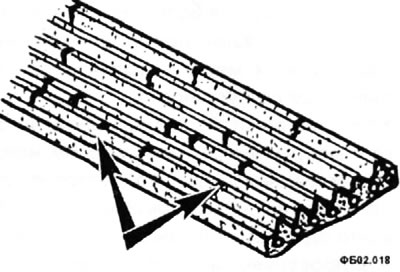
Cracking and erosion
The belt has deep cracks that cause kinks. Excessive bending will result in overheating and premature wear. Cracks (arrows) may be the result of using a belt on the wrong size pulley.
Softening (oiling)
Oil and grease on the belt causes the material to soften and separate from the cord that holds the belt together. The belt first slips, then fails completely.
Shine
The shine is a result of belt slippage. A slipping belt will result in undercharging of the battery, overheating, or poor operation of other systems. The more the belt slips, the more shine will appear on the belt surface. If the shine is not strong, then tighten the belt.
Worn surface
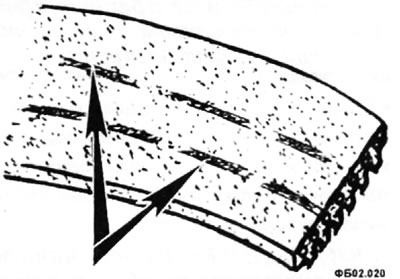
The belt surface is worn and peeling. The belt cord begins to deteriorate, which leads to belt failure. If the belt surface deteriorates quickly or nicks (arrows) appear, check the pulley groove for nicks.
Stratification
The layers of the belt separate and the belt cord breaks. You shouldn't wait until the break is complete.
Checking the alternator drive belt tension
Testing in a garage
To check the drive belt tension, press lightly on the belt approximately halfway between the pulleys with a force of approximately 100 N. Measure the belt deflection with a ruler. At this point, it should deflect by 4.0-11.0 mm, which corresponds to a specific belt tension in Newtons. Belt tension values are shown in the table.
Belt tension
| Belt in use | New belt | |||||
| Limit | After adjustment | |||||
| mm | N | mm | N | mm | N | |
| Generator and air conditioning compressor drive belt | 7,0 | 294 | 4,2-4,6 | 730-818 | 3,7-4,1 | 838-926 |
| Power steering pump drive belt | 11,0 | 196 | 7,3-8,0 | 495-583 | 6,5-7,2 | 603-691 |
Testing in a specialized workshop
- To check the alternator drive belt tension, you need special tools and a diagnostic tester.
- The belt temperature should be as close to the ambient temperature as possible.
- The engine must not be running during the test.
- The presence of strong gusts of wind or loud noise sources in the belt area can significantly distort the measurement results.
- Connect a special tool, which includes a microphone, to the tester.
- Connect the tester to the diagnostic connector.
- Turn on the ignition and select the mode from the tester menu "Belt Tension Measurement" ("Measuring belt tension"),
- Place the microphone in the middle between the pulleys at a distance of 10-20 mm from the back surface of the belt being tested, perpendicular to its surface (deviation no more than + 15°).
- Gently tap your finger in the middle between the pulleys and make sure the belt vibration frequency is within normal limits.
Caution: Do not allow the microphone to come into contact with water or oil. If the microphone touches the belt while measurements are being taken, the measurement results may also be distorted.
- To measure belt tension, you can also use a special device for checking the degree of belt tension.
- If a car owner has such a device or something similar, he can measure the belt tension.
Adjustment
Generator and air conditioning compressor drive belt
Loosen the nut (A) of the tension roller and adjust the belt tension with the bolt (B).
After completing the adjustment, tighten the nut (A) to a torque of 30.4-39.4 N·m and the bolt (B) to a torque of 3.9-6.9 N·m.
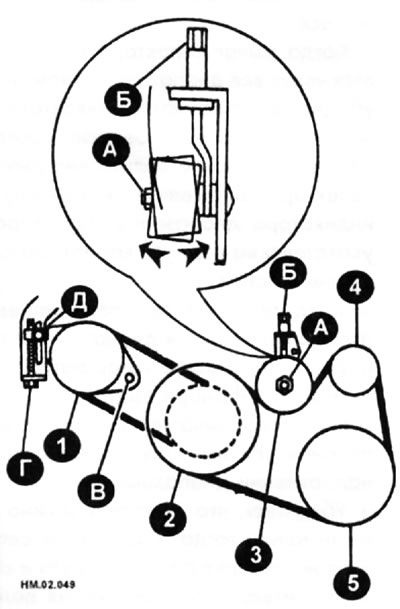
1 — power steering pump pulley; 2 — crankshaft pulley; 3 - tension roller; 4 - generator; 5 — air conditioning compressor.
Power steering pump drive belt
- Loosen the clamping bolt (D).
- Loosen the power steering pump mounting bolt (B) located on the rear of the engine.
- Use the adjusting bolt (G) to adjust the belt tension.
- After adjustment, tighten bolt (D) to a torque of 24.5-31.4 N·m, and bolt (B) to a torque of 36.3-50.0 N·m.