


2. The number of belts installed on the vehicle depends on the engine type and vehicle configuration. Belt drive is provided for the generator, coolant pump, air conditioner compressor and power steering.
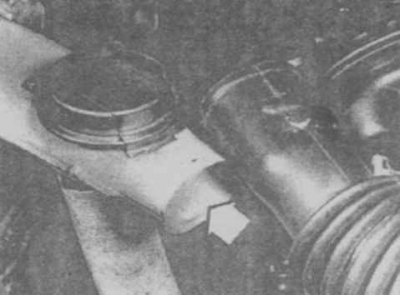
26.4 Air filter nozzle with thermostat
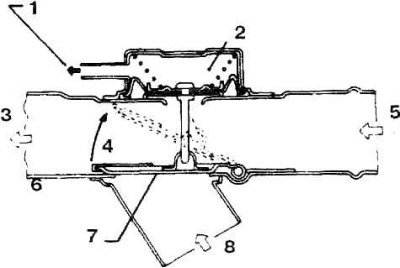
26.5 Thermostat operation diagram
1. To the air temperature sensor; 2. Vacuum drive; 3. Open; 4. Closed; 5. Cold air; 6. To the carburetor; 7. Dividing valve; 8. Hot air from the exhaust manifold
3. The condition of the belts is checked by touch and inspection (shining a flashlight on the belts). Check for peeling of the rubber adhesive pad on both sides of the belt base, tearing of the base at the ends of the belt tape, hardening, damage to the belt surface (cracks, tearing and wear of tracks, see photo). Also check for wear and tear of the belt material, which causes the belt to appear shiny. Twist the belt and inspect both sides.
4. Check the belt tension. With a distance between pulley centers of 170 to 280 mm, the belt deflection should be about 6 mm. If this distance is from 300 to 400 mm, then the deflection should be about 13 mm (photo).
5. Special devices are provided for tension adjustment (photo).
6. To adjust, loosen the unit mounting bolts and move the unit, tightening the belt (or rotate the adjusting bolt). Tighten the fastening bolts and check the tension. If the tension is normal, tighten the fastening bolts (photo). The tension of the toothed belt is adjusted by moving the tensioner roller.
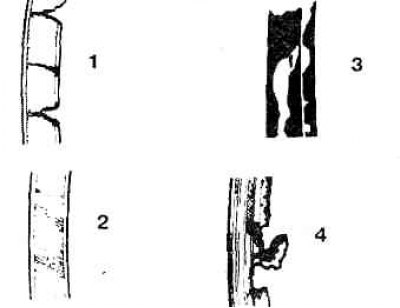
27.3 Some characteristic signs of belt wear.
1. Cracks; 2. Glass transition; 3. Grease penetration; 4. Tear of the belt base
7. It is recommended to change all belts at the same time.