


Table of contents: Air conditioning compressor belt ↓ Power steering pump drive belt ↓ Generator drive belt ↓
The engines of the vehicles in question are equipped with one to three drive belts, depending on the configuration. The belts are designed to drive the following units:
- on cars without power steering or air conditioning, there is one belt (generator and coolant pump drives);
- on cars with power steering there are two belts (one for the generator drive, the other for the power steering pump and coolant pump);
- on cars with power steering and air conditioning, there are three belts (the purpose of two belts is the same as in cars with power steering and one belt to drive the air conditioning compressor).
1. Set the handbrake, lift the front of the car and place it on stands. Remove the right front wheel.
2. Working underneath the front of the vehicle, remove the screws and the plastic shield under the fender to gain access to the crankshaft pulley. You can also remove the engine splash guard by removing the screws to gain more working space.
3. Turn the crankshaft with a socket head placed on the pulley bolt so that the belts can be inspected (or belt) along the entire length. Check the belts for cracks, signs of burning or mechanical damage. Also check the belt for glossy areas and delamination. If damage or signs of wear are found, replace the belt.
4. If the belt condition is satisfactory, then check the belt tension using one of the methods described below (depending on the engine type and configuration).
Air conditioning compressor belt
Removal
1. Working underneath the front of the vehicle, remove the screws and the plastic shield under the fender to gain access to the crankshaft pulley. You can also remove the engine splash guard by removing the screws to gain more working space.
2. Turn the crankshaft with a socket head placed on the pulley bolt so that the belts can be inspected (or belt) along the entire length. Check the belts for cracks, signs of burning or mechanical damage. Also check the belt for glossy areas and delamination. If damage or signs of wear are found, replace the belt.
3. Disconnect the battery from ground.
4. Loosen the nut securing the belt tensioner to the engine.
5. Loosen the adjusting bolt, move the tensioner roller away from the belt until it is completely loosened and remove the belt from the pulleys.
Installation
1. If a new belt is being installed, first make sure that its type exactly matches the type being replaced.
2. Place the belt on the pulleys.
3. Turn the adjusting bolt to tighten the belt.
Tension adjustment
1. Working underneath the front of the vehicle, remove the screws and the plastic shield under the fender to gain access to the crankshaft pulley. You can also remove the engine splash guard by removing the screws to gain more working space.
2. Turn the crankshaft with a socket head placed on the pulley bolt so that the belts can be inspected (or belt) along the entire length. Check the belts for cracks, signs of burning or mechanical damage. Also check the belt for glossy areas and delamination. If damage or signs of wear are found, replace the belt.
3. Proper belt tension will extend its service life. Avoid over-tensioning the belt, otherwise the wear of the generator bearings will increase.
4. Belt tension is checked by the amount of deflection in the middle between two pulleys in the upper part of the belt transmission contour. Under the action of a given force, the belt deflection should be within the normal range.
5. To adjust the tension, loosen the tensioner roller nut and turn the adjusting bolt until the normal tension is achieved. After adjustment, turn the crankshaft two revolutions and check the belt tension again.
6. When finished, tighten the tensioner pulley nut to the specified torque and connect the battery to ground.
7. Install the removed shields, wheel and lower the car.
Power steering pump drive belt
Removal
1. Working underneath the front of the vehicle, remove the screws and the plastic shield under the fender to gain access to the crankshaft pulley. You can also remove the engine splash guard by removing the screws to gain more working space.
2. Turn the crankshaft with a socket head placed on the pulley bolt so that the belts can be inspected (or belt) along the entire length. Check the belts for cracks, signs of burning or mechanical damage. Also check the belt for glossy areas and delamination. If damage or signs of wear are found, replace the belt.
3. Disconnect the battery from ground. On vehicles with air conditioning, remove the air conditioning compressor drive belt.
4. Loosen the nuts (or bolts) of the power steering pump bracket.
5. Loosen the belt by unscrewing the adjusting bolt and remove the belt from the pulleys.
Installation
1. Place the belt on the pulleys. If you are installing a new belt, first make sure that its type exactly matches the type being replaced. Tighten the belt by turning the adjusting bolt.
2. Install and adjust the air conditioning compressor drive belt.
Tension adjustment
1. Working underneath the front of the vehicle, remove the screws and the plastic shield under the fender to gain access to the crankshaft pulley. You can also remove the engine splash guard by removing the screws to gain more working space.
2. Turn the crankshaft with a socket head placed on the pulley bolt so that the belts can be inspected (or belt) along the entire length. Check the belts for cracks, signs of burning or mechanical damage. Also check the belt for glossy areas and delamination. If damage or signs of wear are found, replace the belt.
3. Avoid over-tensioning the belt, otherwise wear on the generator bearings will increase.
4. Belt tension is checked by the amount of deflection in the middle between two pulleys in the upper part of the belt transmission contour. Under the action of a given force, the belt deflection should be within the normal range.
5. To adjust the tension, loosen the upper and lower nuts (or bolts) of the pump bracket, then turn the adjusting bolt until the normal tension is obtained. After adjustment, turn the crankshaft two revolutions and check the belt tension again. Tighten all nuts (and bolts) of the pump mount.
6. Install the removed shields, wheel and lower the car.
Generator drive belt
Removal
1. Working underneath the front of the vehicle, remove the screws and the plastic shield under the fender to gain access to the crankshaft pulley. You can also remove the engine splash guard by removing the screws to gain more working space.
2. Turn the crankshaft with a socket head placed on the pulley bolt so that the belts can be inspected (or belt) along the entire length. Check the belts for cracks, signs of burning or mechanical damage. Also check the belt for glossy areas and delamination. If damage or signs of wear are found, replace the belt.
3. Disconnect the battery from ground. On vehicles with air conditioning, remove the air conditioning compressor drive belt. On vehicles with power steering, remove the power steering pump drive belt.
 |
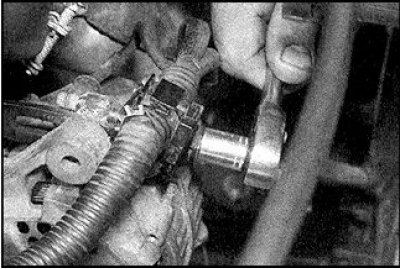 |
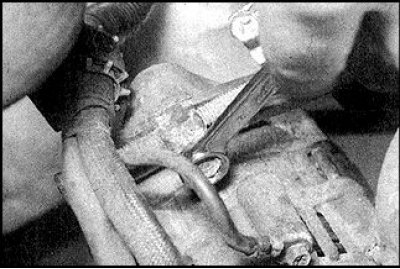
4. Loosen the upper and lower generator mounting nuts (or bolts).
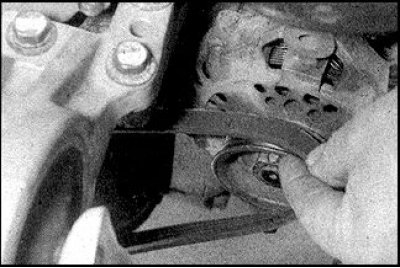
5. By turning the adjusting bolt, loosen the belt, remove the belt from the pulleys.
Installation
1. If a new belt is being installed, first make sure that its type exactly matches the type being replaced.
2. Place the belt on the pulleys.
3. Turn the adjusting bolt to tighten the belt.
4. Install and adjust the air conditioning compressor and power steering drive belts.
Tension adjustment
1. Working underneath the front of the vehicle, remove the screws and the plastic shield under the fender to gain access to the crankshaft pulley. You can also remove the engine splash guard by removing the screws to gain more working space.
2. Turn the crankshaft with a socket head placed on the pulley bolt so that the belts can be inspected (or belt) along the entire length. Check the belts for cracks, signs of burning or mechanical damage. Also check the belt for glossy areas and delamination. If damage or signs of wear are found, replace the belt.
3. Avoid over-tensioning the belt, otherwise wear on the generator bearings will increase.
4. The belt tension is checked by the amount of deflection in the middle between the two pulleys in the upper part of the belt transmission contour. Under the action of a given force, the belt deflection should be within the normal limits (see subsection 2.1).
5. When adjusting the tension, the upper nut (or bolt) of the generator should be slightly tightened, and the lower nut (or bolt) should be loosened. Turn the adjusting bolt to adjust the tension. After adjustment, turn the crankshaft two revolutions and check the belt tension again. Tighten all nuts (and bolts) securing the generator.
6. Install the removed shields, wheel and lower the car.