


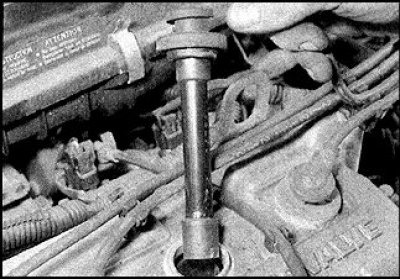
1. If there are no marks on the high-voltage wire tips indicating their belonging to a given cylinder, then apply marks from 1 to 4 (The 1st cylinder is located on the timing chain side). Disconnect wires by holding the tip, not the wire.
2. Before removing the spark plugs, it is recommended to remove dirt from the recesses near the spark plugs using a clean brush, vacuum cleaner or compressed air to avoid dirt getting into the cylinders.
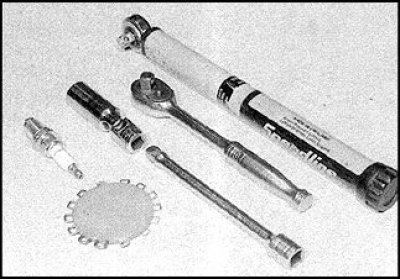
3. Unscrew the spark plugs with a special spark plug wrench, or a socket wrench, or a socket head with an extension. When unscrewing, hold the head strictly in the direction of the spark plug axis, otherwise, if the head is skewed, the porcelain insulator may break. It is recommended to check the spark plugs using the following method.
4. The appearance of the spark plug can be used to determine the condition of the engine quite accurately. If the spark plug insulator skirt is clean and white and there is no coating on it, this indicates a lean fuel mixture or that the spark plug insulator has become hot (a hot spark plug does not conduct heat well from the electrode, while a cold spark plug conducts heat quickly).
5. If the spark plug insulator and electrode are covered with hard black deposits, this indicates an over-rich fuel mixture. Massive oily deposits indicate that the engine is worn out or has been running on an over-rich mixture.
6. If the insulator skirt is covered with a sandy or reddish-brown coating, then the engine is in good condition and the mixture composition is optimal
Data posted on the website nissanbook
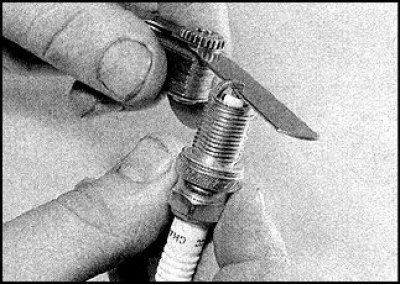
7. The gap between the spark plug electrodes is of particular importance – if the gap is increased or decreased against the norm, the size of the spark gap and the ignition ability of the spark will change significantly. The optimum gap between the electrodes specified in subsection 2.1.
 |
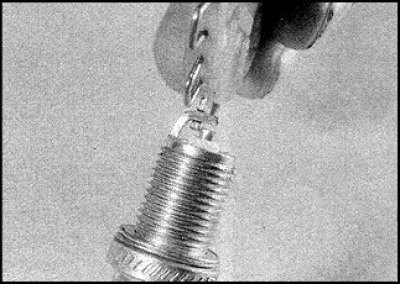 |
8. Before adjusting, measure the gap with a feeler gauge and bend it (or bend it back) outer electrode until the required gap is obtained. It is prohibited to bend the central electrode, as the spark plug insulator may crack, which will lead to serious damage.
9. There is a special device available for sale to measure and adjust the gap.
10. Before installing the spark plugs, make sure that the threaded terminals of the central electrode are secure and that the spark plug threads and insulator are clean, using a piece of rubber hose to screw the spark plugs in without skewing.
11. Remove the rubber hose and tighten the spark plug with a torque wrench with a special socket head. Screw in the remaining spark plugs.
12. Reconnect the high-voltage wires in the same order and install all removed parts.