


Table of contents: Carburetor engines (1.6 l) without…↓ Carburetor engines equipped with a…↓ Fuel Injected Engines ↓
Carburetor engines (1.6 l) without catalytic converter
1. Check the ignition timing (see subsection 7.7.7).
2. Make sure the spark plugs are in good condition and the spark plug gaps are within specification (see subsection 2.2.3 and subsection 7.7.2).
3. Check the throttle cable adjustment (see subsection 6.1.7).
4. Check the tightness of the crankcase ventilation hoses, and that there are no kinks or leaks.
5. Check the cleanliness of the air filter and air ducts.
6. Check the condition of the exhaust system (see subsection 2.3.10).
7. If signs of abnormal engine operation appear, check the compression in the engine cylinders (see subsection 3.1.1.2).
8. Quality of the mixture (cO content in exhaust gases) is installed at the factory and is not adjusted during operation. However, if the composition of the mixture is violated (as a result of general engine wear, or after carburetor repair), then the CO content can be restored, for which a gas analyzer will be needed. If there is no device, the adjustment is performed at a service station.
9. Warm up the engine by driving.
Attention! The mixture should be adjusted within no more than two minutes after driving, without stopping the engine. If this is not possible, or if the cooling system fan does not turn off, wait until the fan stops. Work off the excess fuel in the intake manifold by bringing the engine speed to 2000–3000 rpm 2–3 times, and then return the engine to idle mode.
10. Make sure that all consumers are disconnected. If the car is not equipped with a tachometer, connect the tachometer in accordance with the instructions for this device. Determine and remember the idle speed, compare them with the standard.
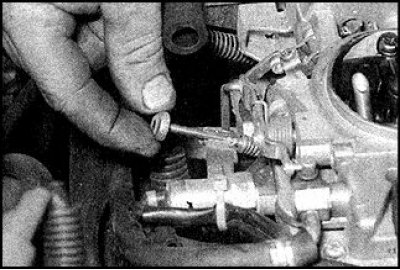
11. The idle speed adjustment screw is located on the rear of the carburetor and is accessible from behind the air filter. Set the desired idle speed by turning the screw in or out.
12. If you have a gas analyzer, measure the CO content in the exhaust gases in accordance with the instructions for the device. If necessary, adjust the mixture composition with the quality screw, which is located directly under the idle speed screw.
13. By turning the quality screw at small angles, achieve the desired CO content in the exhaust gases. When tightening the screw (clockwise rotation) the mixture becomes leaner and the CO level decreases; when the screw is turned away, the mixture becomes richer and the CO level increases.
14. When finished, disconnect the instruments and check the idle speed again, adjusting if necessary.
Carburetor engines equipped with a catalytic converter
1. Adjust the idle speed.
2. Following point 8, check and adjust the mixture composition at idle speed, for which proceed as follows.
3. Stop the engine and turn the ignition key to the "off" position. Disconnect the connector from the exhaust gas sensor (the sensor is screwed into the exhaust manifold) and from the solenoid air valve (mounted on the intake manifold on the left side).
4. Remove the cap from the exhaust gas sampling pipe, which is located on the left side of the exhaust manifold, and connect the gas analyzer to this pipe.
5. Start the engine. Work off the excess fuel in the intake manifold by running the engine at 2000–3000 rpm 2–3 times and then return the engine to idle mode. Make sure the CO content is as specified in subsection 2.1.
6. If necessary, adjust the CO content by removing the restrictor sleeve from the carburetor with a thin tool to gain access to the mixture quality screw, which is located directly below the idle speed screw.
(The original can be read on the website NissanBook.ru)
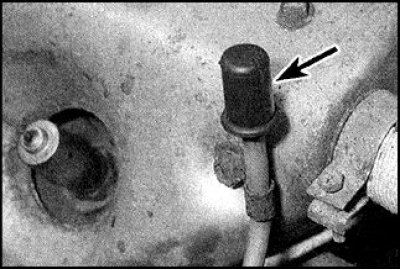
7. By turning the quality screw at small angles, achieve the desired CO content in the exhaust gases. It is measured in the exhaust gas sampling tube (indicated by the arrow). When unscrewing the screw (clockwise rotation) the mixture becomes leaner and the CO level decreases; when the screw is turned, the mixture becomes richer and the CO level increases.
8. When finished, disconnect the device, install a new restrictor sleeve on the quality screw. Install the cap on the gas sampling tube, connect the connectors to the exhaust gas sensor and to the solenoid valve.
9. When finished, disconnect the device and check the idle speed again, adjusting if necessary.
Fuel Injected Engines
1. Stop the engine and turn the ignition key to the "off" position. Disconnect the connector from the throttle angle sensor, which is mounted on the side of the throttle body.
2. Start the engine. Work off any excess fuel in the intake manifold by running the engine at 2000–3000 rpm 2–3 times and then return the engine to idle mode. Make sure the idle speed is as specified in subsection 2.1.
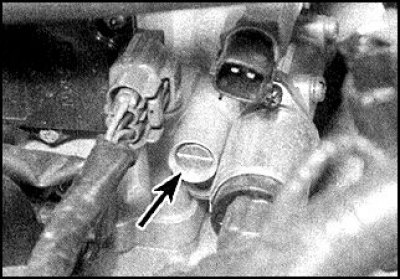
3. If necessary, adjust the idle speed by turning the adjusting screw, which is located on the right side of the throttle chamber (indicated by the arrow). By tightening or loosening the screw, achieve the desired idle speed.
4. After adjustment, stop the engine and connect the connector to the throttle angle sensor.
5. The CO content in exhaust gases can be determined independently, if you have sufficient experience and qualifications, as well as the necessary equipment (including a precise tachometer and a verified gas analyzer)However, if the need for CO adjustment is detected, the probable cause may be a failure of the engine control processor system (ECCS systems). The CO content cannot be adjusted independently.
6. If the CO content is found to be out of compliance with the standard, check the serviceability of the exhaust gas sensor and fuel injection system components using the ECCS self-diagnosis function (see subsection 6.2.11). If a fault is detected during the self-test, the car should be taken to a car service center for testing.