


- S - for gasoline engines,
- C - for diesel engines.
The second letter denotes the quality in alphabetical order. The higher the letter in the alphabet, the better the quality of the oil.
Diesel engine oils are not suitable for spark ignition engines. There are oils that are suitable for both gasoline and diesel engines. In this case, two classifications SF/CD are indicated on the bank (SF - spark ignition engine).
Oils are classified by viscosity according to the Society of Automotive Engineers (SAE) standard: the conventional numerical viscosity index is included in the oil designation. If an oil is all-season, its designation includes the letter W. Based on viscosity, imported and domestic oils are interchangeable, but they cannot be mixed, as they have completely different additive packages. All packaging of imported oils indicates the API and SAE classification.
Attention: When choosing oil, it is necessary to pay attention to the classification according to two standards: the same oil according to SAE with a difference according to API are different oils, which are not recommended to be mixed.
Graph of oil viscosity versus temperature
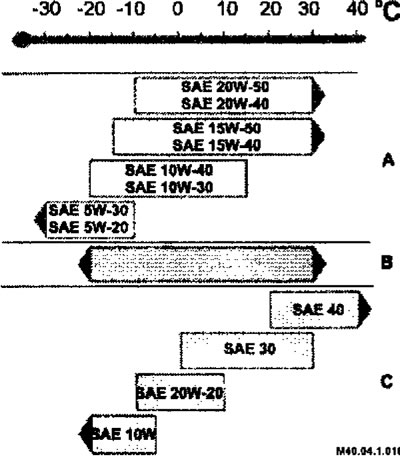
A - all-season oil; B - synthetic oil; C - seasonal oil.
Oils of a higher group have a more complex set of additives, the need for which is determined by the engine parameters and its design features (crankcase ventilation system, cooling system, bearing material, etc.), degree of tightness of the cylinder-piston group (level of technology). Excess additives are harmful: oil with additives is prone to coking, forms sediment, and has increased ash content. If there is no recommended one, it is better to use a higher grade of oil, and if you have to use a lower grade of oil, it will need to be changed more often.
Synthetic oils
The main advantages of synthetic oils:
- Longer service life (at least 20 thousand km of mileage).
- Easier engine starting at low temperatures (lower melting point and high viscosity index).
- High suitability for high-performance engines (form fewer high-temperature deposits, have better thermal stability, and a lower degree of dependence of oil viscosity on temperature changes),
- Lower oil consumption for burning (up to 40%).
- Fuel savings (up to 5%).
The disadvantage of synthetic oils is their higher price (several times), which is compensated by the above-mentioned advantages. The most famous manufacturer of synthetic oils is the company "Caslroi".
(Information copied from the website: «NISSANBOOK.ru»)
Caution: Mixing synthetic and mineral oils is not permitted. It is also not recommended to mix synthetic oils from different manufacturers, even if they have the same markings.
If you decide to use synthetic oils, do so only in accordance with the manufacturer's recommendations.
When operating a vehicle, please note that the recommendations given in the operating instructions apply to a new engine. Over time, the engine's condition deteriorates - gaps in the cylinder-piston group elements and in the engine crankshaft bearings increase. Generally, it is recommended to use a higher viscosity oil in these situations. This helps improve compression in the cylinders, reduces or completely stops smoke emission from the engine exhaust system, and the engine runs quieter.
Naturally, switching to a more viscous oil is individual for each specific engine, and the effect of such a switch can only be determined by the change in engine performance, which can only be assessed by a sufficiently experienced specialist.