

Table of contents: Checking the oil level and condition ↓ Checking for oil leaks ↓ Replacement frequency ↓
Checking the oil level and condition
Check the oil level before starting the engine. Start the engine, let it run for 10 minutes, then turn it off. Check the oil level again.
The oil level should be between the two marks on the dipstick, see figure
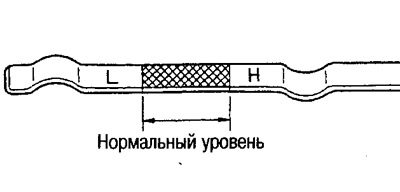
If necessary, top up the oil level to normal.
Check the oil for cloudy white sediment. If excessive contamination occurs, replace the oil.
If there is a cloudy white suspension in the oil, it can be assumed that coolant has entered the oil. In this case, repairs are necessary.
Checking for oil leaks
Check the following areas and surrounding areas for oil leaks:
- Oil pan and oil pan drain plug
- Oil pressure warning light switch
- Oil filter bracket and filter itself
- Front cover (SR) and vacuum pump (YD).
- Cylinder head and rear cover assembly (YD)
- Timing Chain Cover (YD)
- Oil filter housing (YD)
- Contact surfaces of the cylinder block and cylinder head
- Contact surfaces of the cylinder head and valve cover
- Turbocharger (YD)
- Oil radiator (YD)
Replacement frequency
Engine SR20DE
Oil class SE, SF, SG, SH, SJ: every 15,000 km or annually.
Note: It is recommended to use NISSAN 5W-30 oil grade SJ.
Engine YD25DDTi
Oil class CD, CF-4: every 15,000 km or annually.
At the manufacturing plant, the following engine oil is poured:
- Standard equipment: 10W-30 (cF-4 class)
- Cold climate specification: 5W-30 (CD class)
Filling volumes
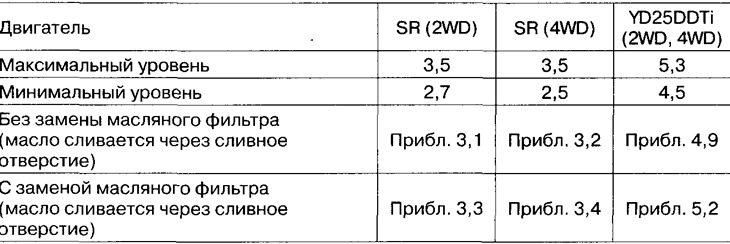
Amount of oil (l)