


Brake system of the car Nissan Serena 2 (C24)
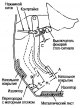
Brake pedal — check on the car
1. Check the height of the brake pedal from the bulkhead with the engine compartment. 2. Adjust the height according to the following dimensions. Height H 1 pedals:...
1. Check the height of the brake pedal from the bulkhead with the engine compartment. 2. Adjust the height according to the following dimensions. Height H 1 pedals:...

Brake Booster — Functional Check
Without starting the engine, depress the brake pedal several times and check that no change in pedal stroke is felt. Step on the brake pedal, then start the engine. If...
Without starting the engine, depress the brake pedal several times and check that no change in pedal stroke is felt. Step on the brake pedal, then start the engine. If...

Check Valve Quick Check
The stop valve is located in the vacuum hose. Check by blowing air into the vacuum hose as shown in the illustration. If air flows only from the booster side, the valve...
The stop valve is located in the vacuum hose. Check by blowing air into the vacuum hose as shown in the illustration. If air flows only from the booster side, the valve...

Reservoir — checking the fluid level
Make sure the fluid level in the reservoir is correct (between MAX and MIN·marks). Visually check for fluid leaks around the reservoir.
Make sure the fluid level in the reservoir is correct (between MAX and MIN·marks). Visually check for fluid leaks around the reservoir.

Brake fluid
Replacement interval Individual vehicle use: initially after 3 years, then every 2 years For commercial vehicle use: every 2 years Draining liquid 1. Connect vinyl...
Replacement interval Individual vehicle use: initially after 3 years, then every 2 years For commercial vehicle use: every 2 years Draining liquid 1. Connect vinyl...

Brake Hoses — Check
1. Check for fluid leakage, damage, kinking, deformation on hoses, tubes, whether they touch other parts, and whether the tightness at the joints is loose. 2. Keeping...
1. Check for fluid leakage, damage, kinking, deformation on hoses, tubes, whether they touch other parts, and whether the tightness at the joints is loose. 2. Keeping...

Brake pads — wear check
Raise the vehicle, remove the wheel and check the thickness of the pad through the inspection hole in the cylinder body. Use a ruler if necessary. Front wheel brake pads...
Raise the vehicle, remove the wheel and check the thickness of the pad through the inspection hole in the cylinder body. Use a ruler if necessary. Front wheel brake pads...

Parking brake
Lever travel By pressing the parking brake lever with a force of 196 N (20 kg), check that the lever stroke is the specified number of clicks (check ratchet clicks by...
Lever travel By pressing the parking brake lever with a force of 196 N (20 kg), check that the lever stroke is the specified number of clicks (check ratchet clicks by...

Brake pedal — removal and installation
Removing 1. Remove the lower section of the dashboard from the driver's side. 2. Remove the steering column covers. 3. Remove the cotter pin and pin from the brake...
Removing 1. Remove the lower section of the dashboard from the driver's side. 2. Remove the steering column covers. 3. Remove the cotter pin and pin from the brake...

Brake booster — removal and installation
Removing 1. Models with YD25DDTi engine: Remove the intercooler and vacuum reservoir. 2. Disconnect the vacuum hose from the brake booster. 3. Remove the master...
Removing 1. Models with YD25DDTi engine: Remove the intercooler and vacuum reservoir. 2. Disconnect the vacuum hose from the brake booster. 3. Remove the master...

Vacuum tubes and hoses
Examination Stop valve leak test Check with a manual vacuum pump. When connected from the amplifier side (1): The vacuum reduction should be in the order of 1.3 kPa (10...
Examination Stop valve leak test Check with a manual vacuum pump. When connected from the amplifier side (1): The vacuum reduction should be in the order of 1.3 kPa (10...

Master brake cylinder — removal and installation
Master cylinder seal replacement intervals: When using the car individually: do not change For commercial vehicle use: every 4 years Removing 1. Drain the brake fluid....
Master cylinder seal replacement intervals: When using the car individually: do not change For commercial vehicle use: every 4 years Removing 1. Drain the brake fluid....

Master brake cylinder — disassembly and assembly
Disassembly Caution: Nabuko Cylinder: Remove the master cylinder reservoir only when necessary. 1. Using a flathead screwdriver, pry the retaining cap tabs outward as...
Disassembly Caution: Nabuko Cylinder: Remove the master cylinder reservoir only when necessary. 1. Using a flathead screwdriver, pry the retaining cap tabs outward as...

Brake pipes and hoses
Replacement intervals (brake hoses): When using the car individually: do not change For commercial vehicle use: every 4 years Attention: Do not bend or twist hoses...
Replacement intervals (brake hoses): When using the car individually: do not change For commercial vehicle use: every 4 years Attention: Do not bend or twist hoses...

Front disc brakes — device
Replacement intervals (caliper piston seal): When using the car individually: do not change For commercial vehicle use: every 2 years
Replacement intervals (caliper piston seal): When using the car individually: do not change For commercial vehicle use: every 2 years

Front disc brake assembly — removal and installation
Type AD31VA Attention: Clean the caliper and brake pads only with a vacuum cleaner. Do not blow with compressed air. When the cylinder body is open, do not press the...
Type AD31VA Attention: Clean the caliper and brake pads only with a vacuum cleaner. Do not blow with compressed air. When the cylinder body is open, do not press the...

Front disc brake assembly — disassembly and assembly
Disassembly 1. Remove the caliper assembly from the vehicle. 2. Turn out bolts of directing fingers from the case of the cylinder, take out from a support in gathering...
Disassembly 1. Remove the caliper assembly from the vehicle. 2. Turn out bolts of directing fingers from the case of the cylinder, take out from a support in gathering...
Front wheel brake pads
Removing Attention: Clean the caliper and brake pads only with a vacuum cleaner. Do not blow with compressed air. There is no need to remove the brake hose mounting...
Removing Attention: Clean the caliper and brake pads only with a vacuum cleaner. Do not blow with compressed air. There is no need to remove the brake hose mounting...


Rear drum brake assembly — removal and installation
Type LT26F Attention: To reduce the health hazard of dust particles from the brake unit, clean the drum and support plate with a vacuum cleaner. Do not blow with...
Type LT26F Attention: To reduce the health hazard of dust particles from the brake unit, clean the drum and support plate with a vacuum cleaner. Do not blow with...

Working cylinder
Replacement intervals (cuff and anther of the working cylinder): For a car in individual use: do not change For commercial vehicle: every 2 years Removing 1. Remove the...
Replacement intervals (cuff and anther of the working cylinder): For a car in individual use: do not change For commercial vehicle: every 2 years Removing 1. Remove the...

Parking brake — check
Examination Check the parking brake lever assembly for distortion, damage or cracks and replace if necessary. Check for wear and damage on cables and compensator. If a...
Examination Check the parking brake lever assembly for distortion, damage or cracks and replace if necessary. Check for wear and damage on cables and compensator. If a...

ABS System — Preliminary Notes
When a malfunction occurs that causes the ABS warning light to come on, it is necessary to gather information about the circumstances under which it occurred and assess...
When a malfunction occurs that causes the ABS warning light to come on, it is necessary to gather information about the circumstances under which it occurred and assess...

ABS system — emergency mode
If a malfunction occurs in the ABS system, the ABS warning lamp in the instrument cluster comes on. In this case, the ABS system is deactivated and the brakes continue...
If a malfunction occurs in the ABS system, the ABS warning lamp in the instrument cluster comes on. In this case, the ABS system is deactivated and the brakes continue...

ABS system — self-diagnosis function
Description If a malfunction occurs in the system, the ABS warning lamp lights up in the instrument cluster. In this case, switch to «mass» contact of the diagnostic...
Description If a malfunction occurs in the system, the ABS warning lamp lights up in the instrument cluster. In this case, switch to «mass» contact of the diagnostic...

Checking the components of the ABS control unit and drive
Checking the power and ground circuit Disconnect the connector from the ABS control unit and actuator. Check continuity and voltage between each pin of the connector on...
Checking the power and ground circuit Disconnect the connector from the ABS control unit and actuator. Check continuity and voltage between each pin of the connector on...

G-sensors — check
1. Disconnect the connectors and remove the G-sensors from the vehicle. 2. Turn the ignition key to the ON position and check the voltage between the sensor wiring...
1. Disconnect the connectors and remove the G-sensors from the vehicle. 2. Turn the ignition key to the ON position and check the voltage between the sensor wiring...

ABS sensors — removing and installing components
Removal and installation During removal and installation, pay attention to the following points: Rotate the sensor as little as possible during removal. Do not pull on...
Removal and installation During removal and installation, pay attention to the following points: Rotate the sensor as little as possible during removal. Do not pull on...

ABS control unit and drive — removal and installation
Removal and installation Attention: Before carrying out work, disconnect the cables from the battery. In order not to damage the cap nuts and brake pipes, unscrew them...
Removal and installation Attention: Before carrying out work, disconnect the cables from the battery. In order not to damage the cap nuts and brake pipes, unscrew them...
ABS sensor signal rings — removal and installation
Front Perform the removal and installation of the signal rings of the front wheel sensors, guided by the chapter Drive shafts . Behind Perform the removal and...
Front Perform the removal and installation of the signal rings of the front wheel sensors, guided by the chapter Drive shafts . Behind Perform the removal and...

G-sensors (4WD models) — removal and installation
Removing 1. Remove the side sections of the dashboard. 2. Remove the block of gauges of pillows of safety, gl see. Additional passive safety system (SRS) . 3. Disconnect...
Removing 1. Remove the side sections of the dashboard. 2. Remove the block of gauges of pillows of safety, gl see. Additional passive safety system (SRS) . 3. Disconnect...
This section is available on: russian, bulgarian, belarusian, ukrainian, serbian, croatian, romanian, polish, slovak, hungarian
Similar information for other Nissan models
➜ Chassis: Brake system Nissan Almera 1 (1995-2000)
➜ Chassis: Brake system Nissan Maxima 4 (1994-1999)
➜ Chassis: Brake system Nissan Terrano 1 (1986-1995, petrol)
➜ Chassis: Brake system Nissan Patrol 4 (1987-1997, petrol)
➜ Chassis: Brake system Nissan Example 1 (1990-1996, petrol)
➜ Chassis: Brake system Nissan Qashqai 1 (2006-2013)
➜ Chassis: Brake system Nissan Sunny 7 (1990-1998)
➜ Chassis: Brake system Nissan Micra 3 (2002-2010, petrol)
Link in different formats to this section
TEXTHTMLBB Code
- General information
- Control devices
- User manual
- Power unit
- Petrol engine SR20DE
- Diesel engine YD25DDTi
- Cooling and lubrication system
- Engine management SR20DE
- Engine management YD25DDTi
- Power and exhaust system
- Transmission
- Automatic gearbox
- Drive and cardan shafts
- Transfer case
- Chassis
- Front suspension
- Rear suspension
- Brake system
- Steering
- Body
- Safety system
- Interior (internal elements)
- Exterior (external elements)
- Doors, locks and windows
- Heating and air conditioning
- Electrical equipment
- Equipment and devices
- Lighting system
- Windshield wipers and washers
- Electrical circuits
NissanBook.ru © 2018–2024 · Mobile version · Articles about Nissan · Sitemap: EN BG BY UA RS HR RO PL SK HU · Feedback · Site search · Bookmark
Almera 1 (N15) · Maxima 4 (A32) · Terrano 1 (petrol) · Patrol 4 (Y60, petrol) · Example 1 (P10, petrol) · Qashqai 1 (J10) · Serena 2 (C24) · Sunny 7 (B13) · Note 1 · Micra 3 (petrol) ·
Almera 1 (N15) · Maxima 4 (A32) · Terrano 1 (petrol) · Patrol 4 (Y60, petrol) · Example 1 (P10, petrol) · Qashqai 1 (J10) · Serena 2 (C24) · Sunny 7 (B13) · Note 1 · Micra 3 (petrol) ·