


Disassembly
Caution: Nabuko cylinder: remove master cylinder reservoir only when necessary.
1. Using a flat-head screwdriver, bend the tabs of the locking cap outward as shown in the figure and remove the locking cap.
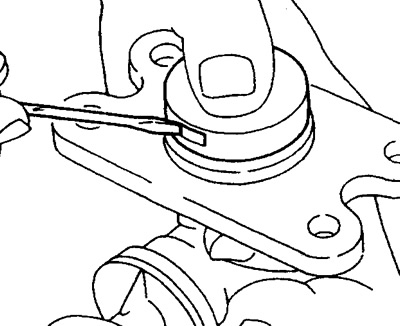
When removing, hold the cap securely to prevent the piston from jumping out of the master cylinder.
2. Fix the cylinder body flange in a vice as shown in the figure.
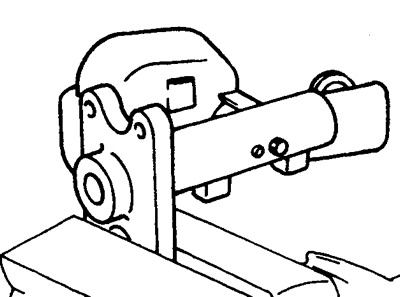
Attention:
Place the master cylinder in a vice with the pin hole facing up.
Place copper plates and cloth between them to prevent damage to the cylinder.
3. Using a center punch with a diameter of approximately 4 mm, knock out the tank mounting pin.
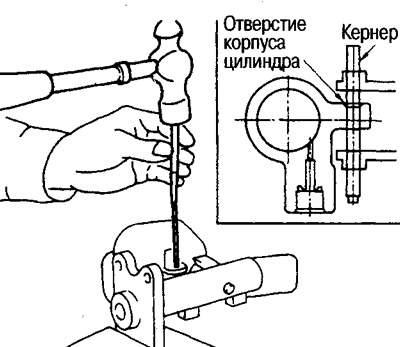
4. Remove the master cylinder assembly from the vice.
5. Remove the reservoir and rubber bushings from the cylinder body.
6. Using a Phillips screwdriver, disconnect the piston and press the piston stopper out of the cylinder body.
7. Carefully, without distorting it, to avoid damaging the cylinder walls, remove the primary piston assembly.
Cylinder manufactured by Tokiko
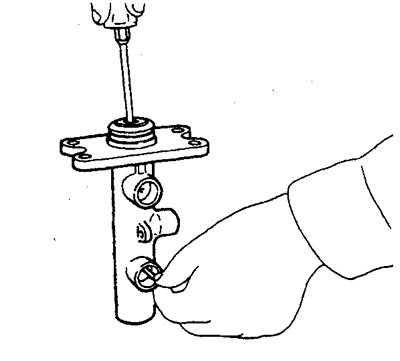
Cylinder made by Nabuko
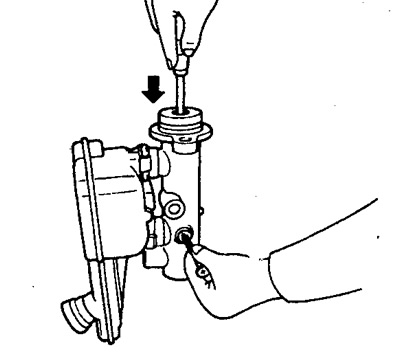
8. Tap the flange on a wooden block and release the secondary piston assembly. Carefully, without distorting it, to avoid damaging the cylinder walls, remove the secondary piston assembly.
Examination
Check the inner cylinder walls for damage, wear, corrosion and pitting. Replace the cylinder if necessary.
Assembly notes
Do not use mineral oils such as kerosene or gasoline, or rubber lubricant when cleaning and assembling.
Make sure there are no foreign particles on the inner walls, piston and cylinder seal. Do not damage the components with special tools during assembly.
Do not drop components. Do not install components that have been dropped.
Assembly
1. Apply Nissan Brake Fluid #2500 or Nissan Rubber Lubricant (KRE1200030) onto the inner walls of the cylinder body and the contact surface of the piston assembly. Then insert the secondary piston assembly first, and then the primary piston assembly into the cylinder body.
Attention:
Do not reuse primary and secondary pistons.
Pay attention to the direction of installation of the piston cuff. Insert it without distortions so that it does not touch the inner walls of the cylinder.
Always replace the complete internal parts kit.
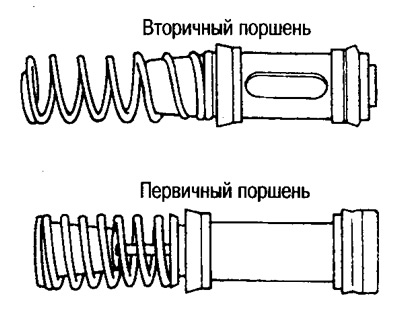
2. Visually check the position of the secondary piston groove through the second hole of the tank and install the piston stopper.
Cylinder manufactured by Tokiko
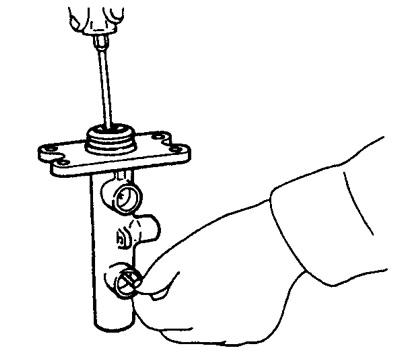
Cylinder made by Nabuko
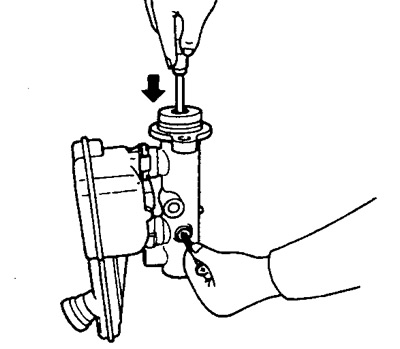
Caution: Nabuko cylinder: Do not reuse piston stop O-ring.
3. Place the locking cap on the piston. Press the locking cap until its claws are fully engaged in the grooves on the cylinder body.
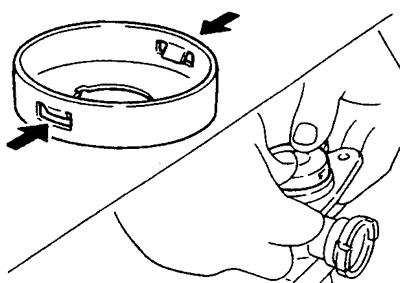
Caution: Do not reuse the retaining cap.
The publication is reprinted from this resource: Nissanbook.ru
4. Apply Nissan Brake Fluid #2500 or Nissan Rubber Lubricant (KRE1200030) on the rubber bushing, insert it into the master cylinder.
Caution: Do not reuse the sleeve.
5. Clamp the cylinder body flange in a vice as shown in the figure.
Attention:
Place the master cylinder in a vice with the pin hole facing up.
Place copper plates and cloth between them to prevent damage to the cylinder.
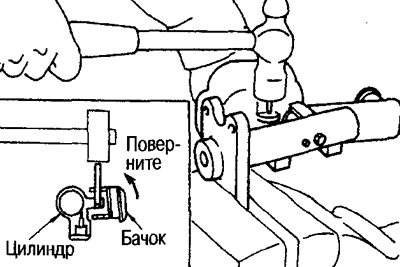
6. Install the reservoir onto the cylinder body as shown in the figure. Align the pin holes and install the pin.
Attention:
Do not reuse the tank retaining pin or the tank itself.
Insert the pin through the cylinder body hole from the chamfer side.