


Table of contents: Front brake hoses ↓ Rear wheel brake hoses ↓
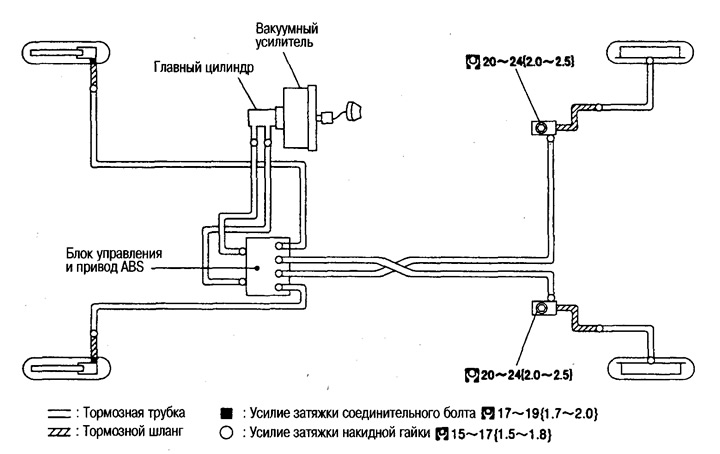
Replacement intervals (brake hoses):
- For individual use of the vehicle: does not change
- For commercial use of the vehicle: every 4 years
Attention:
Do not bend or twist the hoses during installation.
When turning the steering wheel in both directions, the tubes and hoses should not touch other parts.
If a brake fluid leak is detected, disassemble the component in question. Replace with a new one if necessary.
Front brake hoses
Removal
1. Drain the brake fluid.
Caution: Avoid contact with brake fluid on painted surfaces.
2. To prevent dust and other foreign particles from entering the brake fluid, seal the brake line connections.
3. Using a spanner, loosen the union nuts and disconnect the brake pipe from the hose.
4. Loosen the connecting bolt and disconnect the brake hose from the caliper assembly.
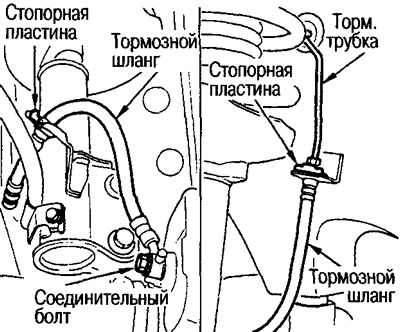
5. Remove the retaining plates from the brake pipe and from the mounting area on the strut. Then remove the brake hose.
Installation
1. Connect the brake hose to the caliper assembly and tighten the connecting bolt to the required torque.
Attention:
Insert the hose firmly into the cylinder body hole.
Do not reuse copper washers for connecting bolts.
2. Connect the brake hose to the strut and secure with the lock plate.
3. Connect the brake hose to the brake pipe. Tighten the union nut by hand and secure with the lock plate. Use a torque wrench to tighten to the required torque.
4. After completing the work, perform bleeding.
Rear wheel brake hoses
Removal
1. Drain the brake fluid.
Caution: Avoid contact with brake fluid on painted surfaces.
2. To prevent dust and other foreign particles from entering the brake fluid, seal the brake line connections.
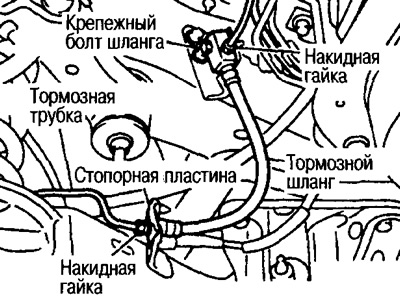
3. Using a spanner, loosen the union nuts and disconnect the brake pipe from the hose.
4. Remove the lock plate, then remove the hose.
Installation
1. Connect the brake hose to the tube. Tighten the union nut by hand.
2. Secure the hose with the locking plate. Tighten the mounting bolt to the required torque.
3. Using a spanner, tighten the union nut to the required torque.
4. After completing the work, perform bleeding.