


Disassembly
1. Remove the caliper assembly from the vehicle.
2. Unscrew the guide pin bolts from the cylinder body, remove the pads with gaskets, gasket covers and pad holders from the caliper assembly.
3. Remove the guide pins with dust boots from the caliper bracket.
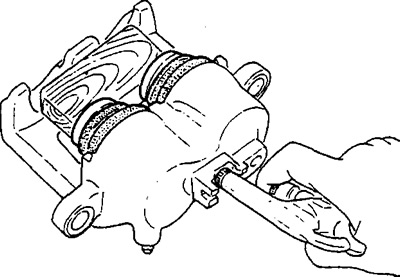
4. Place a wooden block as shown in the figure. Remove the pistons and piston dust boots by applying compressed air through the mounting hole under the connecting bolt. If only one piston comes out, press it slightly into the cylinder body and apply air again.
5. Using a screwdriver, remove the piston seals.
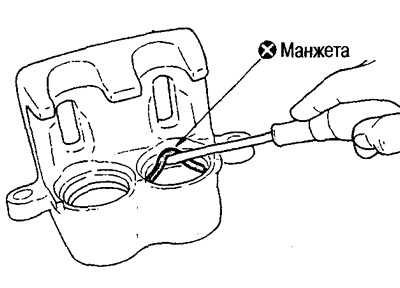
Caution: Do not scratch the inner walls of the cylinder.
Examination
Check the inner cylinder walls for corrosion, wear, damage and foreign particles. Replace the cylinder body if necessary.
Check piston surfaces for corrosion, wear, damage and foreign particles. Replace pistons if necessary.
Attention:
Use fresh brake fluid for cleaning. Do not use mineral oils, gasoline or kerosene.
The piston sliding surface is galvanized. Do not sand it with sandpaper.
Check the guide pins and dust boots for wear, damage or cracks. Replace the component if necessary.
Check for uneven wear, cracks or serious damage on the brake disc surface. Replace if necessary.
Check the brake disc runout as follows.
(1) Secure the brake disc to the front wheel hub with wheel nuts.
(2) Check the runout with an indicator.
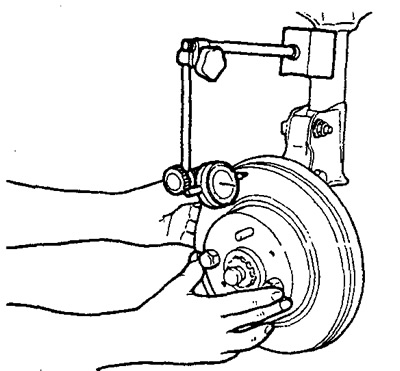
Note: Before measuring, make sure the axial play is 0mm.
(3) If the runout is significant, find the point of minimum runout by successively moving the installation position of the brake disc on the hub by one hole.
- Measuring point: 10mm from the outer edge of the disc.
- Max. runout: less than 0.06mm
Check the thickness of the brake disc with a micrometer. If the thickness is different from the standard value, replace the brake disc.
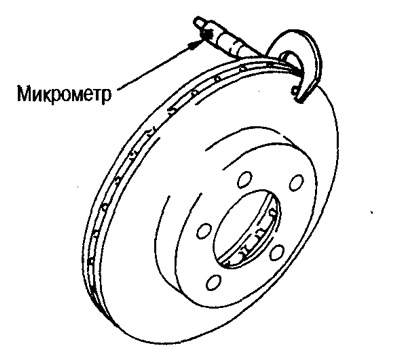
- Standard thickness (new disk): 28 mm
- Wear limit: 26 mm
- Max. thickness variation (measured at 8 points): less than 0.02 mm
Assembly
Caution: Do not use Nissan rubber lubricant during assembly (KRE0000010) and (KRE000001001).
1. Apply Nissan rubber lubricant (KRE1200030) onto the piston cuffs and insert them into the cylinder body.
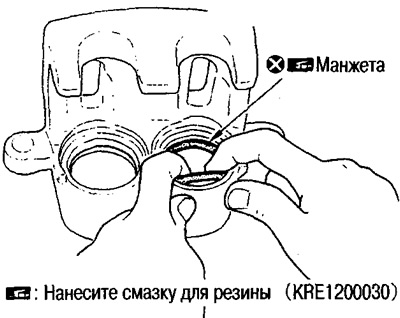
Caution: Do not reuse piston seals.
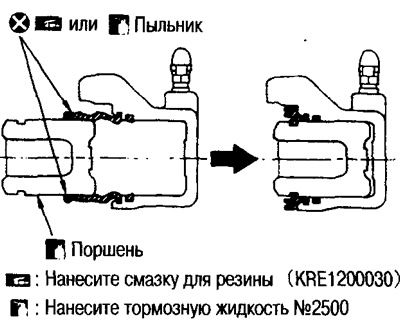
2. Apply Nissan Brake Fluid #2500 or Nissan Rubber Lubricant (KRE1200030) onto the piston dust boots. Place the dust boot on the end of the piston. Correctly insert the edge of the piston dust boot into the groove on the cylinder body.
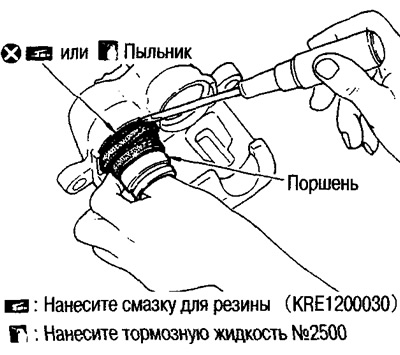
Caution: Do not reuse dust boots.
3. Apply Nissan brake fluid #2500 to the piston. Press the piston into the cylinder body by hand. Correctly insert the edge of the dust boot into the groove on the piston.
Caution: Press the piston in evenly. To avoid scratching the inner cylinder walls, change the point of application of force.
4. Insert the guide pins and dust boots into the caliper bracket.
5. Install the caliper bracket onto the steering knuckle axle and tighten the mounting bolts to the required torque.
Caution: Before installing the caliper bracket onto the steering knuckle axle, wipe off any oil or grease from the seating surfaces of the steering knuckle and bracket.
6. Insert the pad holders, pads, shims, shim covers into the caliper bracket.
7. Install the cylinder body into the caliper bracket and tighten the guide pin bolts to the required torque.
8. Connect the brake hose to the cylinder body and tighten the connecting bolt to the required torque.
Attention:
Do not reuse copper washers from connecting bolts.
Insert the hose firmly into the cylinder body hole.
9. After installing the caliper assembly, fill it with fresh brake fluid and bleed it.