


Disassembly
Attention:
- Be careful not to pinch your fingers in the piston.
- Be careful not to scratch the inner walls of the cylinder.
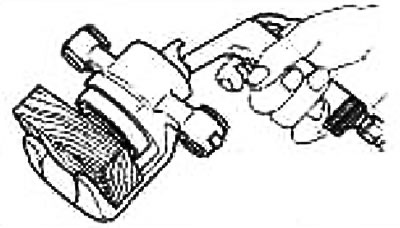
1. Place a wooden block as shown in the figure. Remove the pistons and piston dust boots by blowing air through the mounting hole under the connecting bolt.
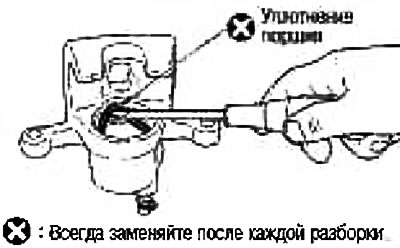
2. Using a flat-blade screwdriver, remove the piston seals.
Checking the caliper
Cylinder body
Attention:
- Use fresh brake fluid for cleaning. Do not use mineral oils, such as gasoline or kerosene.
- Check the inner cylinder walls for wear and damage. Replace the cylinder body if necessary.
Caliper bracket
Check for wear, cracks and damage. Replace the component if necessary.
Piston
Attention:
- The piston sliding surface is galvanized. Do not sand it with sandpaper.
- Check the piston surface for corrosion, wear and damage. Replace the component if necessary.
Guide pin and guide pin boot
Check the guide pin and guide pin boot for wear, damage or cracks. Replace the component if necessary.
Assembly
Caution: Use only the specified rubber lubricant during assembly.
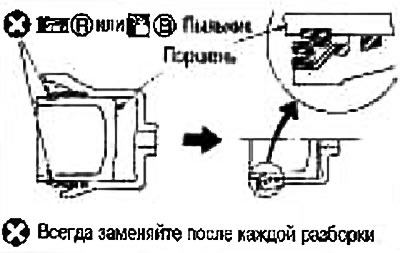
1. Apply polyglycol ether based lubricant to the piston seals and install them into the cylinder body.
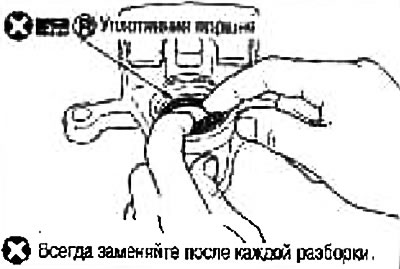
Caution: Do not reuse piston seals.
2. Apply polyglycol ether based grease to the piston dust boots. Place the dust boot onto the end of the piston, then firmly insert the protrusion on the piston dust boot on the cylinder side into the groove on the cylinder body.
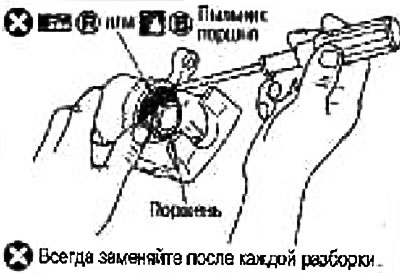
Caution: Do not reuse the piston dust boot.
3. Apply brake fluid to the piston. Press the piston into the cylinder body by hand. Correctly insert the protrusion on the piston dust boot on the piston side into the groove on the piston.
Caution: Press the piston in evenly. To avoid scratching the inner cylinder walls, change the point of application of force.